Natalie Delgadillo
After five long years, the new fossil hall at the Smithsonian National Museum of Natural History finally opened back up again over the weekend. And if the numbers are any indication, people are really into dinosaurs.
On Saturday and Sunday, a total of nearly 42,000 people visited the David H. Koch Hall of Fossils – Deep Time, museum director Kirk Johnson said Monday on the The Kojo Nnamdi Show. That’s more than some of the Smithsonian museums get in an entire year. “This space is the most visited room in the most visited natural history museum in the world,” Johnson said.
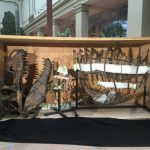
Dinosaur enthusiasts were very excited for the opening of the fossil hall, which had been undergoing extensive renovations since 2014. The space, which previously had been darkly lit and full of large skeletons and plaster casts in static poses, has been completely reimagined—brighter and full of fossils in dynamic poses mimicking actions they might have taken in life. “We’ve turned our dinosaurs into animals,” Johnson said on Kojo.
As WAMU reported earlier this month:
…The museum’s curators have transformed the century-old Hall of Fossils over five years of renovations. What was once a dimly lit set of rooms is now one light-filled, 31,000-square-foot exhibition space packed with interactive exhibits, touchable objects and 700 fossil specimens that span 3.7 billion years of history. All of the dinosaurs have been re-mounted and re-posed.
The hall’s centerpiece is a 66 million year-old T. rex skeleton that’s been positioned to look like it’s ripping the head off a hapless Triceratops. The herbivore’s ribs are cracked under the T. rex’s foot, pointed out Matt Carrano, the museum’s dinosauria curator. He called the pose “a high drama moment.”
The hall had been open since 1911, and the museum had only done minor renovations since then, Johnson said. “A lot of science has happened in the last 100 years, so it had to be done, and we really wanted to deliver a world class fossil hall,” he said.
All told, the museum spent $110 million on the updates to the building and renovating the hall.
The numbers so far are showing a return on investment. The approximate 42,000 visits in one weekend outdoes the total number of visits to the Anacostia Community Museum (33,709) and the Arts and Industries building (19,341) for all of 2018.
Last year, the Museum of Natural History had a total of 4.8 million visits. By several measures, it’s the largest natural history museum in the world: it contains 146 million objects, and has over 100 scientists working there, Johnson said. The museum averages about 5-6 million visits per year—in 2017, it saw 6 million visits and in 2016, 7.1 million visits.