People had different reactions when Navid Azeez told them he was writing a show about the events of October 2002, when the ‘D.C. sniper’ (actually a 41-year-old and 17-year-old pair) terrorized the D.C. area over 22 days, killing 10 people and injuring three.
“Why the hell would you want to do something like that?” a longtime Maryland bus driver asked him.
Others were intrigued, Azeez says. “It taps into this weird nostalgia they have with this event.”
Pointless Theatre decided to bring Forest Treás to the stage. Both Azeez and director Kelly Colburn grew up in the D.C. area, but they interact with the events of October 2002 differently. Most of what Colburn remembers is being cooped up indoors after school, but “now, approaching this material as this adult, it really feels like an unimaginable event: two and a half weeks of pure madness and terror.”
For Azeez, it became a years-long obsession. “It’s an event that’s pretty burned into my memory from childhood,” he says. “I wasn’t at any of the crime scenes, but I remember the atmosphere … That sense of general chaos with no rules is something that is devastatingly interesting to look at from a multimedia perspective.”
The former frontman for D.C. hip-hop band The Delegation, Azeez wrote a few songs about the snipings before he decided on doing a show that combined theater, projection, (his own) sound design, and livestreamed video.
“What I didn’t want to do is write a story about the D.C. sniper—the actual events and the person responsible for them,” Azeez says. The names of the snipers are purposefully left out of the production.
Instead, the fictional neighborhood of Forest Treás is populated with a Mr. Rogers-inspired Mr. Chylle (David S. Kessler), the visiting reporter Roberta (Lee Gerstenhaber), and two town leaders/ newscasters Hiba and Chip (Sara Herrera and Timothy Thompson), as well as six ensemble members who fall in and out of anonymity throughout the show. Forest Treás is a made-up place, but in it, Azeez hopes people will see “a little bit of Takoma Park, a little bit of Gaithersburg, a little bit of Silver Spring.” The idyllic town descends deeper and deeper into panic as the news interjects to inform them of the latest horror.
Azeez originally reached out to Colburn as a video designer for Forest Treás, but when he saw more of her vision for the show, she became the director. The two created what they call “the sniper effect”: moments with bursts of audio and sudden static on the show’s dozen or so screens, followed by convoluted analysis by the town’s cast of news anchors, reporters, and city spokespeople.
“How you can create a sense of horror and spectacle without an actual gunshot?” Colburn says. “The sniper effect should be a bullet’s worth of breaking news. The violence of the moment is not just lives being lost, it’s an assault on the senses.”
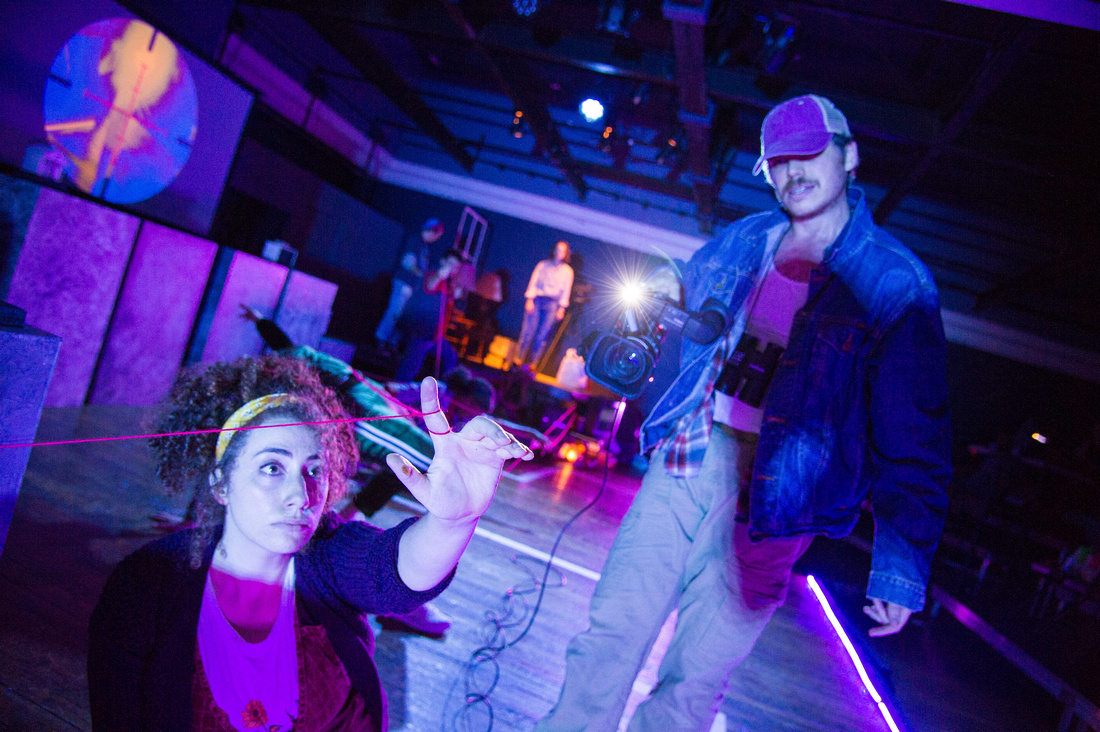
Outside of these moments of assault, though, Forest Treás is more of a sensory playground, a town that exudes a Pleasantville-style sense of fragile perfection and curiosity. Designers Grace Guarniere and Emily Lotz built a series of miniature, stark-white replicas of the town’s landmarks, from Pop’s gas station to people’s homes, that sit on elevated platforms onstage. The characters interact with these miniatures throughout the show, sometimes huddling around them to peek in the tiny windows as if out-of-body is the only way to make sense of the recent events of their lives. The TV screens placed across the stage project the view from a video camera, held by different characters throughout the production as they cast the news, interview each other, and magnify the miniatures on-screen.
Watching Forest Treás is thus an active experience. As an audience member, at any given moment you have the choice to direct your attention towards the screens, the miniatures, or the live characters on stage. The most obvious choice is the large screen in the middle, but for those with the discipline to look around, Forest Treás is a choose-your-own-adventure experience, Colburn says.
A few times, the screens flip to real historical footage of Charles Moose, the Police Chief in Montgomery County at the time who went on to write a book about the sniper attacks. In an early version of the script, Chief Moose was a main character, Azeez says, but in subsequent drafts he realized that Forest Treás had to be more about community, and that he wanted screens to be “the backbone” of the story. The effect is achieved by Colburn’s smart choices about staging and her decision to let the characters themselves direct the audience’s attention.
“Depending on who is holding the camera, you get a different cinematic technique,” she explains. “Some people are a little shaky, some have a steady hand and know how to frame up the shot.”
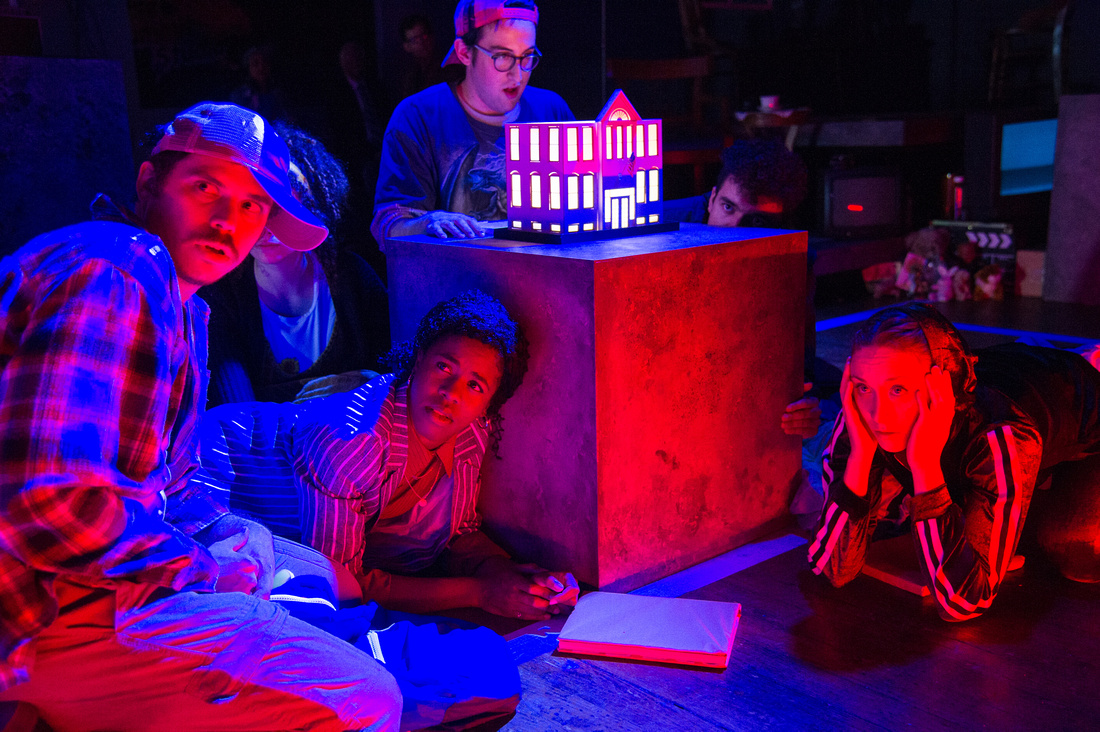
Some of the most creative moments of the production came out of this commitment to co-ownership of the show. The first week of rehearsal was spent playing theater games, something that Colburn first saw as an indulgence. But one warm-up vocal exercise in which the actors create a ‘noise orchestra’, building off of each other with different sounds, turned into a poignant moment in the show: As Mr Chyll flips through channels, the actors turn on and off their voices, creating a ‘noise orchestra’ of the news as they relay the breaking story in various pitches of hysteria.
“The news is spreading rumors that are ultimately not true, the media is leaking things before the police knows them,” Azeez says. “This was relatively unheard of it in 2002.”
Forest Treás is of course achingly relevant today, when our experience of the world’s violence is increasingly filtered through and amplified by media. Azeez, who is Sri Lankan, received a stream of texts from family and friends after the suicide bombings on Easter Sunday. On the same day of the first public performance of Forest Treás in late May, a gunman killed 12 people in a Virginia Beach municipal building. For Azeez, the transition from a physical backyard to a ‘digital backyard’ makes violent events seem at once more immediate and more distant as the sheer number of them becomes numbing.
But even after all these years, Azeez sees something unique in the events of October 2002, which don’t fit as neatly into the narratives of racism, homophobia, or anti-Semitism that are told around many recent shootings. The men behind the D.C. sniper attacks killed indiscriminately, gunning people down as they were mowing the grass, pumping gas, and sitting on park benches. The shootings were also carried out over a period of weeks rather than minutes, setting them apart from the terrifying but quickly-over-with tragedies of late.
Some would rather forget a terrifying event that seems to tell no larger story, one to which no obvious ‘-isms’ apply. But for Azeez, the “fever dream” of October 2002 is worth revisiting, if only to get it out of his own head. Through its frenzy and exaggeration, Forest Treás manages to recreate the now-familiar cycle of paranoia, obsession, and relief in a way that feels deeply accurate despite its fictionalization. Azeez did keep one important part of the show true to history: In the moments of silence held at Forest Treás town meetings, the characters read out the real victims’ names.
“We need to listen more and be better civilians, guarding our history and remembering these events,” he says.
Forest Treás is playing through June 29 at Pointless Theatre, in residence at Dance Loft. Tickets $30.