 Ryan Benk
So often, a barbershop is more than just a place to get a haircut. The classic fixtures and familiar rituals serve as the backdrop for community. Today, we’re telling four stories from D.C.’s barbershops—from places that have been here for decades to new spaces that are expanding the bounds of what a barbershop can be.
Walking up the iron steps to the third-floor barbershop, sandwiched between a comic book store and a smoke shop, it’s hard to miss the feminist aesthetic.
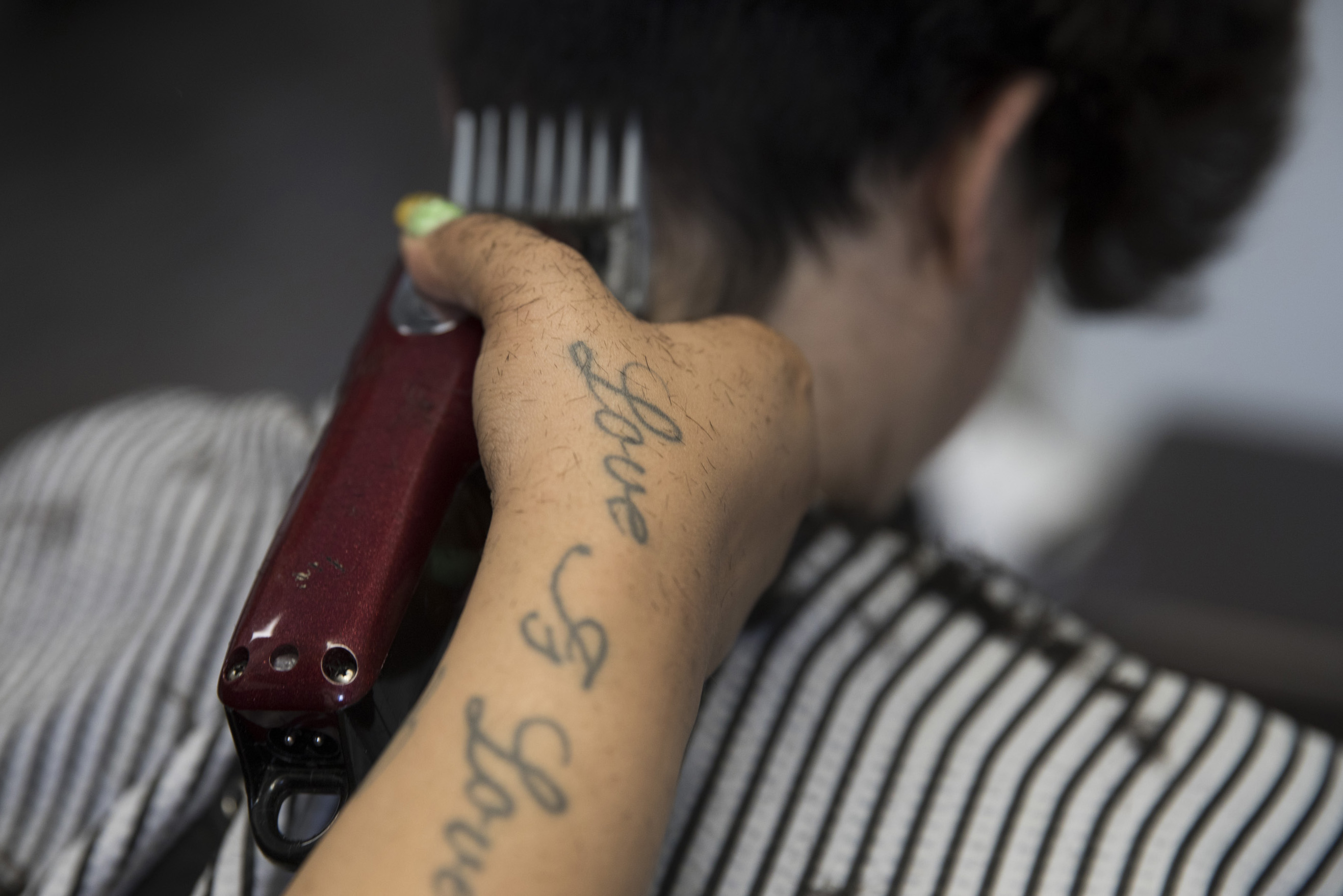
The front door of Lady Clipper is emblazoned with owner and head barber Lesley Bryant’s likeness in full Rosie the Riveter regalia, complete with electric clippers and a bicep-flex pose.
Bryant says there’s one message she wants people, especially women, to get when they head inside.
“[We’re] open to all, accepting to all, comfortable to all, you know?” she says.
Haircuts are some of the most intimate experiences you can have in daily life. Think about it: you’re in a chair, up close and personal with another person for an extended period of time. You could emerge, back straight and headstrong into the world a better version of yourself. Or you might hang your head in shame and stick to wearing hats while your mane grows out again.
But for some marginalized folks—particularly for women, queer, and nonbinary people—a bad hairdo is the least of their worries entering a barbershop.
After I moved to D.C. from Florida, I set out to find the closest grocery store, a good place for dry cleaning, and, eventually, a fresh buzz. As a gay man, that last one gave me the most anxiety.
Growing up in a Latino family in Miami, barbershops were the only choice for boys and men. Patronizing a salon was an easy way to single yourself out for schoolyard harassment. As a closeted kid, the endless competition for “most macho” was exhausting and the fear of inadvertently outing yourself made the male-dominated world of barbershops traumatizing.
Though homophobia exists everywhere, the District has a reputation for being a welcoming place for queer people. So, I decided to give barbershops another chance. But first I spent hours reading forums and reviews, and one place kept coming up: The Lady Clipper, a barbershop staffed entirely by women on U Street.

Bryant, a self-described recovering graphic designer who grew up in D.C., was laid off from her corporate job around five years ago and was looking for another creative outlet. At the suggestion of her barber, she picked up the traditionally male-centered trade and fell in love with cutting.
Bryant went to barber school, picked up a job at a shop, and dove head first into neck fades, blowouts, beard trims, buzz cuts, and crops. But as much as she loved the work, Bryant said the hyper-masculinity that went along with it left her discouraged.
“I dealt with a lot of new clients coming in asking my male counterparts if I could really cut because I was the only female in the shop,” she said. The shop routinely played what Bryant describes as “bikini girl videos” and she faced unwelcome advances from some clients and coworkers. “At times I was a little bit discouraged at how some of the barbers would treat some of the female clients that walked in. They were a little bit rude, hitting on the women … and it would turn most of the female clients that came to me off.”
So she opened her own business, setting up shop on U Street between 15th and 16th streets, in 2017.
The bright cherry red of the barber chairs glow against the gray walls. The muted wall paint is accented with more copies of Lady Clipper’s logo and paintings from local artists. Though Bryant is no longer in graphic designing, she didn’t want to lose sight of her artistic roots, nor did she want to ignore her community of black women.
Bryant says she didn’t exactly start out with the idea of creating a barbershop staffed entirely by women. But she gravitated to a few young black women just finishing barber school because they believed in the same ideas of diversity and inclusion that she did. And they cut great hair.
“I was specifically drawn to them because I saw myself in them,” Bryant said.

One of them is self-described “barberina” Daisy Robinson. Like Bryant, she says she’s no stranger to male barbers or clients questioning her credentials.
“One thing I always get when I tell people I’m a barber is shock and awe… they’re like ‘really, you?’ and I’m like ‘yes, really, me,’” Robinson says. She says she always enjoyed doing hair and mostly shrugged off the the discrimination as part of the job. That is, until she met Bryant.
“As a female in a male-dominated industry, I wanted to be sure that I was someplace that I felt comfortable, that was a good environment,” she added.
Gabby Smith got into the business after leaving another male-dominated industry, computer programming. Smith says where she found programming to be boring and sexist, at least barbering felt creative, if still a bit misogynistic.
“I’m in a man’s world, literally. So you just have to go the extra mile just to show your skills,” she said.
Bryant and her barbers were also careful to point out that most professional barbershops are businesses that have a vested interest in not pushing potential clients away. But the feeling of gender or sexuality-based exclusion is a hard reputation for these establishments to shake, as gay Lady Clipper client Ryan Wilson explains.
“I get nervous when I go to a new barbershop because you just never know what the vibe is going to be like,” he said. “It absolutely stemmed from how overly masculine—hyper masculine—a lot of barbershops are. I’ve been in barbershops where they start using a lot of slurs against gay people. Not particularly to me or anyone in the shop, but just in their description in what’s happened or someone passed by.”
Wilson said he probably tried 15 different shops before finding Bryant at her old job. When he learned she was opening her own place, he followed her there.

Lady Clipper is not exclusively a space for women, or black women, or queer people—but it is intentionally open. More than that, it’s affirming. And that’s what sets Lady Clipper apart from other tolerant shops in the D.C. area, said Nikki Lane, a client of Bryan’s and an anthropologist at American University.
“It’s like a different energy here and you feel that … There’s just something that just feels different than a traditional barbershop in the sense that even when you come here, there are usually mostly women in the chairs,” said Lane, who identifies as queer. “I mean you have men that come in and there are plenty of men that are here, but no one is disrupting the energy in the room.”
Lane’s academic work focuses on race, gender, and social justice, and her dissertation focused on how queer black women gather in D.C. through the lens of “space” and “place.”
The former is intentionally created via the gathering of two or more people. The latter is attached to the physical. For queer people, “spaces” can be things like house parties or book clubs, while common “places” are gay bars or queer bookstores.
Black queer women, in particular, can be some of the most marginalized, Lane says. There are few “places” that cater to them, so they’re more likely to create “spaces” for themselves, like meetup groups at traditionally straight restaurants or bars, she found. But the Lady Clipper is one of the few cases where “place” and “space” are intertwined.
For a lot of queer people, Lady Clipper can seem like a fantasy. That magical idea—that queer men and women can take part in barbershop culture free from judgement—is the subject of Pittsburgh artist and Carnegie Mellon University professor Devan Shimoyama’s latest D.C.-based installation.
“I’ve actually grown accustomed to not going into barbershops due to a lot of that hyper masculine energy in some of those spaces, the way in which barbershops can be celebrated as places for black male fraternal bonding, but not necessarily so much when you’re queer or effeminate in some way,” Shimoyama said.
Growing up, Shimoyama felt excluded from the black cultural institution of the barbershop because of his queerness. He opted instead for haircuts from his uncle in his grandmother’s wood-paneled basement. That continued after he moved to Central Pennsylvania, where he says the mostly white barbershops didn’t know how to handle black hair.
After realizing that his barbershop anxieties weren’t unique to his own experience, Shimoyama created a series of paintings featuring magical realist shops and psychedelic barbers. Now, he’s brought them to life.
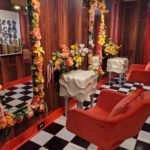
Mighty Mighty: The Barbershop Project sits inside a small mobile art gallery that is currently parked at THEARC. It is a black-and-white tiled, wood-paneled dreamscape, with photographs and drawings of black hair augmented by globs of bright glitter, rhinestones, and diamonds. Bright neon oranges, deep purples, and baby blues slosh around gaudy mirrors surrounded by colorful flowers. The Wonderland-esque experience is complete with real barber chairs (where people can come in and get a free cut.)
The exhibit closes on August 24. But Lady Clipper is its permanent analogue.
Bryant says she isn’t setting out to change the world. She’s not even concerned with changing the industry. She simply wants to show that places like Lady Clipper—shops with explicitly affirming cultures—don’t have to be a fantasy.
“For me, I just want to make sure that my clients feel at home. There’s no judgement. If they come in respectful, we’re going to respect them. Period.”
This story has been updated to clarify that the barbers didn’t attend school together.
More:
This Program Uses Black Barbershops As Ground Zero To Quash Stigma Behind Mental Healthcare
The Senate Has Its Own Longstanding, Secretive Basement Barbershop
This Italian Immigrant Has Been Barbering In Foggy Bottom For Nearly Sixty Years