So often, a barbershop is more than just a place to get a haircut. The classic fixtures and familiar rituals serve as the backdrop for community. Today, we’re telling four stories from D.C.’s barbershops—from places that have been here for decades to new spaces that are expanding the bounds of what a barbershop can be.
Last month, in a quiet moment on the floor of the U.S. Senate, Minority Leader Chuck Schumer mourned a death in “the Senate family.”
“David Miles Knight—the beloved barber in our barber shop—one of the Senate’s master barbers for the last 36 years, lost a lengthy battle with cancer,” the New York Democrat said. “He was always eager to ask about a customer’s day or a colleague’s weekend, and just as eager to regale those folks with stories about his family: his wife Joanne, his three sons, eight grandchildren, and two great-grandchildren.”
Knight’s passing didn’t attract much news coverage, prompting only a brief write-up in Roll Call, but Schumer’s statement was a rare public acknowledgement of a unique and secretive Capitol Hill institution: Senate Hair Care Services, the longstanding taxpayer-subsidized barbershop and salon in the basement of the Russell Office Building.
With employees on the federal payroll, this facility has faced repeated calls for privatization over the decades. Yet the establishment remains open to the public, 8 a.m. to 4:30 p.m. on weekdays, with a devoted following among senators, staffers, reporters, and interns who appreciate an inexpensive haircut. “I go back any time that I can,” said Jim Swift, a senior editor at The Bulwark who worked as a Republican Senate staffer a decade ago. “It’s a great place, with great tradition and great history.”
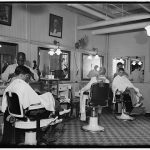
The Senate barbershop dates back to the 19th century, though “its exact date of origin is uncertain,” according to a 2010 report on its history published by the Senate Sergeant at Arms. The shop was initially housed in the Capitol itself, constructed along with bathrooms “to help senators cope with the dirt and distances of Washington” at a time when mud filled the city streets.
“Arguing that the irregular schedules of Senate clientele would hamper a private business, the Senate funded the barbershop’s utilities and products and paid the salaries of barbers,” the report explains. For many years, each senator received a gold-trimmed “shaving mug” inscribed with his name.
Early visitors to the shop included Presidents Andrew Johnson and Teddy Roosevelt, and senators routinely debated the great issues of their time while getting a shave or a trim, including Reconstruction after the Civil War. Some barbers ended up shaping national politics themselves, influencing senators’ beliefs though their friendships and even hitting the campaign trail to support their clients.
As the years passed, Senate barbers took on more diverse clients. The original shop was exclusively for senators, but by 1867 there was another location in the Capitol for senators and staffers. Then, in 1930, the Senate Rules Committee greenlit the creation of a barbershop and a beauty salon in what is now the Russell basement, the latter showing “a growing concern for women’s equality,” according to the Sergeant at Arms report. Still, this progress only went so far—the Rules committee declined to subsidize the salon.
By 1997, the barbershop and beauty parlor in the Russell basement were the only Senate hair facilities. That’s about when then-Pennsylvania Senator Rick Santorum learned they’d lost nearly $2 million in five years, and decided they ought to be privatized. (A separate taxpayer-funded House of Representatives barbershop had already been privatized in 1995 under budget-cutting Speaker Newt Gingrich.)
The Sergeant at Arms report describes how Senator Arlen Specter, a fellow Republican from Santorum’s state, was among those who defended his chamber’s barbershop, saying privatization would “put a lot of people out of a job” and lead to “a lot of disruptions.” Remarking on the influence barbers and stylists had in the Senate, Senator Wendell Ford, a Kentucky Democrat, reportedly quipped, “That shouldn’t be surprising. They have the knife to our throat.”
After Santorum’s plan failed, the Senate Sergeant at Arms did consolidate the two hair-care services. But another push for privatization came six years ago, with proponents including Senator John McCain. The Arizona Republican was a longtime barbershop client, but he argued the facility’s government funding was no longer feasible. (A year earlier, the shop had received a $300,000 federal bailout while some of its stylists made between $70,000 and $80,000, TIME reported.)
In 2013, Senate Hair Care Services had run deficits of roughly $350,000 a year for 15 years, according to The Weekly Standard, costing taxpayers about $5.25 million over that decade and a half.
Despite this history, Swift, who worked at the Standard for half a dozen years, thinks the subsidized barbershop is worthwhile—to keep up a space of collegiality amid bitter political fighting and make the busy lives of senators a bit more efficient. “I understand that conservatives like myself are generally for privatization and not having big government,” he said. “But I don’t think this is an example of big government … It’s such an institution.”
It’s also a bargain, as I saw when I visited last week. A men’s haircut goes for $23, or $27 if you want shampoo, and you can watch CNN while your stylist snips away.
What kind of quality do you get for that price? Swift gave the place good reviews. My trim was fine, but nothing special. Still, I didn’t come away as disappointed as Matt Laslo, a contributor at VICE News and longtime congressional reporter, who was a Senate Hair Care Services regular for many years.
“Every time I would go there I would have to come home and use my own damn scissors to fix the haircut,” Laslo said with a laugh. “I got what I was paying for, but it was so cheap and convenient I kept coming back.”
“It’s not something you really want to admit,” he added a few moments later. “I’m taking one for the team and admitting to the world that I got shitty haircuts for 12 years.”
Despite cutting reporters’ hair, the Senate barbers are famously averse to interviews with journalists. Senate Hair Care Services manager Cindi Brown declined DCist’s interview request. When Asawin Suebsaeng dropped in as a reporter for Mother Jones in 2013, one employee told him, “We’re not allowed to talk about anything that goes on here.”
This isn’t terribly surprising at a shop where discretion is the tradition. “I heard a lot of conversations between senators,” Senate barber Elbert Link said in 1981, “but I never talked about it with anyone.”
More:
This Program Uses Black Barbershops As Ground Zero To Quash Stigma Behind Mental Healthcare
This Italian Immigrant Has Been Barbering In Foggy Bottom For Nearly Sixty Years
Barbershops Can Be Fraught For People Who Aren’t Straight Cis Men. These Women Want To Change That