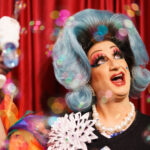
Laurenellen McCann’s drag alter ego, Buhnana Gunz, never gets nervous.
Buhnana flounces on stage in bursts of flamboyance and joy, climbing atop tables to the sounds of Freddie Mercury and Peaches. While McCann is sometimes risk-averse, Buhnana Gunz is fueled by spectacle and propelled by confidence.
At a punk drag show called GAY BASH in Logan Circle, Buhnana Gunz is the closing act, but they aren’t dressed in quintessential drag attire. Instead, they dance to a raunchy song about genitalia while wearing wolf-like furs and a David Bowie-inspired lightning stripe across their face. Amid the pumping beats of “Ripe” by Peaches, Buhnana strips down to increasingly delicate wares: a lace one-piece, half-palm leather gloves, and—the pièce de résistance—handmade prosthetic “alien genitalia” they learned to make on YouTube.
“I’m a monster in the making,” McCann, 32, tells me later. (Buhnana and McCann both use they/them pronouns) “If you could be anything, why would you just stay human?”
View this post on Instagram
With the rise of RuPaul’s Drag Race, Hedwig and the Angry Inch and the like, drag queens have entered the mainstream, and drag kings aren’t far behind. Performers use sultry catwalks and punchy red lipstick, or hulky strides and slouchy denim as tools to poke fun at gender norms in exaggerated ways. But nonbinary “monster drag” performer McCann uses their art to redefine and overturn gender expression, oftentimes crossing the lines into the surreal.
“I think that drag at its best is satire—it’s thumbing the nose at the patterns of power,” McCann says. “At its best it’s a genderqueer person becoming even harder to understand and not giving a fuck that you don’t understand.”
More than complicating the lines of gender, drag performance has helped McCann come to terms with their own identity. In 2015, McCann began to explore the fact that they didn’t identify as a cisgender woman—that perhaps they were something else, or multiple things at once.
McCann continued to explore at a beginner’s workshop with D.C.’s drag king troupe Pretty Boi Drag in 2015, where a producer encouraged McCann to dance to “Bicycle” by Queen.
Once the music started, “it was just instantly freeing,” McCann says. “It was embarrassing and shocking, and when enough time passed, completely revolutionary.”
Soon after, McCann began researching how to make prosthetics and props, picking up skills to build horns, liquid latex crafts, facial adhesives, and miscellaneous accessories like jabots and gloves. As for McCann’s drag name, “Buhnana Gunz” was thought up accidentally: While at a cafe with a friend one afternoon, McCann picked up two bananas and proceeded to play with them like a pair of pistols. The name has stuck ever since.
Today, McCann performs all over the D.C. metropolitan area both as a free agent and as part of troupes like Pretty Boi Drag and #TeamHusband.
“Buhnana really made space for me to reconcile that there are so many genders, that there are so many expressions, that the person that I am outside of drag can wear any goddamn thing they want and still be the same person,” McCann says.
In that vein, their drag performances tend to have moments of catharsis. During D.C. Pride one year, for example, they dressed as a pink-washed and blindfolded Lady Justice who slowly sheds a pussy hat and a “Nasty Woman” shirt, in a performance meant to comment on the ways white feminism can exclude minorities. Toward the end, Buhnana Gunz takes off the blindfold and picks up a rock.
“That story has a very clear political message that is of the times,” McCann says. “It’s about breaking something in a different way.”
View this post on Instagram
Other times, the performances are joyful for joyfulness’ sake: Buhnana Gunz has appeared as a gangly Nosferatu, a creepy version of Dorothy from The Wizard of Oz, a Rapunzel-haired Satan, and a six-nippled wolf.
Recently, McCann learned that drag even runs in their family. McCann’s mother excavated old family photos, revealing that their Italian great-grandparents used to dress in clothes from the opposite gender while playing live music and performing for their friends.
“[Through my performances], I have been in dialogue with these photos,” McCann says. “There’s an arrow that they have set that I’m following.”
As events like D.C. Pride create more spaces for LGBT folks to share their experiences, the battle for acceptance continues. This year alone, at least 10 transgender people were reportedly killed in the United States, a rate that the American Medical Association has identified as “an epidemic.” Here in D.C., two black trans women were recently killed on the same street in the space of three months, and queer people continue to face discrimination in public spaces.
These issues “prompt interesting questions about spectacle and substance in our revelry,” McCann says. While violence persists against trans and queer communities, McCann says, drag performance is its own form of revolution.
“There is something inherently radical about trans, queer, and gay bodies coming together to just be joyful,” McCann says. “That is its own important thing—and that doesn’t erase the complexities of our experiences.”