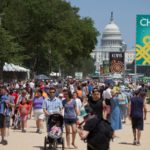
Each year, the Smithsonian Folklife Festival brings performers, storytellers, artists, and chefs from around the world to the National Mall, filling its grassy expanse with a massive ensemble of international flavors, sounds, art, and culture.
This year’s festival is a bit different: Not only will the festival be compressed into two days instead of the usual 10, but it’s also shifted its focus a bit closer to home—the city’s local music scene.
Previous festivals have always included D.C.-based artists and performers alongside international ones, and the original plan for this year’s festival was no different. But scheduling delays—resulting in part from this year’s federal government shutdown—pushed the festival’s D.C.-focused programming to the forefront, turning what’s usually an international festival of cultural exchange into a celebration of local music and sonic history. (As for the original other themes for this year: Brazil, Benin, and Louisiana, among a few others, those are set to be back next year).
The theme of next weekend’s festival is The Social Power of Music, which festival director Sabrina Motley says is about “how music connects people,” and more generally, how music functions in social life.
The festival also features a family-friendly set of workshops and presentations on sound and community, an afternoon concert honoring American folk singer and activist Pete Seeger, and a sonic history of hip hop.
Concerts and workshops are pretty standard fare for the Folklife Festival, but this year also includes a pop up dedicated to D.C. music history.
The D.C. Music Preservation Pop Up is organized by Smithsonian curators Sojin Kim and Nichole Procopenko, who said that the idea grew out of conversations with local individuals and organizations interested in preserving and archiving the District’s unique music. Then, when the go-go controversy unfolded in Shaw earlier this year, Kim and Procopenko saw an opportunity to extend their partnerships with documentarians, organizers, and promoters in the local music scene.
Kim calls it a “block party” more than anything else. The pop up will have a fair-like element to it, with 12 local organizations tabling the event and sharing information about how they preserve D.C. music and how attendees can get involved.
Go-go will certainly have a presence at the pop up, with a presentation and musical performance from the go-go conga players of Royal Pocket, hosted by Ronald Moten and Natalie Hopkinson of the #DontMuteDC movement. The DC Oral History Collaborative will be on site collecting 5-minute music memories that’ll be archived jointly by the collaborative and the Smithsonian. Pop up attendees will also get a music digitization demo from the D.C. Public Library’s Punk and Go-Go archives.
But the pop up isn’t just about preserving the past, it’s also about celebrating the present state of local music. It will also include a drumming workshop led by D.C.-native Malik “Dope Drummer” Stewart , a bluegrass jam put on by the D.C. Bluegrass Union, and a local music market with merchandise from seven local labels—the majority of which don’t have brick and mortar shops.
The festival also includes an outdoor concert series curated by D.C. producer and rapper Kokayi and artist-activist Quetzal Flores. Filipina American spoken-word artist Ruby Ibarra will kick-off the set, but the rest of the line-up is forthcoming. (D.C. rapper Goldlink was originally supposed to curate the set but had a scheduling conflict.)
Between the concert series, workshops, presentations, and the pop up—and despite the shortened timeline—Kim is hopeful that this year’s festival will still stay true to its long legacy of creating space for people to grapple with the complexities of their lives and communities.
“Since the first folklife festival in 1967,” Kim says, “[the Smithsonian’s] idea of culture, including music and food, was that these are not just entertainment and leisure activities, they have political, economic, and social implications—culture is serious business.”
The Smithsonian Folklife Festival will take place June 29-30 with events at the National Mall and the Freer Plaza. The Music Preservation Pop Up will be open Saturday, June 29, 12-5 p.m. at the Freer Plaza.