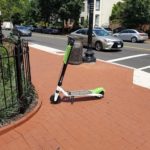
A new bill introduced at the D.C. Council would ban the use of electric scooters at night, reduce the scooter speed limit on sidewalks, and set up new rules for parking the vehicles.
The legislation, introduced by Ward 3 Councilmember Mary Cheh on Tuesday, would make it illegal to ride electric scooters between the hours of 10 p.m. and 4 a.m in the District.
“There is a concern about people coming out of bars and taverns being inebriated and using a scooter,” Cheh told DCist. “Unlike with regular bicycles, we don’t have an established culture that sufficiently emphasizes safety or regulation.” E-scooters are also difficult for drivers to spot at night, she added.
The speed limit for e-scooters would be decreased to 6 miles per hour on sidewalks, and increased to 15 m.p.h. on roads. Currently, it is illegal to ride e-scooters faster than 10 m.p.h. within District lines. Riding on sidewalks is allowed, but only outside of D.C.’s Central Business District area, a rule which also applies to bicycles.
Unlike jurisdictions like Nashville, Cheh doesn’t want to ban e-scooters. She calls them a “good option” for transportation, though she believes they need “a safe set of rules and a structure.”
Questions have swirled around the safety of e-scooters since the District Department of Transportation launched its pilot program for dockless vehicles in September 2017. Since then, companies like Lime, Skip, and Lyft have flooded the District’s streets with zippy vehicles that are relatively cheap and easy to rent for a short ride.
But their rapid proliferation has not been without controversy. Critics say that e-scooters often block sidewalk access and create obstacles for people in wheelchairs and the visually impaired. Last year, a man riding a rented e-scooter died after being struck by a vehicle in Dupont Circle.
Users would not be allowed to park their e-scooters in the middle of the sidewalk under the new legislation. The bill specifies that “electric mobility devices” should be parked in “an upright position with at least four feet of unobstructed pedestrian walkway.” Electric scooter companies would have three hours to remove a vehicle after receiving a complaint. Permitted operators would be required to set up a hotline for residents to submit complaints about the vehicles.
Cheh said she hoped the bill would help officials gather more data on the use of e-scooters and e-bikes in the District. The new legislation grants the District Department of Transportation access to crash data collected by e-scooter companies.
The lack of information available to the city about issues with the scooters became apparent after the city suspended the operating license of Skip, after one of the company’s scooters caught fire on a District sidewalk, followed shortly thereafter by a lithium battery fire in the company’s downtown warehouse (the latest in a series of fires at the K Street facility). As DCist reported, the company was not required to tell the city when a scooter exploded in a D.C. backyard last year.
Cheh said that safety isn’t the only goal of her legislation—the bill also makes e-scooters more accessible to all residents, she said. E-scooter operators would be required to keep at least 10 percent of their fleets in each ward by 6 a.m. each day. “It’s an equity matter,” Cheh said. “People from any quadrant, any ward, should have the same opportunity as others to use the scooters.”
The D.C. Council will hold hearing on the new legislation in the fall, but a specific date has not yet been set, according to Cheh. She expects robust debate about the measures of the bill, which was co-introduced by Ward 1 Councilmember Brianne Nadeau, Ward 2 Councilmember Jack Evans, and Ward 6 Councilmember Charles Allen. “Some people may say we didn’t go far enough here, or you went too far there,” said Cheh. “All that will be aired out at a hearing.”
A spokesperson for Lime, one of the current scooter operators in D.C., did not say whether the company was concerned about the proposed restrictions.
Lime said it was “reviewing the bill and look[s] forward to working with the City Council on legislation that enables D.C. residents and visitors to continue to enjoy the benefits of micromobility.”