Summer in the D.C. area generally means hot, muggy days and lots of mosquitoes, accompanied by mosquito bites.
Mosquito bites aren’t just a nuisance—they’re a serious public health concern. These bothersome insects are capable of ferrying viruses like West Nile, dengue, Zika, and chikungunya from one person to the next.
The District is no stranger to the impacts of mosquitos carrying viruses. In 2012, West Nile virus led to a fatality in the District. In 2016, amid growing international concern about the Zika virus, the D.C. Department of Health rolled out an enhanced plan to capture and test mosquitoes for Zika, West Nile, dengue, and chikungunya viruses, and some residents contracted Zika abroad.
But what if mosquitoes didn’t have to bite? Or more accurately, what if those lady mosquitoes didn’t have to bite? (It’s female mosquitoes that are often responsible for those itchy swollen patches that most of us would rather do without). A handful of researchers, including local Georgetown professor Peter Armbruster, are itching to find the answer to this question.
Armbruster, who’s been studying mosquitoes for the better part of 30 years, didn’t initially start researching the insects. He was studying African elephants, but the doctoral program he was in required students to rotate through various research labs. So, he ended up in mosquito lab studying the pitcher-plant mosquito. One rotation later, and he’d “fallen in love” with the insect, he says.
“I can still remember vividly talking to my mom on the phone and telling her ‘I think I’m gonna switch from elephants to mosquitoes,’” he says. “And her trying to hide the disappointment in her voice as she said to me ‘Oh honey, do you really think that’s a good idea?’”
The rotation kicked off a mosquito habit that’s carried him through graduate school and several postdoctoral fellowships, all the way to his current position as the Davis Family Distinguished Professor in Georgetown’s department of biology.
Armbruster’s research team, which includes a rotating cast of post-doc, graduate, and undergraduate students, has long been studying the Asian tiger mosquito—a major vector for the spread of dengue and chikungunya, among other disease-causing viruses.
Now, they’re adding a new project to their research repertoire: studying the genes that make mosquitoes bite in the first place.

Usually, efforts to curb the spread of viruses like dengue, Zika, and others include encouraging people to minimize standing water in trash, gutters, and drains (some mosquitoes lay their eggs in standing water) or promoting the use of insect repellant and wearing long clothing. Other attempts have tried to infect mosquitoes with a bacterium to limit their ability to carry and spread certain diseases.
Regardless of the specifics, most of these approaches assume that female mosquitoes will always bite. Now, though, Armbruster and a handful of other researchers around the country are turning that assumption on its head. Scientists have known for some time that some mosquitoes don’t bite, but it hasn’t been until recently that they’ve tried to weave that understanding into disease prevention efforts.
It’s still pretty early on, but if these researchers can figure out how to control whether or not a mosquito can bite, they might be able to produce non-biting strains of female mosquitoes capable of reproducing without the blood of humans and animals. After all, if a mosquito doesn’t bite, it can’t spread disease.
Funded by the National Institutes of Health and in collaboration with researchers at the University of Oregon and the Ohio State University, Armbruster’s project aims to pinpoint the genetics that cause some female mosquitoes to bite in order to reproduce and others to not.
“Biting is crucial to a mosquito’s reproduction … but there are some mosquito species that can produce eggs without taking a blood meal,” Armbruster explains. His new project is based in large part on one of those non-biting reproductive mosquitoes and the same mosquito that he fell in love with in grad school: the pitcher-plant mosquito. Female pitcher-plant mosquitoes in the south sometimes bite humans and animals to fuel their reproduction, but those in the north don’t.
Armbruster and his lab are essentially trying to recreate this natural occurrence with the yellow fever mosquito—a species that, as far as scientists know, does bite and is notorious for spreading disease-causing viruses like dengue.
Earlier this month, the team travelled to Florida to begin collecting mosquitoes for the experiment, an experience that Armbruster says “can definitely feel on the edge of unsafe at times.”
“People are pretty suspicious of you when you say you want to check the water in their old tires in their backyard,” he says. In the past, he’s has been met with angry (sometimes armed) landowners yelling at him to get off their property, but for Armbruster, “that’s part of the adventure.”
While in Miami, the team collected a bunch of yellow fever mosquito larvae from a few different environmental habitats in the area, and FedEx-ed them back to Georgetown, where they’d then comb through the samples removing any non-yellow fever mosquito larvae that might have slipped in.
Right now, the mosquitoes are growing and developing, sealed up in a large, clear acrylic container, behind a heavy, metal door on the fifth floor of Regent’s Hall, a sleek glass and red-brick building that houses the university’s physics, biology, and chemistry departments. The room looks like the sort of industrial, climate-controlled chamber that you’d expect to find in the back of a restaurant, except instead of oozing frigid air, it’s warm and a bit humid—perfect conditions for mosquitoes.
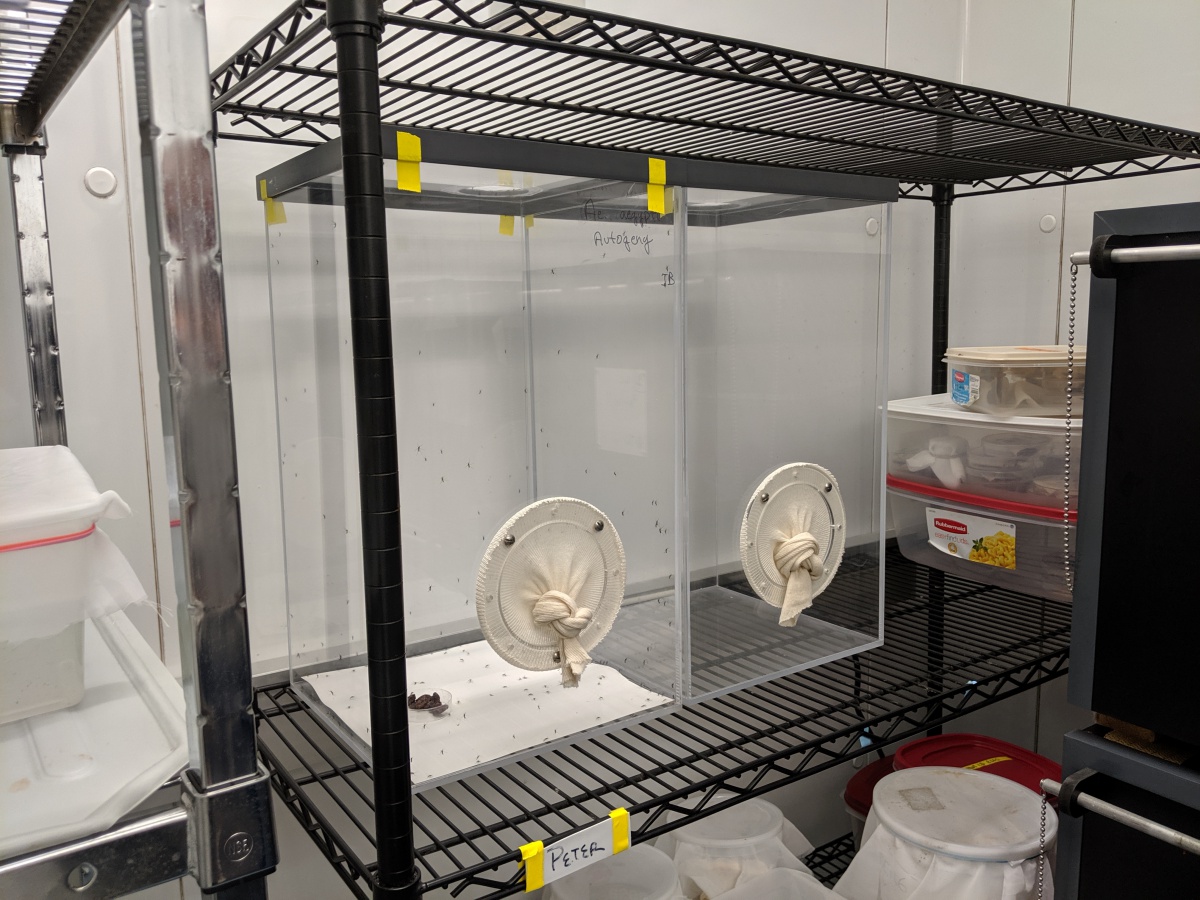
The goal is to get the mosquitoes to reproduce in isolation, without a blood source, and then to collect the ones that successfully do so—that’s an indication that those mosquitoes are genetically different than the others and might have the non-biting gene (or genes). Then, the team will collect these special bloodlessly-reproducing mosquitoes (and their larvae) and allow those mosquitoes and larvae to grow continue their growth. The plan is to do this over and over until they’ve got a population that is purely composed of female yellow fever mosquitoes that can reproduce without feeding on blood.
From there, Armbruster says that the group should be able to identify the genes that control biting behavior in the mosquitoes and determine if those genes are also responsible for biting behavior in the pitcher-plant mosquito, the mosquito that the project was built off of.
If they find that the same genes are responsible for biting in both the pitcher-plant mosquito and the yellow fever mosquito, it might mean that those same genes control biting in other mosquitoes, as well, says Armbruster. Once they’ve got the genetics figured out, Armbruster and other scientists might then be able to try their hand at engineering female yellow fever mosquitoes that don’t need blood to reproduce.
But, Armbruster cautions that’s “way, way down the road,” and so far, the team has only gotten to the genetically-unknown-mosquitoes-in-an-acrylic-box stage of their work.
In the meantime, mosquitoes will most likely still be biting and transmitting disease in the near future—a fact that makes makes eliminating mosquito-friendly habitats an important strategy for keeping the insects at bay.
Vito DelVento, the D.C. Department of Health’s program manager of animal services, recommends that residents remove any unnecessary vegetation, like underlying brush and unmanicured lawns, and prevent any opportunities for water to pool and create standing water.
“Vegetation provides mosquitoes both an opportunity for habitat as well as the right conditions for reproduction,” DelVento tells DCist. The District’s scattered green spaces, along with being surrounded by both natural and manmade water bodies create conditions that favor mosquitoes.
On the whole, the District, like many other parts of the nation, has already seen an increase in its mosquito season. A 2016 report from Climate Central found that the District’s mosquito season increased by 29 days compared to what it was in 1980. A more recent report in 2018 determined that the number of days where disease transmission via mosquitoes was particularly dangerous increased by five days since 1970.