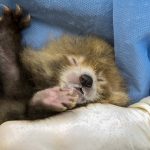
Moonlight—a four-year old red panda—gave birth to a baby cub at the Smithsonian Conservation Biology Institute in Front Royal, Virginia on June 12. The cub weighed six ounces as of June 19, according to a quick medical exam performed by zookeepers. It is reportedly in good health and being nursed by Moonlight.
This isn’t Moonlight’s first cub, says Devin Murphy, a spokesperson at the Smithsonian National Zoological Park. She had two in 2017 as well—one of whom survived and is adorable, though the other died shortly after birth.
Frank, Moonlight’s mate this year, is much older than she is. He was born in 2008 and came to the SCBI from Greenville Zoo in South Carolina.
Plans for the name of the new cub are still up in the air, and probably won’t be decided until a couple of months from now. Murphy explains that they’ll decide on a name after they find out its sex, which won’t be until its first thorough veterinarian exam. “We need to let the mom [and cub] bond,” she says, adding that it’s traumatic to separate the two of them in these early stages.
But in a year to 18 months, Moonlight’s cub will leave its mother’s care. After reaching maturity, it will either be moved to a separate unit at the SCBI or sent to another zoo. That decision will be made in accordance with the Species Survival Plan program, which basically serves as a matchmaker for species at zoos and aquariums.
“If there’s a good genetic match [at another zoo], it’ll be sent there,” says Murphy. Finding genetic matches for healthy red pandas is a huge component of making sure the species has a good chance at survival. According to the International Union for Conservation of Nature, red pandas are endangered—their population in the wild is less than 10,000. This is because much of their habitat, the nesting trees of the Eastern Himalayas, is being destroyed.
Among the red pandas living the good life in Front Royal is Rusty. If you don’t remember, that rogue red panda escaped his enclosure in the National Zoo in 2013 and was found in Adams Morgan. In January 2014, the Smithsonian moved Rusty and his mate Shama to the quieter location. Reportedly, the increased visitors for Bao Bao the panda at the zoo “compromised successful breeding” for the pair. The change-up appears to have worked—Shama gave birth to three baby cubs in June 2014.