Natalie Delgadillo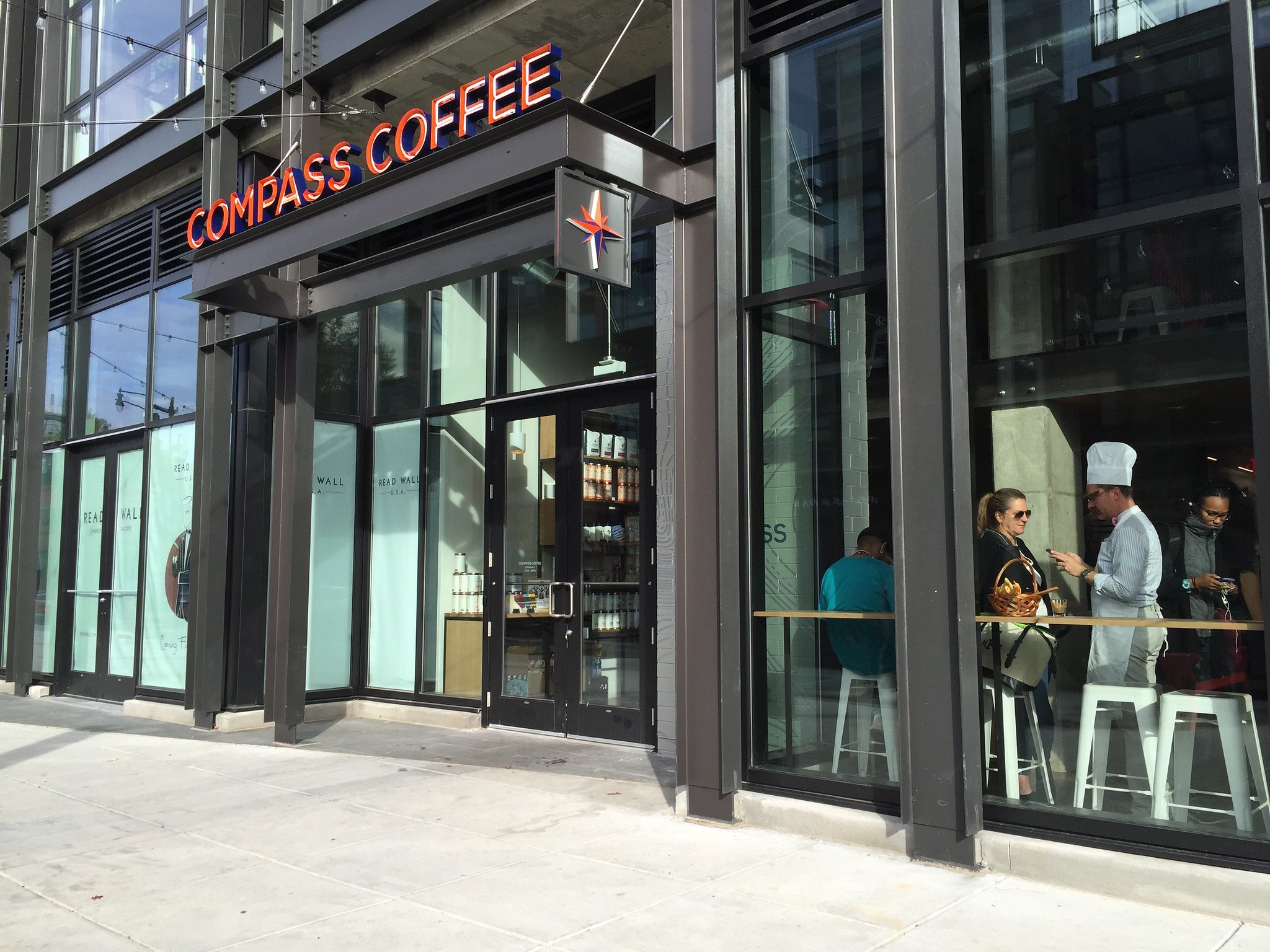
Amid an ongoing debate about the fairness of cashless policies, one of the city’s biggest local coffee chains is experimenting with a new policy to limit—but not completely eliminate—cash transactions.
Compass Coffee will try out the new, semi-cashless model to “get customer feedback” and figure out “what it would look like to minimize our cash handling,” says co-founder Michael Haft.
At two D.C. locations, baristas will now only accept exact change. Customers will also be able to use cash to purchase gift cards, which can then be used to make purchases. The policy is in effect at the company’s 8th Street store in Shaw and the New York Avenue store in Mount Vernon Square.
The impetus for trying out the new system is the minimal and declining number of cash sales at several of Compass’s locations in D.C., according to Haft. At the Shaw location, for example, cash transactions make up only about six percent of the total over nearly four years of operation, he says. Additionally, each coffee shop that handles cash has to pay for the use of a machine that dispenses money for the cash drawer to employees, Haft says. It’s an expensive piece of equipment to pay for when cash makes up such a small portion of overall sales.
But if customers dislike the new policy, Haft says they’re willing to switch back.
“We’ve talked to people about it and people don’t seem too concerned honestly,” he says. “But we could be wrong, and if we are we’re happy to change.”
The move comes as Sweetgreen, another homegrown chain, decided in April to begin accepting cash again after going cashless in 2016. Activists and others argued the policy excludes people without access to credit or debit cards. As of 2017, a full eight percent of people in the District were “unbanked,” according to the Federal Deposit Insurance Corporation.
Sweetgreen said it instituted its cashless policy to shorten lines and increase safety for employees, who would be less vulnerable to robberies given that they wouldn’t be handling any cash. But the policy also “had the unintended consequence of excluding those who prefer to pay or can only pay with cash,” Sweetgreen wrote in a release. “Ultimately, we have realized that while being cashless has advantages, today it is not the right solution to fulfill our mission. To accomplish our mission, everyone in the community needs to have access to real food.”
Last summer, At-large Councilmember David Grosso introduced a bill that would ban businesses from going cashless in the District. “By denying patrons the ability to use cash as a form of payment, businesses are effectively telling lower-income and young patrons that they are not welcome,” Grosso wrote in a press release at the time. “Practices like this further stratify our diverse city when we should be working to foster greater inclusion.”
Haft says he’s aware of these criticisms of cashless businesses.
“It’s definitely an important consideration, and it’s something we wanted to learn about firsthand from our customers,” he says. Haft works at the Shaw location every day, and says he’s built up relationships with several regulars who don’t always have access to debit or credit cards. Those customers have told him they’ll simply pay for a gift card with cash to buy their coffee, he says. “We are trying to minimize cash. We aren’t trying to get rid of anyone,” he says.
Also, Haft says, the chain isn’t currently considering minimizing or eliminating cash at all of its locations. Some locations, like the one in Chinatown (which is frequented by lots of cash-wielding tourists), continue to do a lot of business in paper currency. Haft says that around 20 percent of the Chinatown store’s sales are still cash.
As the experiment gets underway, Haft says he’s keeping his ear to the ground for feedback from customers and Compass employees alike.
“For us, it’s really thinking about what our customers are interested in and how we can best meet their needs,” he says.