 Gabe Bullard
Sobriety is on-trend. Today’s tipplers are ditching booze for tea, kombucha, extravagant juices, and mocktails. But for those who want to slake with the original refreshment, there’s Water Bar DC.
The menu on the website for the bar in Park View lists more than 40 waters, including brands you might find at the gym (TotalFit, $4), at a duty-free shop (Norwegian Voss and Italian Acqua Panna, $8 each), at a new barbecue restaurant (Topo Chico, $8), or in the mountains of Chile (Andes Mountain Water, $25). And there are infused waters, made using what cofounder Jason Forte calls “proprietary techniques that we utilize to extract all the nutrients from the fruits and vegetables.”
News of the Water Bar’s existence has been spreading over the last month or so, following a curious Reddit post. There are Groupon offers for tastings and tickets for sale on EventBrite. A YouTube video announcing Water Bar ended up embedded on a local TV news website as well as PoPville, which asked “do you think this is real?” The comments sections declared it either a sign of gentrification and capitalism run amok or a front dealing in something other than water. Either way, people thought the bar represented something larger.
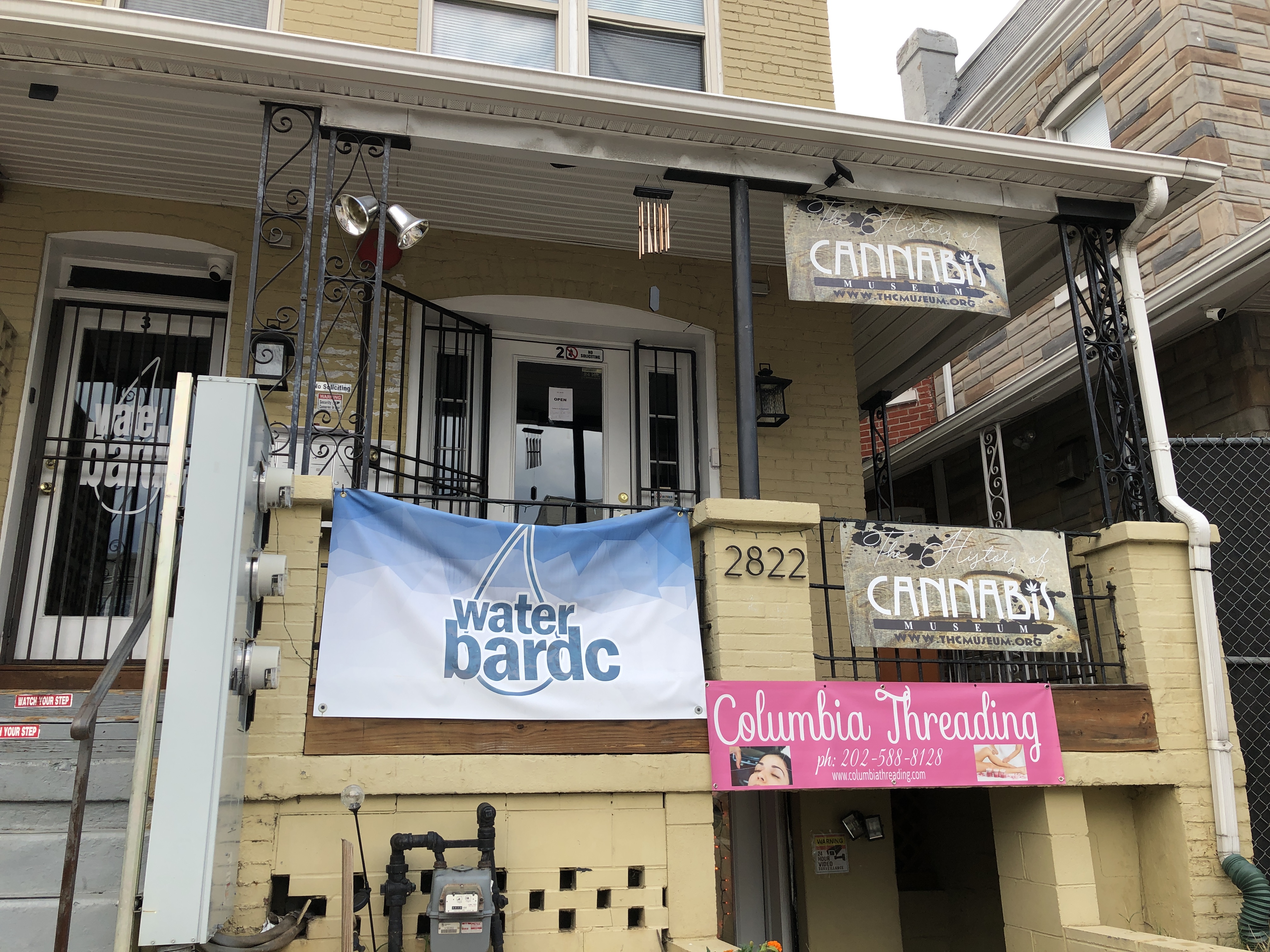
A visit to Water Bar on Georgia Avenue in early June led to a locked door and no answer to the doorbell. A call to the bar’s phone number got no answer either, and the voicemail prompted no return call. Next door at the History of Cannabis Museum, a docent said Water Bar was going through summer renovations for the next few weeks. A refund is pending for a tasting I purchased on EventBrite.
When I got in touch with Forte, he attributed the ticket sales to someone doing media for the bar who was “a little antsy” and he says he tried to put a freeze on it. He says he’s eyeing July 4 as the grand opening, and he needs to hire about eight people to prepare the infusions and to manage orders from Grubhub, Uber Eats, and Postmates.
“It takes a long time to learn how to do this stuff,” Forte says. “It’s not like a Smoothie King or something—you have to have the knowledge, as well, as to the health benefits of drinking certain custom crafted waters.”
Water Bar’s location above the Cannabis Museum, as well as a line on the Groupon page that says visitors can “enjoy taking part in bar games with the chance of winning prizes” raised questions online over whether the bar is an Initiative 71 business that indeed sells water, but offers cannabis “gifts” with a purchase or donation.
“Absolutely not,” Forte says. “Are you serious?”
As a business, Water Bar has been around for almost a year. The business was incorporated with the District Department of Consumer and Regulatory Affairs in July 2018.
Forte says the confusion about what he’s doing is a natural part of spreading the word before a public launch. People have lots of questions. To answer them: No, there’s no alcohol served, Forte says, and you can’t bring in your own booze either. Ditto your vape or hookah. (The Water Bar Eventbrite page does, though, limit entry to people over 21.)
“It’s just water?” Forte says people ask him. “Yeah. So now you know it’s just water, would you like to try some? And when they try it, they’re like ‘Wow! I’ve never tasted anything like this.’ So it’s like a four-step process. But once they get it, they can tell others. And the others tell others.”
Forte imagines Water Bar becoming an elite water service across the D.C. area, curating water menus at restaurants, and potentially opening satellite locations inside of gyms.
There are lots of places in D.C. where people are thirsty, and high-end water might be just the fix they need.
Is fancy water…a thing?
Forte wouldn’t be the only person distributing luxury water in D.C. Three years ago, Ashley Epperson co-founded Salacious Drinks, a business that sells exotic bottled water to individuals and businesses, including Water Bar. Epperson says Salacious has about 30 business clients and they do about 30 additional deliveries to homes each month (including mine: a case of Mountain Valley appeared on my doorstep just one day after I placed the order through Salacious).
Business used to be much slower. Epperson says she had trouble getting luxury waters to agree to let her distribute them in the U.S. Now she has a variety of products on offer. She’s even one of seven U.S.-based businesses to distribute Svalbardi, a hyper-luxurious water harvested from Norwegian glaciers ($90 for 750 ml).
Customers were skeptical, too, until Epperson started organizing tastings around town.
“We have people come up all the time: ‘It’s just water, I’m not going to taste the difference.’ And then when they’re done with the tasting, they’re like ‘Oh my gosh I really did taste the difference!’” Epperson says. “Some people are like ‘Nope, nope. I’m good.’ And I’m like ‘Alright, you know, I’m not the [company] for you.’ But that’s the beauty in America—you can find your client anywhere.”
For the record: Different types of water really do taste different. Depending on their source, the minerals in water can carry various flavors or affect the carbonation. And people notice. On Twitter, a few drinkers chimed in with their favorite brands (I’m partial to Gerolsteiner mineral water, myself).
Epperson’s clients seem happy.
“She came in and gave us a free case to try out,” says Roger Faddoul of Old Town Deli. Now he sells Found, a flavored mineral water, for $2.59 a pop. “People are willing to pay for it,” Faddoul says.
Visitors to Michael Thomas Clothiers downtown—another client of Epperson’s—don’t need to pay for Found water. Owner Tom Comeau offers them a bottle when they come in.
“We have high-end clients come in, so I think they get impressed with it,” he says, adding that the flavor and the glass packaging give Found a luxurious feeling: “A plastic bottle looks cheap.”
Indeed, it’s not just the taste that drives sales.
“I sell other waters,” Faddoul says. “I sell Fiji, I sell Deer Park. A lot of people cannot afford the Fiji water, but they can afford the Deer Park. People who can afford it always buy the Fiji, the Evian,” he says. “It seems like the brand name matters.”
There’s some research to back this up. A study in the Journal of Wine Economics reviewed the luxury water offerings and “found only a weak association between characteristics related to the water inside a bottle and the price that consumers are willing to pay.”
That price keeps growing, it seems. As consumers move away from sugary drinks, sales of water increase. In 2017, bottled water outsold soft drinks and alcohol by volume in the U.S. And new brands are scrambling to get a piece of the ever-growing pie.
Each new water brand offers some characteristic—bubbles, flavors (“essences” as many call them), minerals, purity, presentation. But luxury itself is also a characteristic.
In this way, water isn’t much different from any other product.
“Years ago, chocolate was just chocolate. No one had any idea where chocolate is coming from. Now you have single origin chocolate bars,” says Michael Mascha, the founder of the Los Angeles-based Fine Waters Society. “Think about salt. Twenty years ago, salt was just salt, an industrial product. And now people have maybe two or three different salts from, you know, Himalayan salt, the Hawaiian salt, and the fleur de sel.”
Chocolate or wine may be fine luxury items, but our survival doesn’t depend on them (no matter what your novelty t-shirt may say). It can be hard to stomach the existence of a multibillion dollar industry built on a lifestyle that involves consuming something necessary for life itself (especially at a time when some American cities go years without potable tap water).
Luxury water aficionados say the lifestyle isn’t about bodily needs.
“I think a distinction to make is the distinction between hydration and having an experience with water,” Mischa says. “If you go to a fine restaurant, you want to have an experience with water. And what you don’t want is to get the water that you can buy in a gas station for 99 cents in the fine dining restaurants for $9.”
But in a way, paying even 99 cents is a luxurious outlay of cash for something that comes out of fountains and taps. Vincent Morris with DC Water is “mystified” that people would pay far more than that.
“I can’t imagine this becoming anything more than a novelty,” Morris says. “You can gussy up water any way you like with cucumbers or lemon or berries but water is still just water and we encourage our customers to drink deep from their taps and skip the cute water.”
There’s also the environmental debate. The prevalence of single-use plastic—like water bottles—is an ecological disaster. Fine water aficionados note that luxury producers tend to be small and environmentally minded, and they only use glass in their packaging. But many of those producers are European, and glass manufacturing in the U.S. is not as prevalent.
Do I need to care about water now?
Salacious Drinks and the Water Bar are the local edges of a growing national trend. Water menus, water tastings, water sections, and water bars might all be common sights around D.C. soon.
“We haven’t scratched the surface of what the water industry can hold or offer,” Epperson says.
Store shelves are increasingly crowded with water infused with CBD, water flavored like wine, and any number of waters derived and packaged to stand out. A restaurant in Los Angeles has had a more than 40-page water menu for years (which reportedly increased the restaurant’s water sales fivefold). And the luxury water hashtag on Instagram brings up row after image after image of good-looking people in good-looking locations with good-looking products. They’re living the luxury water lifestyle.
People in the District might be living it soon, too.