Matt Blitz
On the 50th anniversary of Neil Armstrong’s small step on the moon, there’s going to be one giant projection on the Washington Monument.
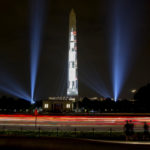
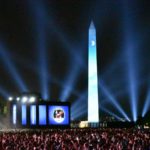
For two nights later this month, the Smithsonian’s National Air and Space Museum will beam a full-scale, 363-foot Saturn V rocket directly onto the monument, while airing a 17-minute show on nearby screens that tell the tale of Apollo 11’s mission and the first moon landing.
Titled “Apollo 50: Go for the Moon,” the program will incorporate a 40-foot-wide recreation of the famous Kennedy Space Center countdown clock, huge projection screens, and giant speakers to project sound.
The viewing area will be in front of the Smithsonian Castle, between 9th and 12th streets. Museum representatives say it is designed to support up an audience of up to 25,000 people per show—meaning upwards of 150,000 people could be attending over the course of three showtimes on both July 19 and 20.
From July 16-18, the Saturn V rocket will be also statically projected on the east face of the monument from 9:30-11:30 p.m.
Projection mapping is a technology that combines video projection with augmented reality that turns irregularly-shaped objects (like buildings or obelisk-shaped national monuments) into screens. Conforming the object into whatever is being projected, it creates an illusion that the object and the projection are one. (The first known instance of this was at Disneyland’s Haunted Mansion ride in 1969, according to projection-mapping.org).
The projection required no less than Congressional approval. On June 10, the bipartisan H.J. Res. 60 was introduced in the House, which asked the Secretary of the Interior to authorize “one-time arrangements for displays on the National Mall and the Washington Monument.” It quickly passed through both the House and Senate unanimously. On July 5, the day after his “Salute to America,” President Donald Trump signed the resolution.
Apollo 11 began its mission to the moon from Florida’s Kennedy Space Center on July 17, 1969. Just under 79 hours later, the Eagle landed on the moon. At 10:56 p.m. EST on July 20, 1969, Neil Armstrong became the first human to walk on our lunar neighbor. He was joined moments later by Buzz Aldrin. High above them orbiting the moon was fellow Apollo 11 astronaut Michael Collins, who spent part of his childhood in D.C. and graduated from St. Albans. The three space explorers returned safely back home to Earth on July 24, cementing their place in history.
“Our identity as Americans is defined in part by the historic act of landing humans on the moon and returning them safely to the Earth,” said Ellen Stofan, Smithsonian’s National Air and Space Museum director, over email. “The Washington Monument is a symbol of our collective national achievements and what we can and will achieve in the future. It took 400,000 people from across the 50 states to make Apollo a reality. This program celebrates them, and we hope it inspires generations too young to have experienced Apollo firsthand to define their own moonshot.”
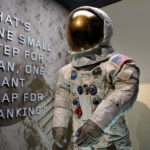
The show at the Washington Monument is not the only way that Apollo 11’s mission is being commemorated in D.C. The National Air and Space Museum is hosting an entire Apollo 50 festival on the Mall from July 18-20. There’s also currently a replica of Armstrong’s spacesuit at Nats Park and the NSO and NASA are doing a tribute concert at the Kennedy Center on July 20 that will include appearances from Pharrell Williams, LaVar Burton, and Meredith Viera.
The rocket will be projected on the Washington Monument from July 16-20. The free show commemorating the anniversary will take place three times on both July 19 and 20, at 9:30 p.m., 10:30 p.m., and 11:30 p.m.
This story has been updated to correct the date the astronauts returned to Earth.