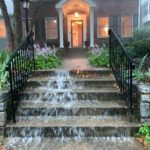
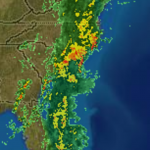
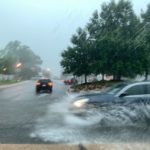
Monday’s record-breaking rainfall has left millions of dollars in damages in its wake that officials, homeowners, and car owners are still working to fully assess.
The torrential rainfall that hit during the morning commute broke a 148-year record for the date, with 3.41 inches of rainfall collected at Washington National Airport. It was a month’s worth of rain dumped in a little more than an hour. (By a more unconventional measure, it was equivalent to the weight of 102 million President Trumps, according to Capital Weather Gang). Dozens of people had to be rescued from their cars amid quickly rising floodwaters.
Needless to say, the damage was widespread.
The county manager’s office estimated that the total cost of flood damage to Arlington property is $3.5 million, which was first reported by ARLnow.
Erika Moore, communications specialist at Arlington County, says that $3 million is being allocated to Parks and Recreation, $300,000 towards roads and bridges, $100,000 towards debris removal, and $100,000 towards public buildings and equipment, per a preliminary breakdown from our Department of Public Safety, Communications, and Emergency Management.
At least six pedestrian bridges and a Bon Air Park storage facility were destroyed by the floods.
A number of roads in the county remain closed to drivers. Moore says that the road closure on 20th Street North and George Mason Drive should end today or tomorrow, while the 18th Street and McKinley closure won’t reopen until the end of the week. Three picnic shelters (Bluemont Park, Bon Air Park, Glencarlyn Park) will be closed throughout the week, and Glencarlyn Park playground will be closed “until further notice.”
“There’s a lot of work to be done. But we’re really appreciative of our citizens’ patience and understanding as we work through some of these issues,” said Mike Moon, chief operating officer for the Arlington County Department of Environmental Services.
Several roads were also damaged in Potomac, Maryland, according to Montgomery County spokesperson Pete Piringer. Perhaps most dramatic was a gulf in Belfast Road off of MacArthur Boulevard. ABC7’s Sam Sweeney reports that it is the only access road for 75 homes, and it could take weeks to fix.
ICYMI – Belfast Rd off MacArthur Blvd, Woodrock/Potomac, road washed away, 1 of several roadways damaged pic.twitter.com/YdTffjjXAM
— Pete Piringer (@mcfrsPIO) July 8, 2019
In D.C., at least one recently repaired sinkhole on Chain Bridge Road reopened amid the flood.
The day after it was fixed a few weeks ago, “it started to open up again. And for the past couple of rainstorms, it’s opened up a little more. Then this morning looks like it’s really opened up big time,” said Michael Finn, an architect who has lived in the area for 40 years. He estimated that the deepest spot was about four feet.
Rock Creek Park largely missed the brunt of the storm’s effects, but erosion on the road leading to Battery Kemble will require repairs, National Park Service spokesperson Jenny Anzelmo-Sarles told DCist via email. The road “is passable and will [be] repaired in the next several weeks,” she said, adding that officials are still waiting to find out more about possible erosion on the park’s waterways.
While there was flooding on Beach Drive and Joyce Road, they were able to reopen within a few hours.
A number of homes and businesses haven’t been so lucky.
Westover Shopping Center in Arlington was hit particularly hard. Ayers Hardware, the Westover Beer Garden, and other shops were “deluged. The businesses’s main levels and storage basements were inundated with water,” according to a GoFundMe page seeking to raise $25,000 for the merchants. The fundraising campaign has already raised more than $8,000.
Thousands of people also lost power. While it has largely been restored, the National Archives remained closed for a second day amid an outage caused by floodwaters.
At least one home in the District and one in Potomac were severely damaged and in danger of structural collapse.
Countless other homeowners experienced flooding, including some cases with multiple feet of water.
At least two homes in Potomac reported more than three feet of water in their basements, and another 10 homes had up to a foot of water, according to Earl Stoddard, director of the Montgomery County Office of Emergency Management & Homeland Security.
The area east of MacArthur Boulevard and south of Falls Road got the worst of the rainfall, he told DCist via email, adding that the Red Cross has made contact with the homes that experienced the most significant damage to offer their services.
Mike Singer, a flood repair expert who runs several service centers in the D.C. region, said his businesses are completely booked for the next few weeks.
“I would say the volume is three times what the normal volume would be,” said Singer, who is a franchisee of ServiceMaster, an international disaster repair company.
Insurance for flood repairs can be complicated. Many people who have home insurance aren’t necessarily covered for flooding by their policies, according to Singer.
“Mostly people don’t live in a floodplain, so they’re not thinking about flood insurance,” said Singer. “There are some people who don’t have the money and this can be devastating to them.”
Flood insurance is a separate insurance policy that can only be purchased from the National Flood Information Program, and a few private companies, according to AAA.
“The problem is, people often don’t realize that damage to your home caused by flood water is not covered by a standard home insurance policy,” the website says.
Some people will try to fix their own homes, but that can be a risky endeavor due to viruses and bacteria that live in flood waters.
“You can get sick doing that kind of stuff,” Singer said. “You’re dealing with the most contaminated level of water. There are health risks that have to be measured.”
He said that anything touched by flood waters is probably contaminated and should be thrown out. Children and the elderly are particularly at risk because their immune systems are weaker.
Hundreds of cars were also damaged in the flooding.
By 12:15 p.m. on Monday, AAA had already received 1,838 calls for service from D.C., Maryland, and Virginia, according to data provided by the insurance company. Of those 1838 calls, more than 65 percent were for cars that would not start or needed to be towed.
“All of this took place in a matter of hours,” said John Townsend, a spokesperson for AAA Mid-Atlantic. “We were inundated by calls from members who were either stranded, stuck, or in distress.”