Matt Blitz
It’s been 50 years since a human first stepped on the moon, and the anniversary of this great scientific achievement is being celebrated far and wide. Sure, Kennedy Space Center in Florida is celebrating with a concert from Duran Duran and Houston, where mission control was located, is counting down New Years’ Eve-style with synchronized LED wristbands. But, here in D.C., there are plenty of ways to commemorate Apollo 11’s mission, from being blown away by a 363-foot Saturn V rocket being projected on the Washington Monument to seeing a 3.5 billion-year-old moon rock at the National Cathedral.
Go to the Apollo 50 Festival
For three days, the National Air and Space Museum will host an outdoor festival on the National Mall. From July 18-20, moon-minded folks will be able to visit Apollo Mission Control, meet a Mars Rover, take a “tour” of the moon, and marvel at mini-Lego models of Apollo 11. There will also be costumed characters from PBS’s Ready Jet Go for the little astronauts in your life. The festival is free and will take place between 4th and 7th Streets SW. It will run from 9 a.m.-5 p.m. on July 18-19, and from 9 a.m.-8 p.m. on July 20.
See Armstrong’s Spacesuit
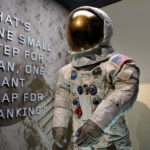
For the first time in 13 years, Neil Armstrong’s lunar-dust-covered spacesuit will go back on display to the public at the National Air and Space Museum. In 2015, a crowd-funded Kickstarter campaign funded the $700,000 conservation of the suit. The artifact will go in a temporary display starting July 16 (near the 1903 Wright Flyer) until it moves in 2022 to the new exhibit “Destination Moon.”
Look into the light of the silvery moon
The National Gallery of Art is putting on a lunar show of rare moon photos, including ones dating back to 1858. The exhibit titled “By the Light of the Silvery Moon: A Century of Lunar Photographs” will display 50 works, including original glass stereographs taken by Armstrong and Aldrin while on the moon. The photo exhibit will be on display through January 2020.
The museum will also host a film program on July 20 and 21 showing space-centric movies like 1983’s The Right Stuff and David Bowie’s The Man Who Fell To Earth.
Spend the night at the museum
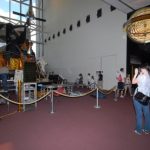
The National Air and Space Museum will keep its doors open until the early morning on July 20th. Besides all the space artifacts, there will be a rebroadcast and countdown of the moon landing, themed musical performances, trivia, and a 1 a.m. spacesuit fashion show.
Hear moon tunes
On July 20th, the National Symphony Orchestra is putting on an Apollo 11 tribute concert at the Kennedy Center in collaboration with NASA. Hosted by Meredith Veira and Mythbusters’s Adam Savage, the concert will feature Pharrell Williams, LeVar Burton, Natasha Bedingfield, and a score from Oscar-winning composer Michael Giacchino. Plus, there will be taped greetings from astronauts, Stephen Colbert, Elton John, and a never-before-seen music video of David Bowie performing “Space Oddity.” Tickets range from $29-$149.
Relive the Apollo 11 launch … on the Washington Monument
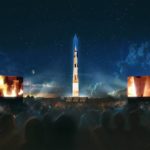
From July 16-20, the Smithsonian’s National Air and Space Museum will project the 363-foot Saturn V rocket, which took Apollo 11 to the moon, onto the Washington Monument. This is such a big deal that it required Congressional approval. From July 16-18 (from 9:30 p.m. to 11:30 p.m.), the rocket will be statically projected on the east face of the monument. The next two nights will feature three showings (at 9:30 p.m., 10:30 p.m., and 11:30 p.m.) of a 17-minute show telling the story of the first moon landing. As an extra D.C.-centric bonus, it will feature music by composer Jeff Beal, who scored “House of Cards.”
Argue space race politics
While scientifically-driven, the space race was inarguably political. On July 18 at George Washington University Lisner Auditorium, Apollo 11 astronaut (and former Washingtonian) Michael Collins will discuss the political and foreign policy ramifications of the Apollo program with folks from NASA and the National Air and Space Museum. The event is free, but tickets are required.
Sit under a moon tree
There’s a very special sycamore at Arlington National Cemetery. In 1971, Apollo 14 astronaut Stuart Roosa brought a canister full of tree seeds with him into space. Five years later, these seeds were planted across the US and grew into “moon trees.” In 2005, a cutting from one of these moon trees was planted near Roosa’s grave at Arlington National Cemetery. It’s now a 40-foot-tall American sycamore.
Visit the Goddard Space Center
About 15 miles from the District is NASA’s Goddard Space Center, a major space research laboratory. The visitors center can be explored without reservations and has exhibits on space communications and the Lunar Reconnaissance Orbiter. Plus, there’s a rocket garden, another moon tree, and a pretty decent gift shop.
Crane your neck for a moon rock
At the National Cathedral, there’s a blue and red stained glass window that commemorates Apollo 11’s trip to the moon. What’s more impressive is that embedded inside of that window is a 3.5-billion-year-old moon rock that Neil Armstrong picked up at the Sea of Tranquility in 1969. It’s a bit high up, so take a step back and crane your neck to get a glimpse of a rock that’s almost as old as the Earth itself.
Hit the road to Udvar-Hazy
Truck 30 miles outside of the city to the National Air and Space Museum’s Udvar-Hazy Center on July 16 as they’ll open early at 8:45 a.m. to celebrate the anniversary. There’ll be astronaut talks, NASA TV, and rarely seen items from the archives. While there, check out the Mobile Quarantine Facility that the astronauts had to hang out in for 88 hours after coming back to Earth just in case they had space germs. Yeah, it’s a converted Airstream.