Matt Blitz
Sure, it was crowded and nearly record-settingly hot. But “Apollo 50: Go for the Moon” captured the city’s (and the nation’s) attention in a manner that hasn’t been seen in quite a long time.
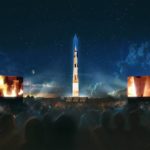
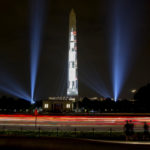
For five nights, the Washington Monument transformed into Apollo 11’s Saturn V rocket and also into something else that’s rarely been seen in D.C. in recent years—a unified vision of what we could accomplish as Americans. It was communal, inspiring, educational, and really, really cool.
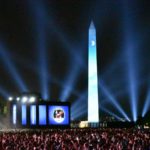
On Friday and Saturday night, the projection was accompanied by archival footage on giant digital video screens and a riveting musical score (written by the composer of the House of Cards theme). It told a streamlined, 17-minute story of how humans first walked on the moon, from President John F. Kennedy’s 1962 speech to the future Artemis mission. The show was a celebration of science, history, ingenuity, engineering, teamwork, and human curiosity.
According to the Smithsonian National Air & Space Museum, an estimated half a million people over two steaming hot nights came to the National Mall to watch the tale unfold on the obelisk-shaped national monument, far exceeding the predicted 150,000. Event management company Linder Global arrived at the figure by estimating crowd density on the grass—it doesn’t include people who watched from the Mall’s gravel paths or in places covered by trees, for example. Seemingly at least that number of photos and videos flew across the social media galaxy as well.
People cheered when the Saturn V rocket launched, when the Eagle landed on the moon, and, most notably, when it climaxed with Armstrong’s boot print.
The whole experience projected the message that America’s greatest achievement wasn’t warfare or violence, but traveling 238,855 miles through space to our lunar neighbor to take one small step.
It was about 18 months ago when Katie Moyer and Nick Partridge first came up with the idea to project the Saturn V rocket on the Washington Monument. With Apollo 11’s 50th anniversary approaching, the two Smithsonian National Air and Space Museum employees had a brainstorming session about how the museum should celebrate it at a place where many good ideas come to pass.
“Nick and I went out to a bar in Chinatown … to get all the crazy ideas out to see what stuck and actually could happen,” says Moyer. She and Partridge are the two executive producers of the project.
After mocking it up on a napkin (“No whiteboards. You want to write everything down on a cocktail napkin,” Partridge jokes), their next task was convincing their museum colleagues this was a good and doable idea. “That was not as hard as you’d think it might have been considering the scope of the project,” says Partridge. “The first taste that we got that people were really going to be into this was when we were convincing [everyone at] the museum.”
They brought Boeing and Raytheon on as financial sponsors and enlisted 59 Productions (who also did projection-mapping for the Freer|Sackler in 2017) to do the technical heavy lifting while working with the U.S. Department of Interior and worked closely with the D.C. Homeland Security and Emergency Management Agency for logistics. Notably, unlike other large-scale events on the National Mall, the display came with no metal detectors or specific entry points (though there was a consistent police presence). “We felt very strongly that… this should be as open as it possibly could be,” says Moyer. “After all, we were doing this on the National Mall, which is… America’s park. We wanted this to be inviting.”
Although Moyer and Partridge have spent more than a year on this project, there were moments that caught them by surprise—and because of the show’s production schedule, they saw all of “Apollo 50: Go For the Moon” for the first time at Friday’s public showing with everyone else. “To hear people clap when [the astronauts] safely made it into orbit and when they touched down on the moon… it was incredible,” says Moyer. “People reacted like they were watching the real launch of Apollo 11,” Partridge adds.
The team included at least one surprise in the show for viewers who know their history. The Saturday show scheduled for 10:30 p.m. actually began at 10:42 p.m. Moyer confirms that this was planned so that at 10:56 p.m., 50 years to the second that Neil Armstrong set foot on the surface of the moon, Armstrong’s boot print on the moon appeared on the Washington Monument.
“History waits for no one, but we will wait a few minutes for history,” quips Partridge.
They both said that the heat and potential for thunderstorms on Saturday night worried them. But the weather threat turned out to be a relative non-issue, thanks to the storm narrowly missing the National Mall.
In the end, it will be a D.C.-only event that will be talked about for a long time.
“It exceeded all of our expectations,” says Partridge. “It was really gratifying but also very humbling to see people react in a way [about the moon landing] that said they felt the same way for those few moments that we feel working here at the museum.”