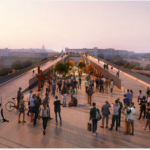
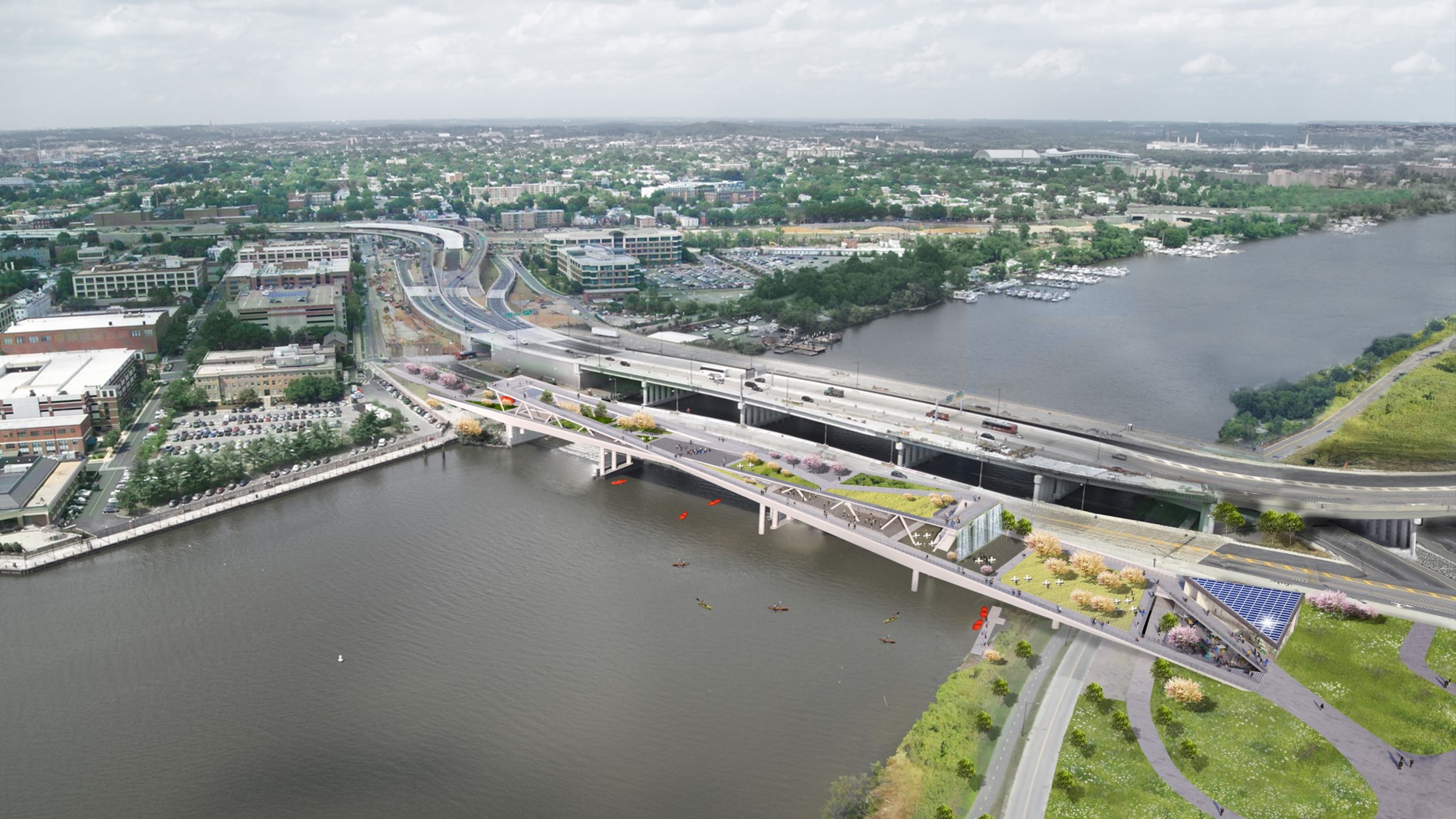
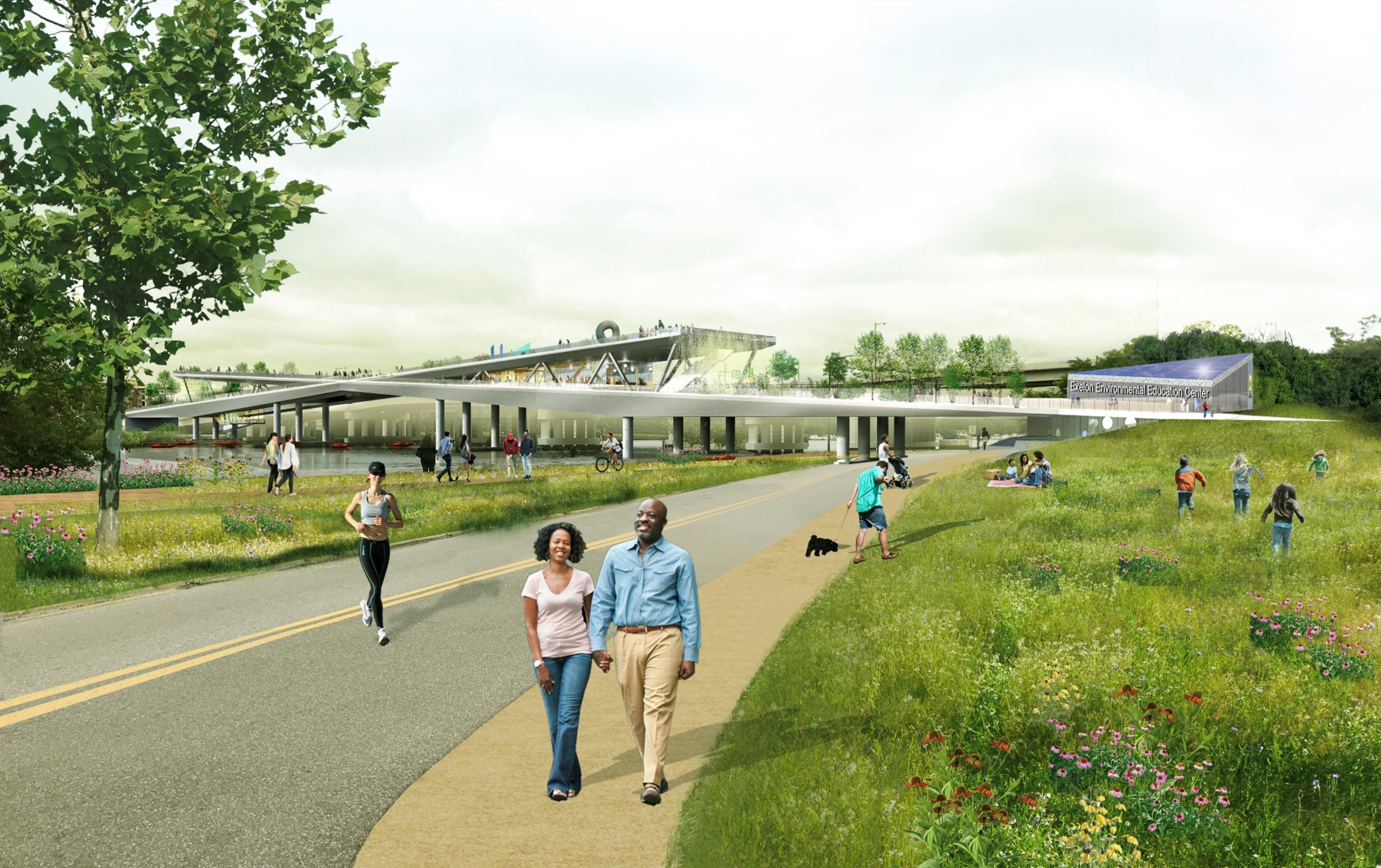
The forthcoming 11th Street Bridge Park will be D.C.’s first elevated public park, and will include an amphitheater, hammock grove, public plaza, and more built along 1.45 miles across the Anacostia River.
Local officials announced the latest donation towards making this multimillion project happen at a press conference on Tuesday morning: utility company Exelon, which owns Pepco, is giving $5 million.
“We hope this community investment inspires other companies, individuals, and foundations to recognize the enormous potential that this new public space will have to literally and metaphorically bridge D.C.,” said William Von Hoene, Jr., Exelon’s executive vice president and chief strategy officer in a press release.
Exelon wants to establish the Exelon Environmental Education Center, which aims to teach younger generations about the river and the environment. The company envisions a space that’s powered by solar panels from Constellation and potentially has charging stations from Pepco for electronic transportation.
Scott Kratz, director of the 11th Street Bridge Park project, says that the hub will anchor the eastern side of the park.
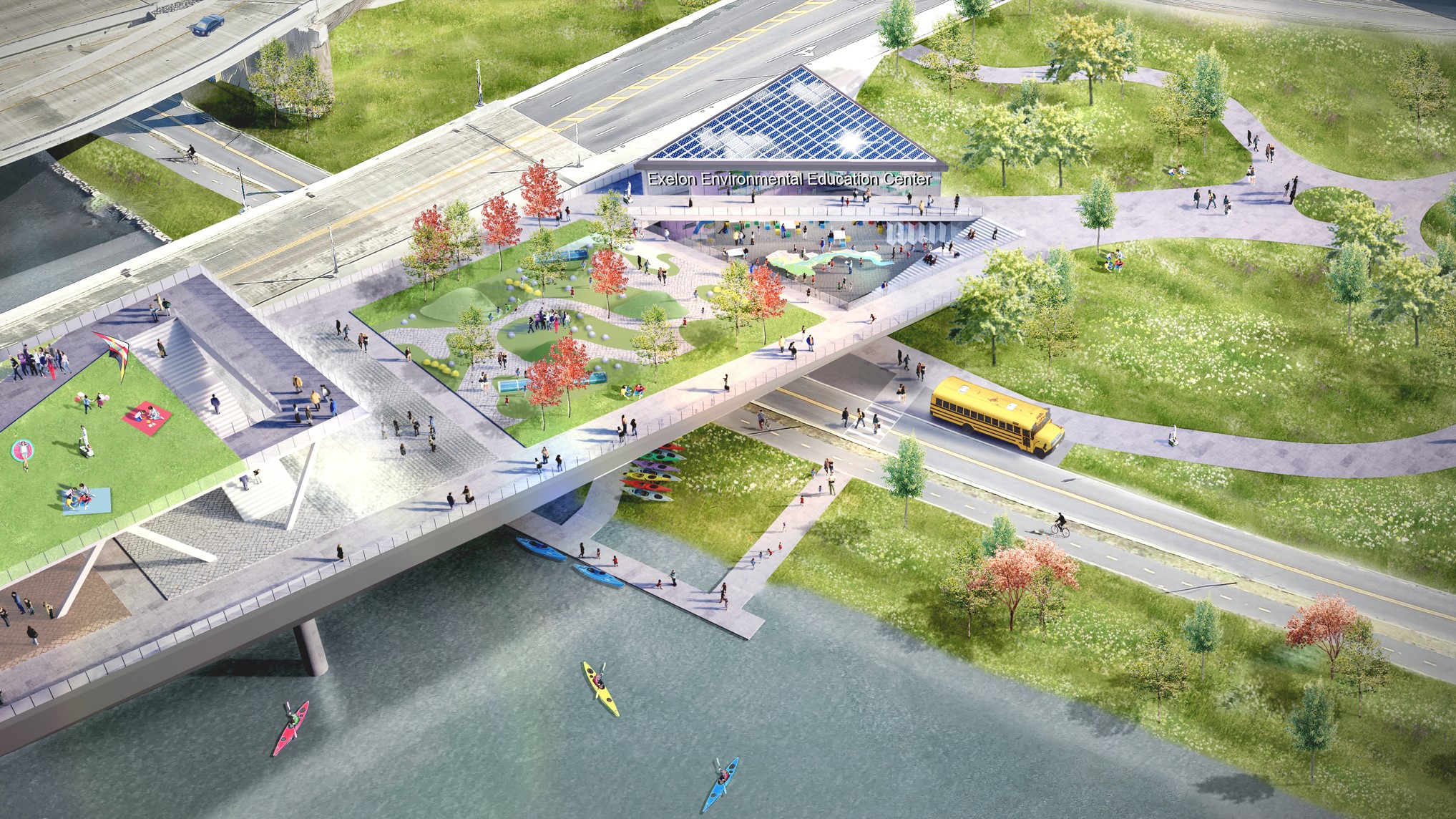
Kratz says that the education center will house both indoor and outdoor classrooms, and have a capacity of 90 children. Students in the District will be able to come and learn about science, engineering, river health, and the flora and fauna of the river. These classes will happen Monday through Friday and be open to students in D.C.’s public and charter schools. On nights and weekends, there will be events for adults.
The Anacostia Watershed Society, which helped select the final design team for the hub, is set to run the center when it opens and be housed there permanently.
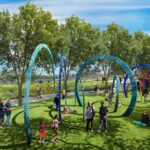
Kratz says that there will be an 11,000 square foot, intergenerational play space right next to the environmental education hub. And further along the bridge will be a community meeting room, cafe, hammock grove, and space for demonstrations of urban agriculture. Then, on the other end of the bridge, there will be a 203-person outdoor amphitheater, which Kratz explains, “anchors the Capitol Hill side of the park.”
“We have a lot of places in this city where you can cross rivers, but not many [where] you can stop and linger to take in that view,” says Kratz. It’s located where the Anacostia river slightly bends, allowing folks to get a clear view down the river.
“From a design standpoint,” he explains, “the bridge itself gets wider. That’s important because we want to make sure that folks are not only coming to the park, but that the park is deeply stitched into the adjacent neighborhoods, particularly the East of the River communities.”
The project is the result of a collaboration between D.C. government and the Ward 8 nonprofit, “Building Bridges Across the River at THEARC.” The city has committed $38.25 million, and the rest of the money is coming through fundraising.
The goal of the park is not only to revitalize public space, but to do it in an equitable manner. An 11-page plan released by the project’s Equitable Development Taskforce in November 2015 outlined the ways they would do that—namely, by prioritizing residents in Wards 6, 7, and 8 for the development’s construction jobs, establishing a kiosk food-service market in the park, and ensuring local residents will be able to continue living nearby the park, among other strategies.
Some community organizers are concerned that the development of the park would push longtime residents out of the area. A similar situation unfolded in New York City, where the creation of the High Line contributed to a high-end real estate boom that transformed the surrounding neighborhoods.
Large corporations and philanthropists have already pledged funds in an effort to prevent the same phenomenon from happening in Anacostia. In 2016, the Washington Post reported that the Local Initiatives Support Corp. announced their investment of $50 million “to groups providing affordable housing, early childhood education, medical care, food support, arts education, and other services in the area near the park site.”
And in 2017, JPMorgan pledged $5 million to the 11th Street Bridge Park development, with $3 million dedicated to supporting a community land trust, $1 million to aiding local businesses, and the rest to improving “construction-skills training and program evaluation.” Building Bridges has already partnered with City First Homes to begin purchasing homes for the land trust. In a 2018 article from Next City, the equitable development manager at Building Bridges, Vaughn Perry, explains that “if we wait one or two years down the line [to purchase properties], it might not be financially sustainable.”
Longtime Ward 8 resident Brenda Richardson, who has been involved throughout the development process, is hopeful about what the 11th Street Bridge Park could bring to her neighborhood. “The beauty of this bridge is not only will it connect us to Capitol Hill, but the the beauty of this bridge is that it will heal our communities,” she said at the press conference on Tuesday. “There is great trauma on our side of the river, and we are looking for some happiness and some joy.”
Although the 11th Street Bridge Park team used to describe the costs of the park itself as separate from their investments in the local community, Kratz says that that has changed. “We now describe this as a $139 million capital campaign,” he says, combining the brick and mortar price of the park and the costs of equitable development strategies.
And even though that number is far from the initial estimate of $40 million, they are close to meeting their goals. Including Exelon’s investment, they’ve raised $111.5 million.
But don’t expect to see the finished product too soon—it’s still in the earlier stages of development. According to Kratz, they will finish the complete design of the project in two years, break ground in 2021, and open the park in 2023.
This story has been updated with additional context.