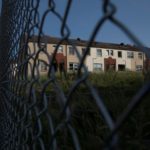
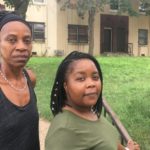
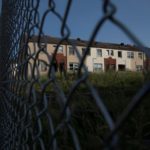
Residents who once lived at the Barry Farm public housing complex in Southeast D.C. are requesting landmark status for 32 buildings currently destined for demolition.
The D.C. Historic Preservation Review Board heard arguments for the designation Thursday. Detrice Belt, president of the Barry Farm Tenants and Allies Association, was the first to speak in favor of historic status.
“If places like Barry Farm are denied protection, then what do we have left in this city?” Belt said. “We are asking for protection of these buildings because they are more than just buildings to us. It will ensure our history is protected and our stories are told.”
A historic designation, Belt said, could mean a possible museum along with upgrades and renovations for the development. “We feel like our ancestors deserve this,” she said.
Barry Farm was constructed in 1941, on a portion of a settlement created by the Freedmen’s Bureau in 1862. It was D.C.’s first homeownership community for African Americans after the Civil War. The street grid in the development is the last remnant of that early post-Emancipation community, according to the BFTAA.
The redevelopment of Barry Farm was delayed more than a year ago when the D.C. Court of Appeals sided with the Barry Farm Tenants Association, and sent the project back to the zoning commission. Part of the court’s decision said the commission falsely concluded that the proposed relocation for Barry Farm residents wouldn’t cause hardship or displacement.
Despite that decision, families in 444 units and more than 200 buildings—which have already been torn down—have moved into temporary housing. Hundreds who once lived at Barry Farm were given vouchers, making way for the long-promised redevelopment. Residents were told by city officials they could move back once the redevelopment is finished, but some doubt they will be able to return to the property.
At the historic preservation meeting on Thursday, between 60 and 70 residents gathered in support of the request, but only witnesses were permitted to testify.
“In the best interest of the neighborhood, we request the application for historic preservation of Barry Farm be denied in order for the redevelopment of this property to move ahead,” said Kerry Smyser, senior deputy director of Capital Programs at D.C. Housing Authority.
Smyser said the housing authority is open to preserving the site in other ways, such as through oral histories, public art, and photography.
Sarah Shoenfeld of local history blog Prologue D.C. spoke in favor of Barry Farm gaining historic status.
“While the early history of Barry Farm is significant, the history of the dwellings is equally important,” Shoenfeld said. “For instance, it was home to Etta Mae Horn, who led the Barry Farm Band of Angels and became a national leader on welfare rights issues. It was also home to several key plaintiffs in Bolling v. Sharpe, which ended the legal segregation of D.C.’s public schools when it was heard as a companion case to Brown v. Board of Education in 1954.”
“We know that it was not just the people, but also the intentional design, structure, and location of the Barry Farm community that fostered this spirit of activism,” Shoenfeld added.
Supporters argue that Barry Farm meets the criteria required by the D.C. Historic Preservation Review Board.
“What do we lose as a city when we wipe away places like Barry Farm? Our history, our identity and our social [conscience],” said Parisa Norouzi, director of Empower D.C., a city-wide organization which has worked with Barry Farm residents for nearly a decade to protect their rights.
“We are a city known for monuments and memorials—but it’s the humble places like Barry Farm that speak to the stories of Washingtonians who shaped this city. Their contributions deserve the recognition that landmark status confers,” Norouzi said.
Residents of Barry Farm say they still have not been told when the redevelopment will be complete, and they can return from their temporary housing.
“I definitely am not at home where I am. I’m in an apartment. I was in a house. I don’t have the yard space I had,” Detrice Belt said. “I want to get back to Barry Farm—my community, my home.”
The board is expected to vote next week on whether Barry Farm will receive the historic designation.
This story was originally published at WAMU.