Jacob Fenston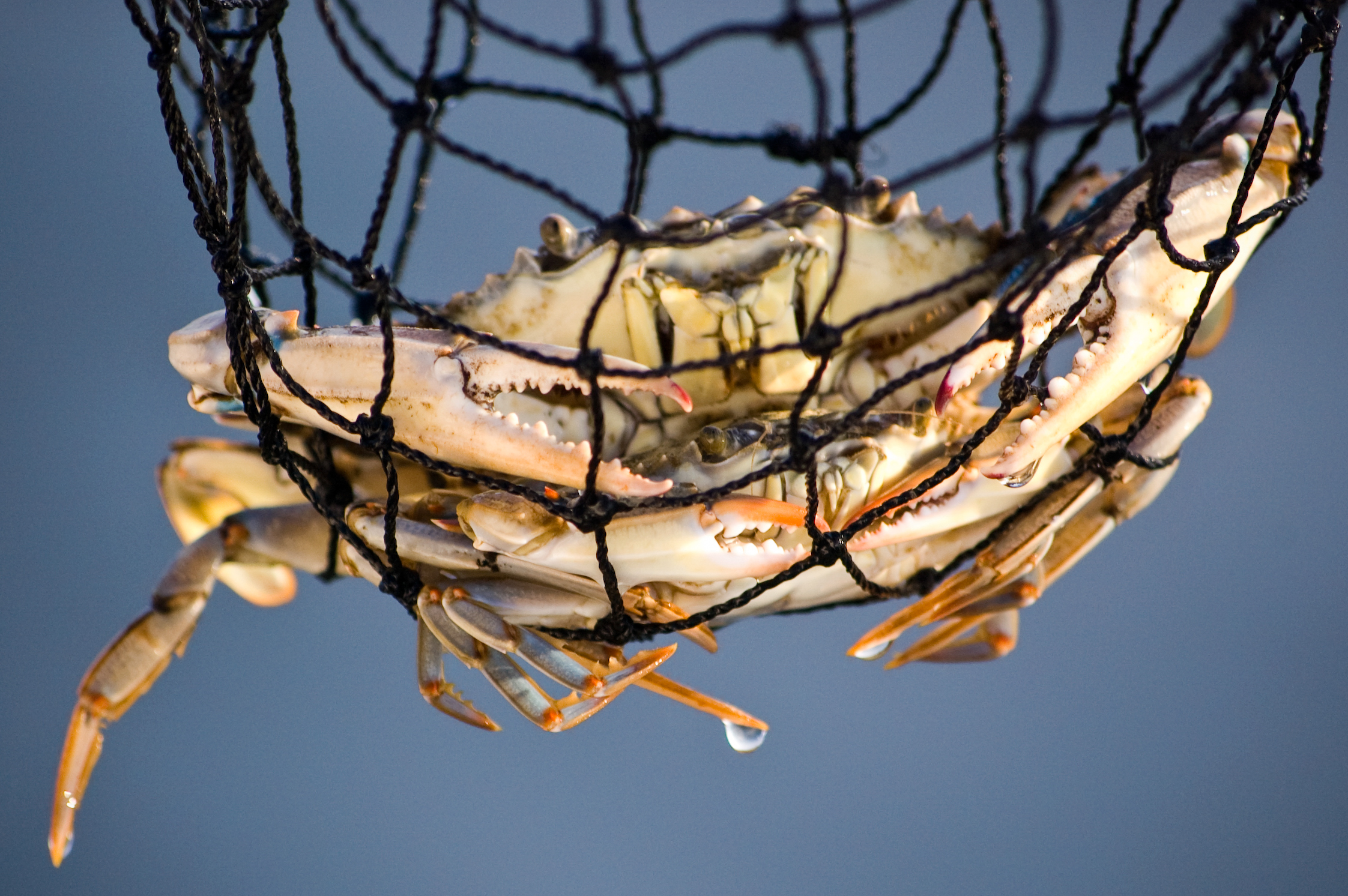
It’s the year 2100. You’re lounging on the patio of your favorite Chesapeake crab shack watching the sun set over the bay. It’s 110 degrees out (and feels like 135)—but you’re used to that, because, hey that’s pretty much the new normal. You’re keeping cool—the bay water is up to your knees (sea level has risen about five feet since the early 2000s). The best part: all-you-can-eat crab! And crab season lasts all year.
“Blue crab are a climate change winner in the Chesapeake Bay, there’s no doubt about that,” says Thomas Miller, director of the Chesapeake Biological Laboratory at the University of Maryland Center for Environmental Science. He’s one of the authors of a new study that found blue crabs are likely to thrive in a warming Chesapeake. The winter survival rate for blue crabs will increase by at least 20 percent, according to the study.
Winters in the region will be much shorter and warmer by 2100. In fact, for crabs, there may be no winter at all. When water temperatures dip below roughly 50 degrees, crabs go into their winter dormancy mode, burrowing into the mud and sleeping through the cold months. That period of winter dormancy is already a lot shorter than it used to be, and could nearly disappear by the end of the century.
For the study, researchers looked at historical temperature data and climate change projections to get a picture of what the future may look like for Chesapeake crabs. They had access to a trove of historical temperature readings. The Chesapeake Biological Laboratory is located in Solomons, Maryland, where the Patuxent River flows into the Chesapeake. Since 1938, lab workers have been taking regular temperature readings. Until 2012, that meant walking to the end of a 900 ft. long pier every day at noon, and dipping a mercury thermometer in the water. (Since then they’ve used a fancy automatic sonde or underwater probe to measure and record the temperature every 15 minutes.)
“We have one of the longest continuous records of water temperature in the region, and those data show that water temperatures increased steadily since those readings began January 1, 1938,” Miller says.
Water in the Chesapeake has already warmed so much that crabs’ winter dormancy period in Maryland has shrunk by about a month since the 1930s. By the end of this century, there will likely be winters when crabs don’t go dormant at all. Miller says the Chesapeake Bay of 2100 will be comparable to the sounds of North Carolina today.
Of course, what may sound like good news for crabs and the people who eat them, is more complicated. For one thing, they could have ripple effects throughout the ecosystem. “If blue crabs are active year-round, they’re probably also feeding year-round,” says Miller. “It’s almost like we’re adding another predator to the Chesapeake Bay and we really don’t understand how the Chesapeake Bay ecosystem will respond to that increasing predation.”
Another open question for crabs: how fisheries managers will respond. Crabs are currently off limits during the winter months. Those restrictions have helped the crab population rebound over the past decade. If crabs are active year-round, and crabbers are allowed to harvest them year-round, that could “drastically reduce population levels during cold years,” according to the report.
This story originally appeared on WAMU.