 Jordan Pascale
The price for parking in parts of Chinatown and Penn Quarter depends, in part, on how many people are trying to park.
Demand-based parking started in D.C. in 2015 as an effort to keep some spots free and to limit congestion caused by people circling the block looking for a place to put their car. Since then, the District Department of Transportation has steadily increased the maximum price while also considering putting more demand-based-parking spaces elsewhere in the city.
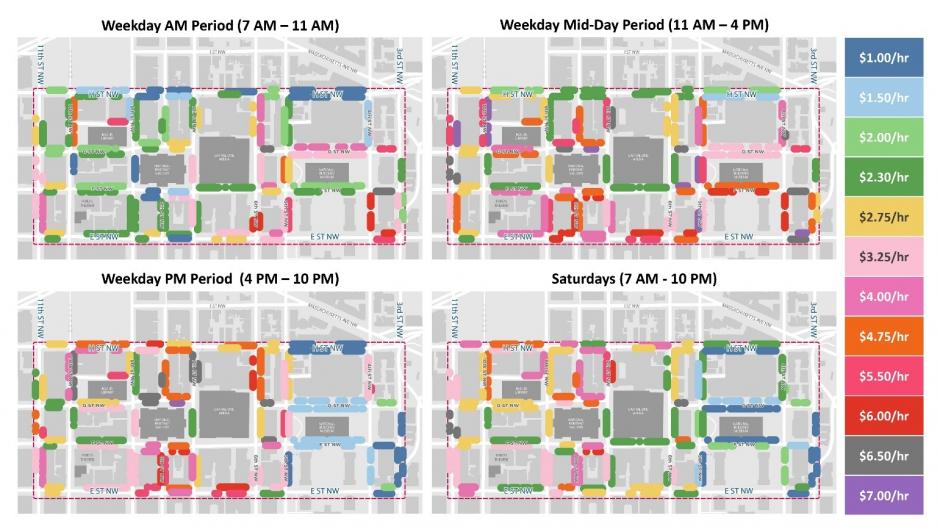
Starting August 5, the prices will range from $1 to $7 an hour depending on the spot and time of day. In 2015, the max price per hour was $2.75.
WAMU’s Jonathan Wilson spoke with District Department of Transportation Director Jeff Marootian about the program.
When and where will we see peak pricing?
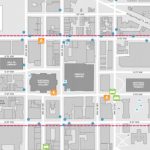
As anyone who has parked in the city knows, most meters are not part of demand-based pricing — only 1,300 in a 93-block area of Chinatown and Penn Quarter (see map below).
“The nature of the rate changes dynamically,” Marootian says. “And so some blocks at certain peak periods during the day will change based on that demand.”
For drivers scoping out pricing, the ParkDC app gives live updates.
Does demand parking make the price too high? Or is it already too low?
For people used to cheaper spaces, $7 an hour might seem like a lot to pay. But many urbanists say that’s almost nothing, considering drivers are borrowing a plot of space in the downtown of a major American city.
“We’re at a point now where the nature of our curbside is changing considerably, and the demand for that use is changing considerably. And so we’re doing all the things that we can, really, to ensure the safety in the efficiency of our roadways,” Marootian says.
“We’ve heard a lot of positive feedback about many of the approaches, not just demand parking,” he adds.
Why adjust parking prices?
“There is a challenge of people circling blocks consistently having to look for parking spaces, while just a few blocks away, there’s available parking spaces,” Marootian says. And the demand parking model tries to ensure at least one space stays open on a block at all times.
“This, for us, is about safety, reducing the incidents of people needing to circle blocks in order to find parking,” Marootian says.
Why does the maximum price keep changing? And how does the city determine how much to charge?
This is the third time in the last year the maximum price has changed. Marootian says D.C.’s model is the same as in many other cities. And DDOT says the changes have helped keep spaces available.
“It’s worth noting that in some locations, prices will actually go down based on demand as well,” he adds.
Is there a ceiling that prices can reach?
The law around the pilot for demand parking allowed DDOT to change the price every three months, but the program can’t go above an $8 an hour cap.
DDOT did an evaluation of the program earlier this year. What did it find?
“What we found is that this type of approach actually works to help reduce the incidents of people needing to circle the blocks to find parking. It also leads to what we think are important safety outcomes,” Marootian says. “What we want to try to avoid is people double parking and blocking bike lanes and crosswalks because they can’t find a parking space.”
The pilot has gone on for four years now. What comes next?
Marootian says DDOT is considering other places where dynamic pricing might be effective, and the department will continue to update the public as it looks to expand the concept.
This story originally appeared on WAMU.