Martin Austermuhle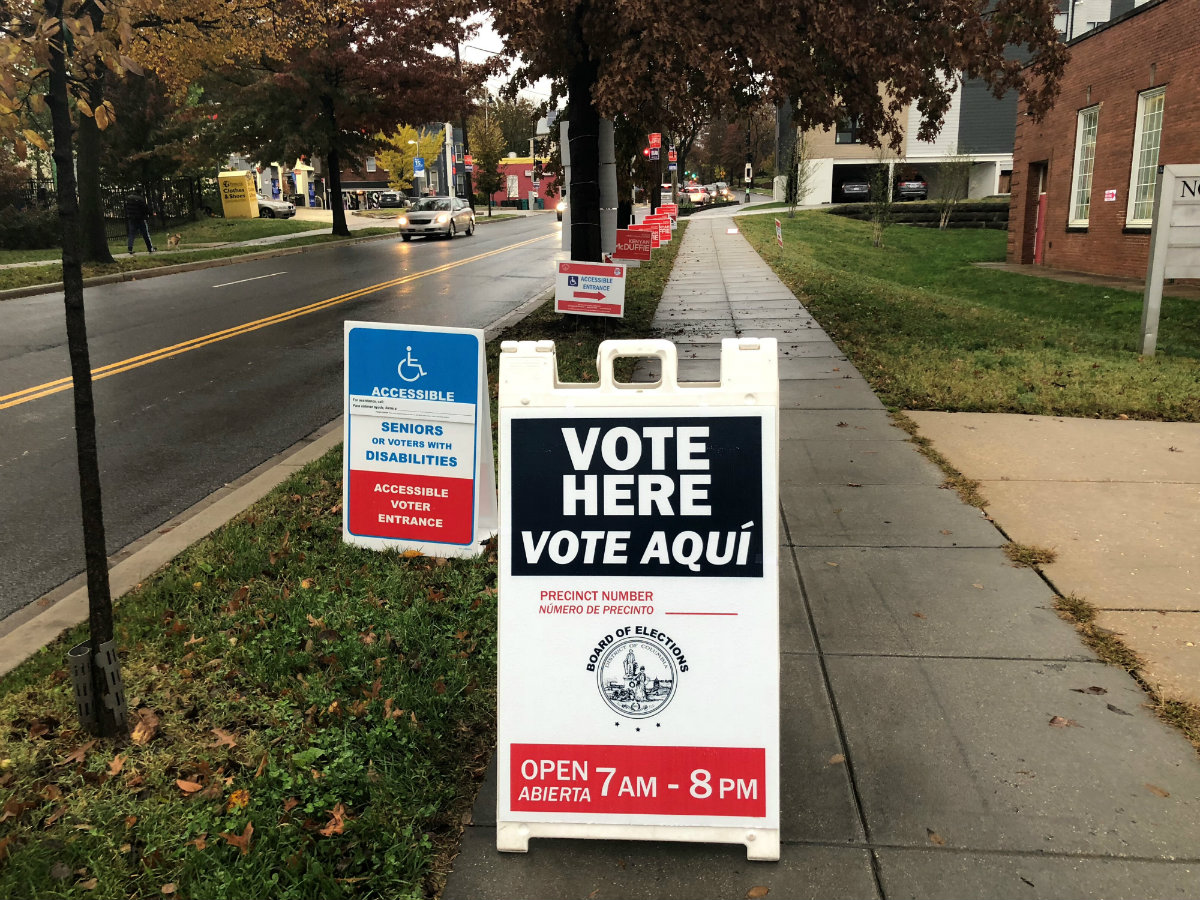
When Janeese Lewis George announced earlier this month that she would challenge D.C. Councilmember Brandon Todd (D-Ward 4) in next June’s Democratic primary, she knew she would face an uphill battle. According to his first campaign finance filing, Todd, a prodigious fundraiser and two-time incumbent, took in $180,000 in two months.
But George, a former assistant D.C. attorney general, now has a way to catch up: public money. This is the first election cycle since the D.C. Council approved a new program that offers public funds to candidates for office who swear off big-dollar contributions. Once a candidate qualifies for the Fair Elections Program, every $50 contribution from a D.C. resident is matched with $250 in public funds.
For George, public financing could turn an initial haul of $5,000 from 150 D.C. residents into more than $65,000 in matching funds, plus a $20,000 base payment for qualifying for the program.
“Fair Elections is allowing for more candidates who are representative of the city and from all different backgrounds to have a fighting chance,” George says. “Shirley Chisholm said, ‘If they don’t give you a seat at the table, bring a folding chair.’ And I think Fair Elections gives more people the opportunity to bring a folding chair to the table.”
And the number of folding chairs is growing. More than a half-dozen candidates have already announced they’re running for the D.C. Council, many of them for the first time. And while in the past many of those hopefuls would have been quickly out-raised by incumbents, they say the Fair Elections program can help close the gap (the Office of Campaign Finance has been working out some of the kinks of administering the program in real time).
For his re-election campaign, Todd says he opted against taking public financing because of his experience navigating the city’s budget.
“When you literally have to scrape together $300,000 to support a program in the government, what that tells me is that public dollars are precious,” he says. “When we’re making these really tough budget decisions, I did not think the best way to use those public dollars would be to run my campaign.”
The budget for the Fair Elections program for the 2020 election cycle is $3.2 million, but it’s expected to increase for the 2022 cycle since more offices—including the mayor and Council chairman—will be on the ballot. If this election and races in other jurisdictions are any indication, those races may draw a number of first-time candidates to run.
Just over two-dozen states, counties and cities currently have public financing programs for elections. That includes Maryland, which has offered matching funds to candidates for governor and lieutenant government since 1974. (Gov. Larry Hogan used the program when he first ran in 2014, but not for his re-election campaign.) And various local counties have adopted their own programs, including Montgomery County, which first gave matching public funds to candidates during the 2018 election cycle.
“It changes how candidates run for office by changing the incentives that drive candidate behavior,” says Phil Andrews, a former member of the Montgomery County Council and author of the bill that created the public financing program there. “And that’s what a public financing system has to do, that’s what Montgomery County’s system does by enabling candidates to leverage a substantial and sufficient amount of public finds to run their campaigns in exchange for not accepting any contributions from interest groups and large donors.”
In D.C., supporters of the Fair Elections program say public financing will help take on businesses, lobbyists, and well-heeled individuals who support incumbents with maximum contributions. (In Todd’s case, 75 percent of his contributors gave the max allowable limit of $500.) And that can chip away at allegations of pay-to-play in city politics.
That’s become particularly relevant in the race for the Ward 2 seat Councilmember Jack Evans has held for 28 years. Faced with federal and local investigations into allegations of influence-peddling, Evans is already facing five challengers—all of whom say they are participating in the Fair Elections program. The last time someone took on Evans was in 2008; the challenger raised $50,000 to the incumbent’s $600,000.
Patrick Kennedy, an ANC commissioner in Foggy Bottom, is one of those challengers. He has raised just over $12,000 for his campaign, $8,500 of which came from D.C. residents. But when his existing small-donor local donations are matched and he gets the base payment, he estimates he’ll have more than $75,000 to work with.
“I want to be somebody who’s accountable to small donors, to individuals, to people who live in the ward, people who are rooted in the community. And those people are not necessarily the types who can give a max $500 contribution. But many of them, most of them, can give $50. And the fact that that turns into $300, it just completely changes the game, it completely changes the paradigm of local elections,” he says.
“The most important person for a campaign like ours is an individual D.C. resident who cares about their local government. It’s not the same old insiders, it’s not big, wealthy corporate contributors,” says Jordan Grossman, another first-time candidate challenging Evans in Ward 2. (The three other challengers include Kishan Putta, John Fanning, and Daniel Hernandez.)
In Ward 7, ANC commissioner Lorenzo Green is challenging Councilmember Vincent Gray, and says he will do so using public financing. In an At-Large race, Councilmember Robert White has filed for re-election, but he will not be using the public financing program—but says he will not accept contributions from corporations, either.
Nationally, supporters of public financing say it is increasingly important in the wake of the 2010 Supreme Court case that opened the floodgates for largely unlimited independent expenditures on elections by corporations.
“Small-donor public financing is the best available answer to the Citizens United problem and really puts elections back in the hands of the people who are going to be represented by people running for office,” says Chisun Lee, an expert in elections and public financing at the Brennan Center for Law.
One potential effect of public financing is that it will not only diversify the pool of candidates, but also contributors. In 2016, a report from the progressive think tank Demos found that most campaign dollars in local elections were coming from contributors who are white, male, and high-income.
“The program has increased participation in elections and election financing by a much more diverse array of donors and candidates,” Lee says about New York City’s public financing program, which has been in place since 1988. “Participation rates are really high among candidates. It’s become part of the culture of running for office in New York City.”
Aside from Todd’s assessment that public money could be saved for other programs, there have been other criticisms of public financing. George Leventhal, who used public funds to run his unsuccessful campaign for Montgomery County Chair, wrote in the Washington Post that the $150 limit on individual contributions was too low and didn’t create as diverse a pool of candidates as proponents claimed it would.
But Andrews says otherwise, arguing that a broad range of candidates—Democrats and Republicans—used public financing, as did six of the nine winning candidates for County Council and the County Executive.
“It enabled more people to run viable grassroots campaigns. It reduced the influence of interest groups because candidates can now run for office without any funding from interest groups and we saw a lot of people do that,” he says. “The proof was in the pudding there.”
This story originally appeared on WAMU.