Natalie Delgadillo
In July, The Metropolitan Transit Authority announced that it was close to fixing its chronically broken cooling systems at Dupont Circle, Farragut North, and Union Station.
It succeeded on one of those counts: By late July, the chiller at Union Station was back online. Per a spokesperson’s statement to DCist at the time, the other two stations, which share a chiller, should have been fixed by late July or early August.
That didn’t happen. And on Thursday, Metro announced that new complications had arisen and it didn’t have a true estimate of when it might be able to fix the chiller at Dupont and Farragut North, which has been broken for four years.
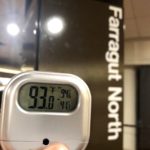
During last month’s heatwave, when the chillers were still out of commission at Dupont and Farragut North, the temperature inside the two stations was around 93 degrees.
None of Metro’s stations have actual air conditioning installed, as the architecture of the tunnels makes it impossible to cool the air down that way. Instead, it has a cooling system that functions via cold water, chilled at a chilling plant and then run through pipes that produce chilled air, which is then pumped into the station. Thanks to aging pipes with leaks and other issues, the system hasn’t been able to move chilled water from the chilling plant to the Dupont and Farragut North Metro stations since 2015.
Earlier this week, contractors completing the repair work finished installing new pipes underneath Connecticut Avenue NW, per a press release from Metro. The pipes passed hydrostatic tests, but the tests also revealed leaks within the chiller plant itself (which only services Dupont and Farragut North), Metro says. Crews now have to assess and repair those leaks, which will require the demolition of a concrete wall, per the transit agency. Thus, “we do not yet know the extent of the problem and are not able to report the impact on the project schedule,” according to the release.
Once all the repairs are in place, the agency will have to run several days of leak testing, and then it’ll be another another 3-4 day preparation process before the system is back online. After that, because of warm air entering the stations through the entrances, it will take several days for the chillers to reduce the temperature to their full potential (generally about six degrees), per Metro.
“Our goal remains to restore chiller service to the stations as soon as possible, including having crews working around the clock if necessary. Metro will update customers when we have confidence in a restoration date,” the agency writes in the release. “Metro apologizes for the unanticipated delays associated with this project, many of them due to the unique configuration of the Dupont/Farragut chiller system, Metro’s oldest, where the chiller plant and cooling tower are both located off Metro property and some distance from the stations. We are as frustrated with the pace of progress as many of our customers, and we will continue to take every opportunity to expedite the repairs.”