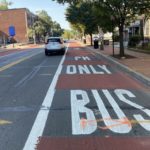
A little over a week ago, Mark Sussman, co-founder of How’s My Driving—a crowd sourced parking and traffic violation tracking app—got an email from one of the app’s users. The person was excited about the dedicated bus lanes along H and I streets that the city is piloting for the summer, but felt that the lanes were getting clogged up with vehicles that shouldn’t be in them.
That message led to Wednesday’s day-long “Data-Informed Bus Lane Blitz,” with 30 volunteers (including the user that emailed Sussman) monitoring portions of the bus lanes for violations during the morning and afternoon hours, when the regulations are in effect. The volunteers recorded nearly 300 violations in a day.
The bus lane pilot project, which kicked off in early June and is slated to run through late September, limits a stretch of right-side curb lanes along H and I Streets to buses, along with right-turning vehicles, bicycles, charter buses, school buses, and marked taxis. The temporary bus lanes, which are demarcated with crimson red paint, are in effect from 7 a.m. to 9:30 a.m. and then again from 4 p.m. to 6:30 p.m.
“We’re hoping that [the Bus Lane Blitz] opens the eyes of city officials to what’s actually occurring in these bus lanes,” Sussman tells DCist. “We think the bus lanes are a huge improvement over what was there previously—which was nothing—but there are certainly things that can be done to make them better.”
The blitz, and more generally, the How’s My Driving app, are some of the many efforts that have cropped up recently pushing for better transportation infrastructure and planning in the city. In fact, this isn’t even the first blitz that Sussman has organized — in May, he partnered with bike advocates in the city to log bike lane violations for a day. And on any non-blitz day, Sussman’s app gets roughly 100 to 150 submissions per day and has logged just over 12,000 violations since launching in January. (Another “pop-up bus lane” along Rhode Island Avenue last year also suffered significant problems with enforcement and drivers breaking the rules, often parking their cars right in the lane).
Many of the people that signed up to collect the bus lane violation data tell Sussman that they wanted to volunteer because they are big supporters of D.C.’s bus system and want to see it improve. Sussman even said that they had a Metro Bus supervisor sign up to volunteer.
At this point, logging a bus lane violation in the app doesn’t necessarily mean that an actual citation will be given to the offending driver. In fact it probably won’t lead to any enforcement action at all — it’s more of a way to raise awareness about the violations and gather data about the nature of them.
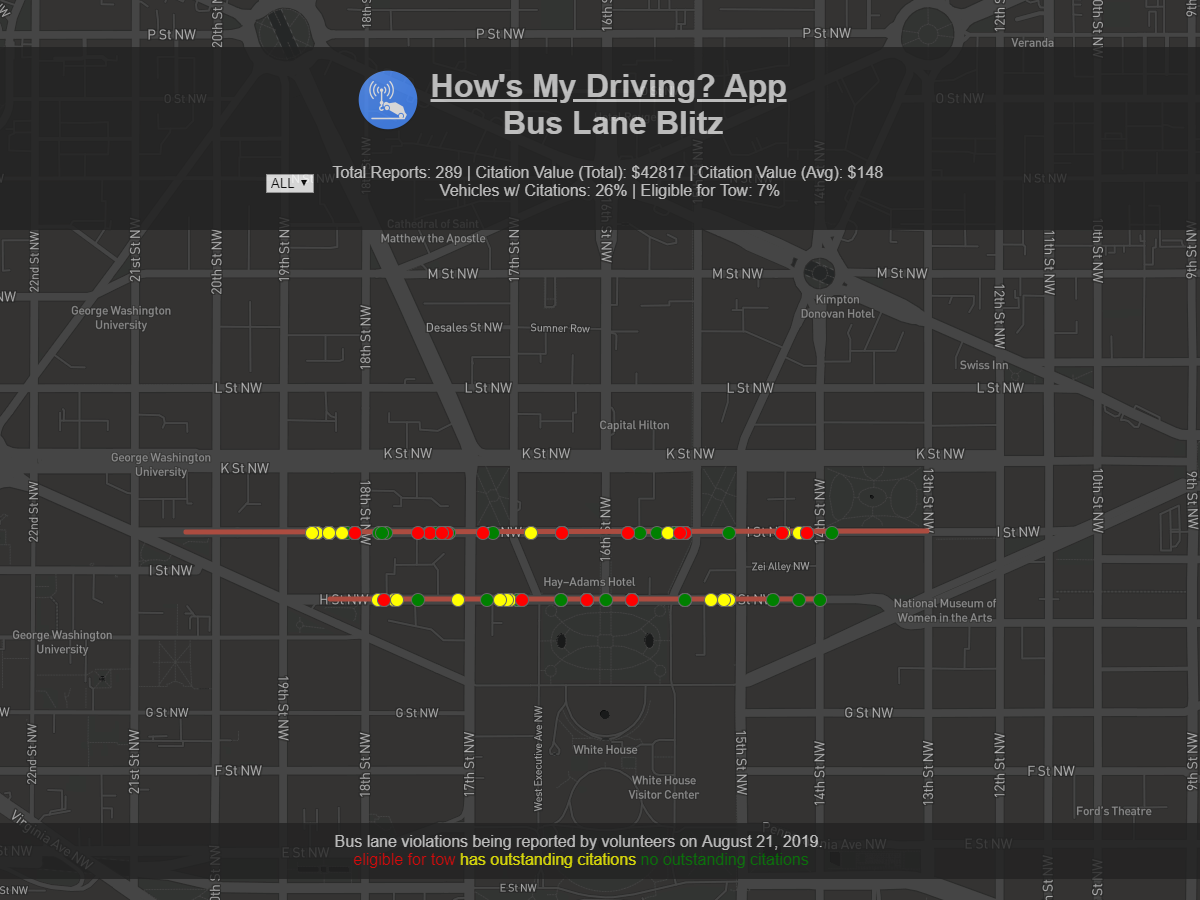
In total, the volunteers reported 289 violations, amounting to nearly $43,000 in citations, based on the app’s estimates. But Sussman says that this figure might be undercounting the actual number of violations. According to him, traffic along the corridor that the volunteers were tracking was a bit lighter than usual, based on his anecdotal experience. Plus, he points out that volunteers can only report one violation at a time, which may have allowed some to slip through the cracks.
Either way, Sussman says that it still offers a useful snapshot of how the bus lanes are actually functioning—information that he believes could be helpful for the District Department of Transportation in planning the future of the bus lanes.
“The goal is to get an understanding of what the problem is, but we’re not city planners,” he says. “Our ultimate goal is to be kind of this marriage of grassroots advocacy and working directly with cities to improve target enforcement and infrastructure building through data-driven evidence.”
Previously:
Dedicated Bus Lanes Are Coming To H And I Streets In Downtown D.C.
Advocates Logged Nearly 700 Vehicles Blocking Bike Lanes Over One Day