 Mikaela Lefrak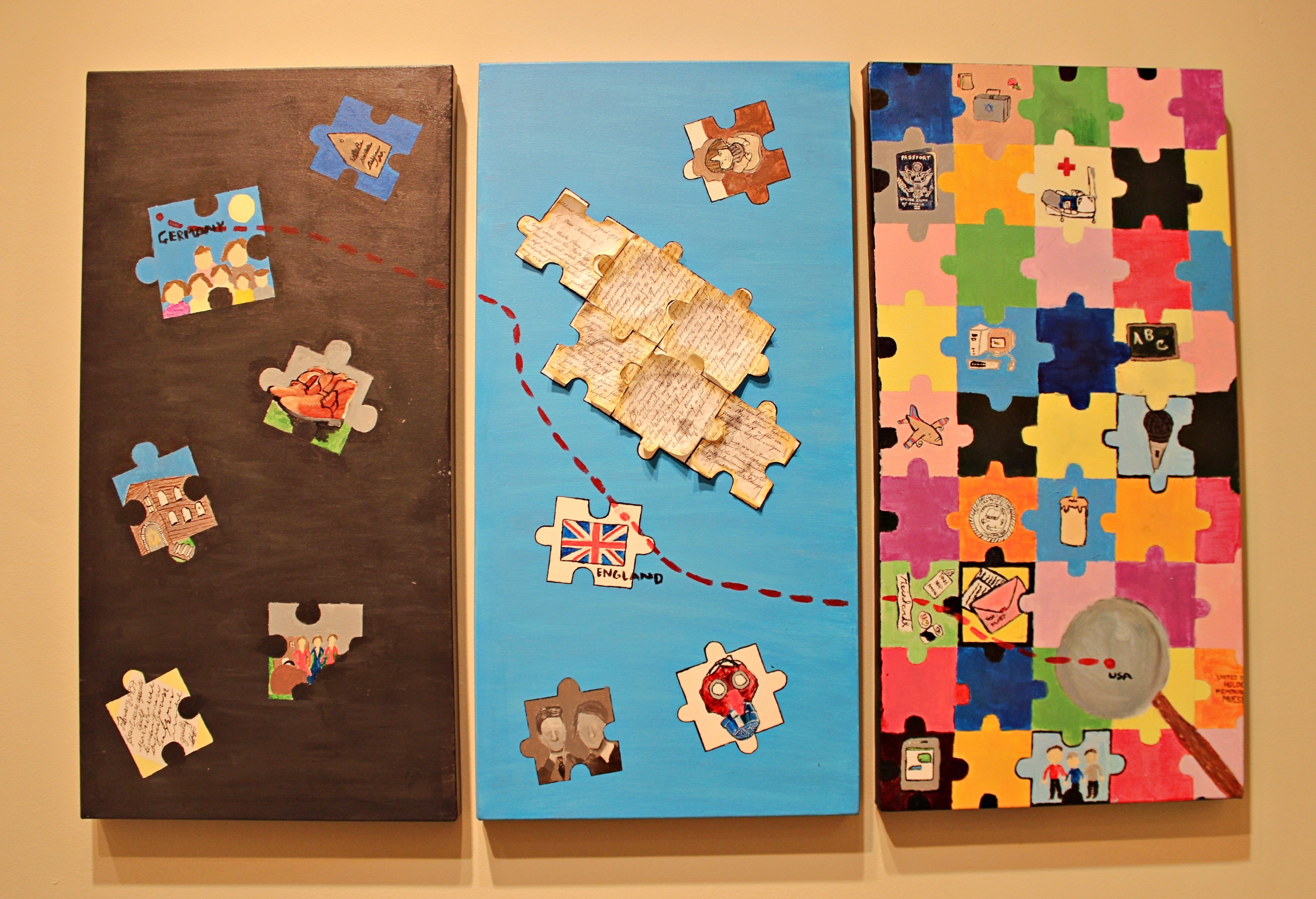
Holocaust survivor Halina Yasharoff Peabody studies a painting based on her life.
“That is in Poland before the war, and that’s my house,” she says, pointing to the first of three panels. The second shows her on the run with her mother and sister during the Holocaust, and in the third she’s with her sister in Haifa, Israel, after the war.
The panels were painted by a group of local high school students taking part in a U.S. Holocaust Memorial Museum program called “Bringing the Lessons Home.” The teens spend three-and-a-half months learning about the history of the Holocaust in Saturday classes, and training to become museum tour guides. They also spend a week interviewing survivors like Peabody and making art about their lives.
Peabody’s story of escape is a harrowing one—at one point, a bomb claimed two of her fingers—but she doesn’t mind retelling it. “Anytime you ask me to work with young people, I say yes,” she says. “It’s interesting to see how they see my story.”
As the number of survivors dwindles, the Holocaust Museum’s leadership has made it a priority to connect the survivors who volunteer there with young people. About 1,200 sophomores from D.C. public schools visit the museum each year as part of their world history curriculum.

A group of teenagers, including Alejandra Gibbs, made this piece based on the life of a Holocaust survivor.
Still, the Holocaust continues to fade from public consciousness. A 2018 survey commissioned by the Conference on Jewish Material Claims Against Germany found that 66 percent of millennials polled nationwide did not know that Auschwitz was a concentration camp. Twenty-two percent said they hadn’t heard of the Holocaust or weren’t sure if they’d heard of it—that’s twice the percentage of older adults who responded the same.
Alejanda Gibbs, 16, says she now knows way more about the Holocaust than her friends at school, who only receive a day or two of instruction on the genocide.
“Sometimes I talk to my friends, saying, ‘Oh I do this program at the Holocaust Museum,’ and then they ask me, ‘What is the Holocaust?’ ”
Gibbs worked with a survivor whose parents died during World War II. Gibbs says she didn’t feel nervous talking to the survivor because her tone and appearance reminded Gibbs of her own grandmother. She sees her participation in the program as a step towards ensuring that a similar genocide doesn’t happen again.
The teen program is run by James Fleming, an alumnus of the program’s inaugural year in 1994. The art they make is typically displayed in the Holocaust Museum and local synagogues; this year, for the first time, it’s on view at a gallery space outside the museum.
Another participant, Annalise Vezina, 15, spent about a month last year learning about World War II as part of her ninth grade curriculum. Still, she says, she doesn’t feel like they learned enough about the Holocaust.
“They’re so important and they’re not going to be around forever,” she says of the survivors she’s met through the museum. “We have to be sure to tell their stories.”
The exhibition runs through August 30 at the ArtReach GW Community Gallery at THEARC in Southeast D.C.
This story originally appeared on WAMU.