Elliot C. Williams
The day before the Fourth of July, the owners of Capitol Hill Books did something they always do: They tweeted something sarcastic. The difference between this tweet and their previous 8,000 was that this one went viral.
“Reminder: the best way to avoid MAGA tourists in DC this holiday weekend is to enter a bookstore,” the tweet read.
The response was immediate and unrelenting. Sure, there were more than 16,000 retweets and 89,000 likes, but many of the replies expressed frustration. One commenter: “Hey, let’s insult a large number of potential customers’ is a real marketing hot take.” Another: “I was a patron of your store all the time when I worked on the Hill. Is this insult the work of an intern, or does it represent your company policy? A suggestion: sell MAGA hats and see how fast they sell. Free market research. But can the slime, please.”
No, this was not the work of an intern, says Aaron Beckwith, one of the co-owners who took over the store last summer when longtime owner Jim Toole passed on the torch. “We’ve always thought of our store as more satirical than political,” Beckwith says. “And we make fun of everything, including ourselves.”
It’s true—the owners often fire off tweets from the store’s account aiming at everyone and everything from Kindle users, to lauded author Paulo Coelho, to Twitter itself. Most tweets, Beckwith says, follow the store’s tradition of being snarky. However, in today’s fraught political landscape, some of the store owners’ real-life actions have a more serious bent.
“Trump and the rise of Trumpism have changed the landscape for bookstores for sure,” Beckwith says. “It’s tough for us to just stand on the sidelines while women, minorities, and immigrants are demonized. So that’s what led us to a lot of things, like [when we] donated portions of our sales to places like RAICES, which provides legal services to underserved immigrant children, families, and refugees.”
This raises the question of what exactly the purpose of an independent bookstore should be, especially in a place like Washington where politics are ingrained in all aspects of life. In response to the Fourth of July tweet, one conservative columnist wrote, “One can hope the book store will drop the divisive politics and continue being a longtime D.C. go-to spot.”
But why should a store like Capitol Hill Books drop the politics? Beckwith says the tweet didn’t hurt its sales—if anything, it only increased business.
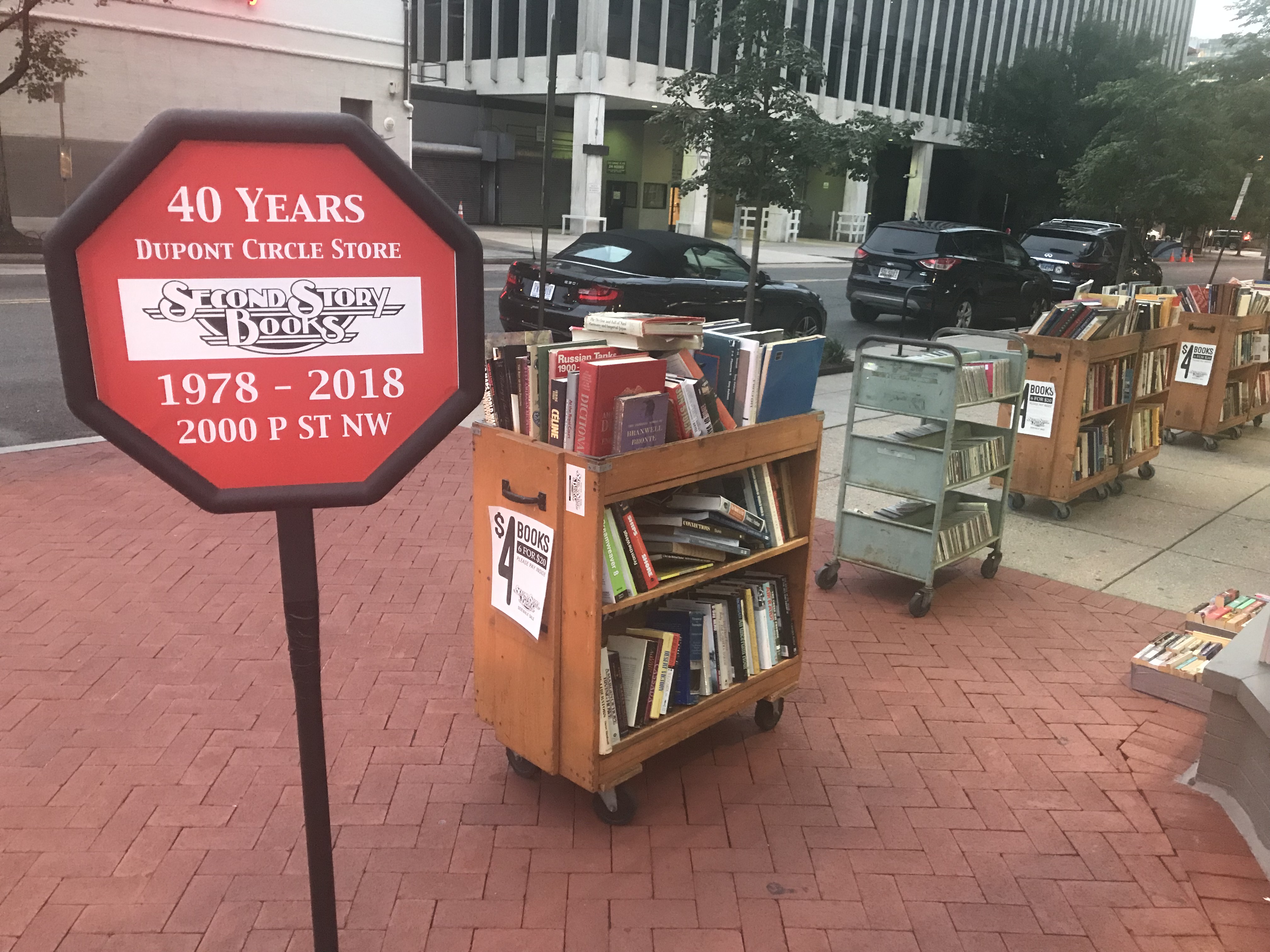
Still, it rubbed at least one of D.C.’s other independent bookstore owners the wrong way. Allan Stypeck, who owns Second Story Books in Dupont and Rockville, found the Capitol Hill Books tweet “quite offensive.”
He’s done appraising for Democrats and Republicans, several congressmen, and Supreme Court justices “for every administration since Nixon,” and says “the absurdity of that statement is infuriating to me. I just can’t believe they would lump every bookstore and say it’s off-limits to anyone who doesn’t agree with them.”
Beckwith says that wasn’t what the missive meant, though “it’s probably easy to misinterpret that tweet if you aren’t familiar with our Twitter account, where we poke fun at everyone including ourselves.” Indeed, under D.C.’s anti-discrimination law, it’s illegal to refuse entrance or service to people based on their political affiliation.
Stypeck reminiscences about the 1970s, when he would sit in the store with liberal writer I.F. Stone and right-wing commentator George Will to engage in good-natured political debates. “People would walk in the store and they would just engage in the conversation,” Stypeck says. “Which is what makes an indie a great place, because people can use the location as a platform of thought. I think a bookstore should be an arena where people don’t feel intimidated to speak their mind.”
There has been an independent bookstore boom in D.C. in recent years, which has coincided with a time in the city where consumer choices are more freighted than ever. When President Barack Obama visited what was then called Upshur Street Books (now rebranded as Loyalty Books) in 2015, the response in the heavily Democratic District was broadly celebratory. Compare that to Taylor Gourmet blaming its demise, at least in part, on a boycott in response to the owner meeting with President Donald Trump. (There are no reports of Trump having visited a local bookstore while in office.)
And bookstores have invariably had to deal with this divisive atmosphere.
Politics and Prose was caught off guard by a series of events this spring. First, leftist protesters shouted down former Department of Homeland Security Secretary Janet Napolitano during her book talk. Then, the store became embroiled in a debate about the Syrian Civil War. And at the end of April, another author event was interrupted by a group of white nationalists chanting “This land is our land.”
Store owner Bradley Graham, a bit reluctant to admit that his store could be the site of a changing political landscape, does say that his employees have undergone new training to prepare for similar events in the future.
“We just have no way of knowing if these demonstrations will happen again or not,” he says. “If they do happen, it will likely be author-specific.” Graham insists Politics and Prose is, and has always been, open to all customers, and that the store is “still intent on putting on author talks for writers of all political persuasions.”
But the politics of some D.C. bookstores are decidedly more local. Take, for instance, the organizers of the Charnice Milton Community Bookstore, who three years ago started giving away books on three carts outside We Act Radio’s studio in Anacostia. The bookstore, which operates as a nonprofit, is named after a D.C. native and journalist who was killed by a stray bullet in 2015 while coming home from a reporting assignment for Capital Community News.
To create the nonprofit, a teacher, who goes by the initials LJM, set out to create a sort of literary oasis and mold new readers south of the river. She enlisted the help of people like Kymone Freeman, the local activist who co-owns We Act Radio, and volunteer Virginia Spatz, a local journalist.
“There’s kind of this stigma that people in Ward 8 don’t read, or that people who come through there couldn’t care less. But the first day we put the bookshelves out there, it was like a magnet,” Spatz says. “We’re trying to make an organic thing with the neighborhood. We’re trying to meet people where they are, which is either on the street or at an event, because they do want them. It’s just, the whole bookstore vibe doesn’t work for everybody.”
On the CMCB Facebook page, there is a video in which Freeman identifies the books he wants to see in the store (by authors like Toni Morrison and Howard Zinn) and books he doesn’t want (by Clarence Thomas and T.D. Jakes). The store does not accept religious books or outright conservative books—We Act Radio is a progressive-leaning media outlet, after all.
Spatz says that with more customized bookstores popping up every year—like Mahogany Books in Anacostia, which primarily sells books by black authors—there will soon be a plethora of options for readers who hunt for specific titles and topics. One can perhaps imagine, for example, the opening of a conservative bookstore in D.C. (no one I interviewed could name a D.C. bookstore geared towards conservatives).
Recently, the Charnice Milton Community Bookstore partnered with the Busboys and Poets that opened a few blocks away in March, which sells used books in a designated section to help fund the project. The organizers say this is a model other communities can use to attract readers who might not be comfortable purchasing new, often expensive, books.
And even that new Busboys and Poets faced criticism that its arrival in Anacostia would quicken gentrification in the neighborhood. (A decade ago, UrbanTurf wrote that the bookstore/restaurant “has become an institution in the zip codes where it has opened, and its arrival has been credited with invigorating neighborhoods that were once down on their luck.”)
In March, owner Andy Shallal disagreed that neighborhood changes were directly attributable to his establishment. He told DCist at the time that “the displacement doesn’t happen because of a restaurant, it happens because government policies don’t take into account the impact of the market. Our government has to take into account the inevitable parts of the change and put things in place to prevent those changes from happening.”
Shallal himself is no stranger to politics. He was a candidate for D.C. mayor in 2014, calling for, among other things, more community gathering spaces.
For store owners like Stypeck of Second Story Books, the independent bookstore will always represent a place of free thinking and community engagement. “I think that’s what makes an indie bookstore so different,” he says. “People come into an indie, and I don’t think they come into the store to buy sometimes. They come in the store to be involved with the culture of the people in the store.”
And for a general champion of literacy and community like Spatz of CMCB, independent bookstores represent a place where readers can rise above their differences.
“What I think independent bookstores should represent at their best is a kind of connection between what’s on people’s minds already and what can be on their minds if they are able to share their thoughts with each other,” she says. “People once said bookstores were gone, but they’re coming back because people need them.”
This story has been updated to clarify the timeline of Capitol Hill Books’ co-owners taking ownership of the store.