If Karen Collins doesn’t get to the Thrive DC computer lab right when sign-ups open in the morning, she says she will probably have to wait until the next day to use one of the six publicly available desktops.
“I see a lot of people use this computer room,” she says. “A lot of people.”
Collins has experienced homelessness in the past and is presently living in transitional housing as part of a six-month reentry program for returning citizens. She uses the lab at Thrive DC, a non-profit that provides services to people experiencing homelessness or in vulnerable situations, “pretty much everyday.” She describes the internet as “an absolute necessity.”
“In order to be able to find jobs, to find housing, to find people who might even help you find housing—you need to be able to utilize computers,” Collins says.
But nearly 50 percent of people making $25,000 or less per year don’t have internet access, according to a 2016 U.S. Census Bureau report on computer and internet use.
Mariah Cowsert, Thrive DC’s communications coordinator, says many of the people who frequent the lab use it to contact family members, to stay up to date with news, and to search for information about things like what their legal rights are or the location of the nearest cooling center.
It’s one of at least 80 locations around the city where people experiencing homelessness or housing instability can freely access the internet. Other locations include public libraries, recreation centers, senior wellness centers, area nonprofits, and a small number of faith-based institutions.
Thrive DC’s lab only requires potential users to provide their name, “or a name if you’re not comfortable sharing that,” Cowsert says.
Jessica Chavez, the program services coordinator at the non-profit says that they’ve adopted this policy to make it as easy as possible for anyone to make use of the services, especially “if someone isn’t able to have a library card, is barred from the library, or is running away from a certain situation and isn’t comfortable disclosing their personal information.”
But it’s common for people who use the Thrive DC lab to also turn to the DC Public Library system for similar computer and technology services, especially the Mount Pleasant library, which is closest to the nonprofit.
Almost all DCPL branches offer computers with internet access and wi-fi to library cardholders. While this can be a barrier to access, since a permanent library card requires proof of address, DCPL runs a number of programs to ensure that cards are attainable for folks experiencing homelessness.
The system’s Department of Outreach and Inclusion offers assistance with computer access, gaining a library card, writing a resume, and other services. The department was established two years ago, after Martin Luther King Library—the flagship library branch that was often frequented by D.C. residents experiencing homelessness–closed for renovations.
The services that they provide don’t actually take place at a library branch, though, according to Tracy Sumler, who leads the seven-person team. “If they can’t get to the library, the library can come to them,” she says.
They often partner with various organizations working toward similar goals, including the new Downtown Day Services center, which opened in February. In addition to a variety of other services, the center offers computer access.
Library staff with the Department of Outreach and Inclusion come by every Monday from 2-4 p.m. to help. “If you want a library card, we get them library cards; we promote our online services … we try to do some computer classes,” Sumler explains.
She says they also offer one-on-one technology assistance if there’s a need for it.“If someone says, ‘I’m having issues getting email on my phone, or I don’t understand how I can set up an email’ — because you basically need an email for almost anything now — staff will be able to sit with them and walk them through step-by-step to get that email.”
Another DCPL program can be even more personal. Peer Outreach specialists, who each have had experiences with homelessness themselves, work with library patrons directly.
Over the span of a few months, Daniel Robinson says he got an email address, a phone, a job, a housing voucher, and, eventually, an apartment with the help of his specialist, Ellery Lampkin. Robinson believes he’d still be experiencing homelessness without Lampkin’s assistance.
For his part. Lampkin explains that getting Robinson internet access was an important aspect of their work. The services offered by DCPL, he says, allow folks experiencing homelessness “to go onto the computers, to go online, to look for jobs…. Or if they have a voucher but do not have an apartment, they can go online and look for an apartment as well.” And they don’t have to navigate everything alone, either. “You have about five peers inside the library that can help, along with the librarians.”
Other governmental resources for D.C. residents experiencing homelessness include the computer labs available at 33 recreation centers run by the Department of Parks & Recreation (patrons are only required to provide their name to use the facilities) and the Department of Aging and Community Living’s six senior wellness, which each have with computer labs (they accept shelter IDs and/or verification of one’s D.C. residency from a case manager).
And the city’s ConnectDC initiative, which is run out of the Office of the Chief Technology Officer, works to expand internet and computer access to the city’s most vulnerable residents. Among the programs is a Mobile Tech Lab, a 48-foot converted bookmobile with public computers on board.
People experiencing homelessness increasingly access the internet through smartphones, and there have also been legislative efforts to expand access to free-public wi-fi. At a public hearing in 2017 for one of those measures, Councilmember Brandon Todd called free, public wi-fi “a matter of economic equality.”
There are at least 69 brick-and-mortar locations offering free public wi-fi, mostly public libraries and recreation centers, while DC-Net, a program aimed at helping bridge the city’s digital divides, has also installed more than 600 wi-fi hotspots throughout the city.
But while smartphones might be allowing more people experiencing homelessness to get online, they don’t always provide the same benefits that a desktop or laptop does, says Yvette Scorse, the communications director at Byte Back, a nonprofit that offers technology training and certification courses to adults. In 2018, 31 percent of students in the Byte Back program were experiencing homelessness or housing instability when they registered for one of the nonprofit’s courses.
“Just handing someone internet doesn’t solve the whole puzzle,” Scorse says. “From a technical standpoint, just being able to fill out job applications on a smartphone is more challenging.”
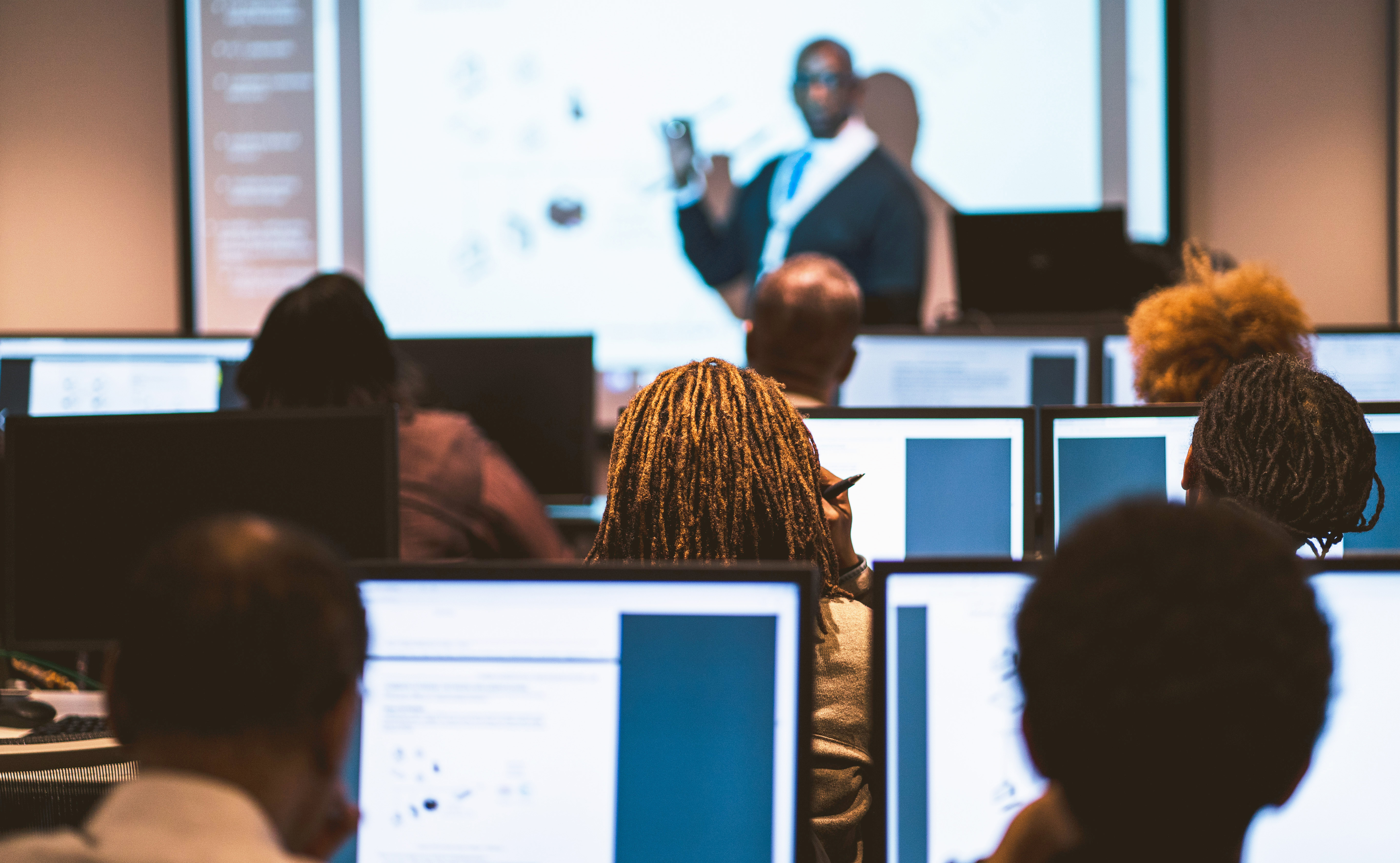
For Byte Back, training people on how to use technology is just as important as providing it in the first place.
“Jobs that require low-tech skills are disappearing,” she says, “and it’s only going to get more challenging to get work, to get out of the cycle of homelessness” without computer and technical skills.