Natalie Delgadillo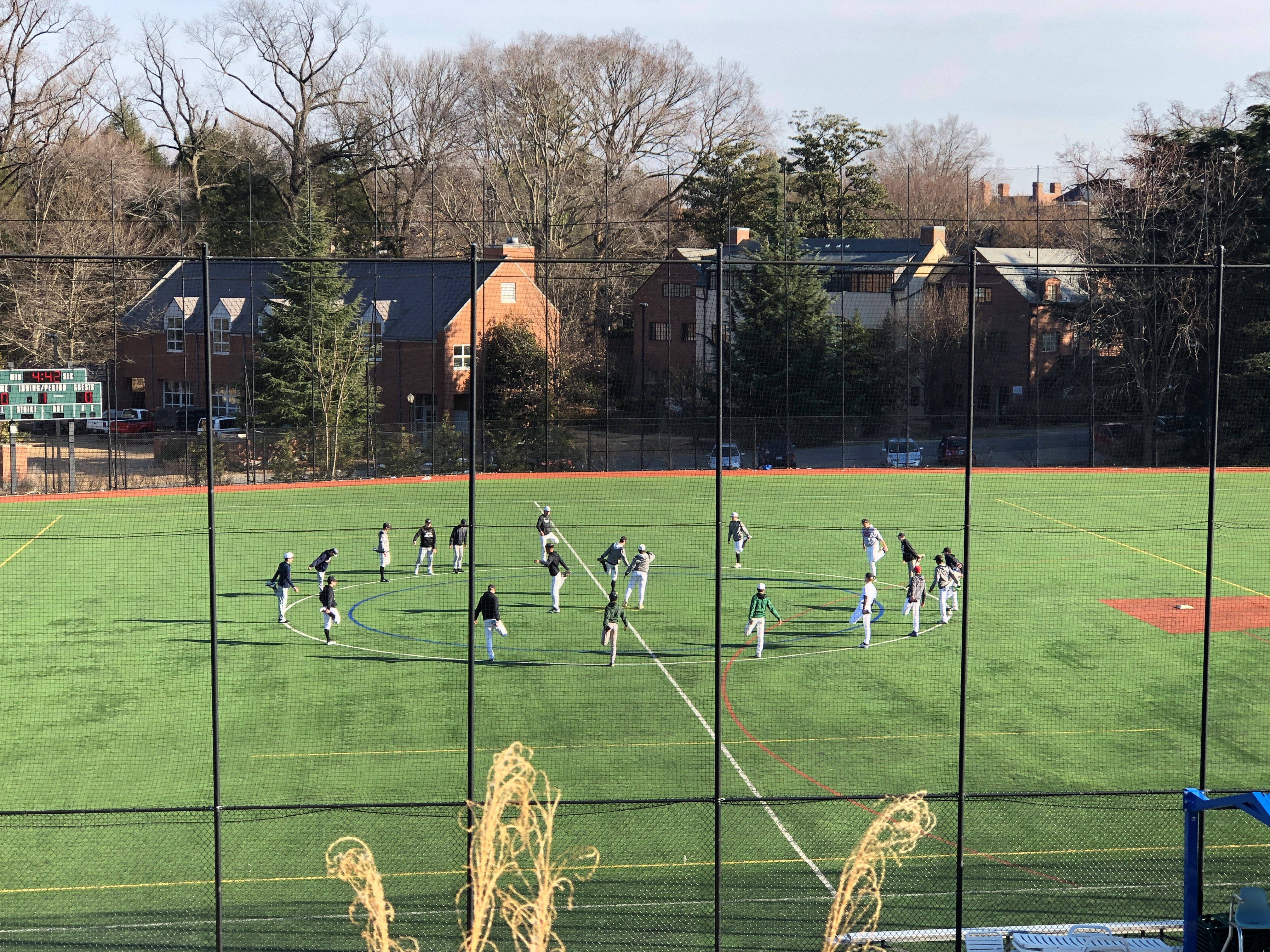
It’s been nearly ten years since the public has had regular, after school access to a city-owned field in Georgetown. And, as of now, it will be ten more before they have it again.
Jelleff Field is a coveted expanse of land—a regulation-size athletic field where teams can play soccer, lacrosse, and baseball. Public schools surround the artificial turf field, and a chapter of the Boys and Girls Club is hosted in the adjacent Jelleff Recreation Center.
But during some of the field’s most prized hours—directly after school, during the seasons when it’s neither too hot or too cold to play outdoor sports—none of those organizations can use it.
For ten years, the city has allowed Maret School, a nearby private school with an annual tuition that reaches nearly $40,000, to have exclusive use of the field every weekday in the spring and fall from about 3:30 p.m. to 5:30 p.m. (on Wednesdays, they start even earlier). The school has also been granted access to the field for four Saturdays during both the fall and spring, along with full-days during the two weeks before school starts in the fall.
It’s an unusual agreement, and one that a number of school and community groups believe is unfair to the public. The hours for virtually all youth sports and after-school programs overlap with the window during which Maret has exclusive use of the field.
Typically, the Department of Parks & Recreation doles out permits for fields without preference for one group over another, and there are a rotating cast of youth sports teams and other organizations playing games or having practices in any given space. But in 2010, DPR and Maret struck a special deal: in exchange for use during prime times, Maret would spend $2.4 million to renovate the field, which included putting down artificial turf, fixing up the swimming pool on site, and maintaining the facilities out of their own pocket.
From the start, the deal rubbed some neighbors the wrong way. Nearby ANCs passed resolutions against it at the time, calling it a backroom deal and a “no-bid contract.” Notwithstanding grumbles of discontent, the community did get some access to an amenity they didn’t previously have: Jelleff was largely unusable as an athletic field before Maret’s renovations.
“I admit they did a lot of work and a lot of people really appreciate the work they did 10 years ago,” says Bob Stowers, a branch director at the Boys and Girls Club of Greater Washington hosted in the Jelleff Recreation Center. “There are a lot of other users besides Maret on evenings and weekends. If you asked other people in the community if they appreciate what Maret did, most people that use the field would say yes.”
But Stowers tells DCist that he is not among those people. For the past decade, the roughly 100 kids at the Boys and Girls Club’s after-school program have largely been unable to use the field. Except when Maret students aren’t practicing, the kids are confined indoors. By 6 p.m. in the spring and fall, when the field becomes available for public use, most of the kids have already been picked up and gone home, Stowers says. In the summer and winter, when Maret doesn’t have exclusive access, it’s often either too hot or too cold for the kids to play outside (“I don’t think our camp went out at all this summer because it’s just too hot,” he says.)
Kids on the BGC sports teams are generally unable to use the field to practice, Stowers says. They have to practice indoors in the gym or on fields further away.
Stowers and other members of the community have been waiting for Maret’s 10-year deal to expire in 2020 with no small amount of impatience. But they will likely have to get a lot more patient: in July, the city approved a nine-year extension of Maret’s contract. Sports teams for the private school will continue to get exclusive access to the field during their allotted times until 2029.
That is, unless neighbors’ opposition campaign is successful. Parents, local government officials, and organization heads are spearheading a number of measures to try to get the city to reverse its decision and give public school students a chance to use the field during Maret’s allotted times.
“The basic truth of the matter is that the hours that kids have available to use this field, it’s not available to them. It’s a basic issue of fairness,” says Kishan Putta, a Ward 2 ANC commissioner who is also challenging Councilmember Jack Evans in the Ward 2 race. “No one has a problem with Maret playing at a DPR park. All we’re asking is to share the facility. There is real injustice in this.”
The original contract always provided for the possibility of this nine-year extension, but it was never guaranteed. To help secure it, Maret has offered to spend $700,000 to put down new artificial turf and fix part of the field’s fencing, and up to $250,000 to help the city renovate the Recreation Center (a $7 million project whose budget has already been approved).
But that offer hasn’t moved some community members, who say the city is more than capable of paying for those renovations itself.
“They had a deal. It was a 10-year deal. The deal was done, there was no right to an extension,” says Elizabeth Miller, another ANC commissioner in Ward 2. “They are going to put in a replacement field and fix the fence, but honestly, D.C. can afford to do that, and in doing so they would be able to put more D.C. schoolchildren on the field. This is just not a good deal.”
Some of the kids who’ve been most affected by this deal attend nearby Hardy Middle School, a public school for children in grades 6-8. Hardy is a ball-throw away from Jelleff—kids on their way to and from its campus pass right by the field. But because of Maret’s deal with DPR, Hardy’s sports teams are unable to play their games there. In fact, student athletes often have to be taken out of class early to travel an hour in traffic to their “home” games at faraway fields.
“My kids spend an inordinate amount of time traveling on buses to play competitive home games,” says Marty Welles, the parent of three children at Hardy Middle. All of his kids play several sports, and their lack of access to Jelleff for practices and games has long gotten under his skin. Last year, each of his kids had between 18 and 20 excused absences entirely due to missing classes to travel to games, he says.
“We knew this contract was expiring in 2020, so more than a year in advance we started raising awareness that this contract was going to end and we didn’t want an extension. With anybody that would listen,” he says. Now that the city has signed the extension anyway, Welles has joined on with other locals trying to somehow reverse the decision.
Miller’s ANC passed a resolution this year asking DPR not to extend Maret’s contract. On May 8, there was a community meeting involving the local ANCs, Maret, DPR, and other nearby schools and organizations who want access to the field. Many (though not all) expressed dissatisfaction with Maret’s exclusive access to coveted field times.
But on July 19, DPR decided to extend the contract. Now, Miller, Putta, and other members of the community have launched a Change.org petition asking the city to “reverse this backroom deal, and to share the prime hours more equitably with the many public school students desperate to find a place to play, too.”
The petition has garnered over 850 signatures so far.
But DPR appears to be unmoved.
“We are proud to move forward investments that minimize costs to District tax payers and help Washington, DC remain the #1 parks system in the country,” DPR Director Delano Hunter said in a statement to DCist. “We will continue working with the community to ensure all residents enjoy these renovations for years to come.” The agency declined to answer follow-up questions about whether it would consider nixing the deal, and how it responds to community complaints about the general injustice of the setup.
But in emails that parents obtained via a Freedom of Information Act request, a DPR employee acknowledged that the optics of the deal “may come across as favoritism or unfair to residents or groups trying to permit space in after school or high demand times of the day.”
Maret, for its part, says the extension was an expected part of the school’s original deal.
“When Maret entered into this discussion, we originally were talking about a 20-year deal for $2 million plus. But the city said they wanted to make sure we were good partners and we would do what we said we were going to do,” says Maret head of school Marjo Talbott. So the city wrote the possibility of a nine-year extension into the contract, which Talbott says they were told to expect so long as they held up their part of the bargain. “I would say it would be very unfair not to give us this extension that was explicitly written out, given that we made an unusable field usable and have managed it very well.”
Playing fields like Jelleff’s are prize land in the District, where the density inherent to cities means there are often more children and youth sports teams than there are places for everyone to play. Conflicts around who gets to use these fields, and when, have become a sticking point in District neighborhoods.
Talbott says that Maret is interested in being neighborly—they know everyone wants to use the field during the times Maret has access, and the school will try to work out agreements to share the field on Wednesdays with nearby Hardy Middle School, as they did last year.
She says that use of the field during these times is “not a luxury” for Maret, but “a necessity for our programs.” Maret is a school of 650 students on a seven-acre campus. They have one athletic field already, but it’s not regulation-size, and the school’s soccer, lacrosse, and baseball teams cannot use it for games.
But community members have pointed out that Maret School and its students are already relatively wealthy and privileged in comparison with, say, the students attending the Boys and Girls Club’s after-school program. And 38 percent are not even D.C. residents.
“The [kids at the Boys and Girls Club] are not wealthy kids,” says Putta, the ANC commissioner. “These are kids from all over the District who need after-school care.”
It remains to be seen how far neighbors’ campaign will get them. In emails shared with DCist, Ward 2 Councilmember Jack Evans, who represents Georgetown, said that he “support[s] DPR in whatever decision they make.”
But they appear to be gaining some traction with at least with one member of the D.C. Council: on Friday morning, At-large Councilmember Elissa Silverman tweeted her disapproval of the deal and said she would be “asking our agencies to reverse this.”
Julie Depenbrock contributed reporting.