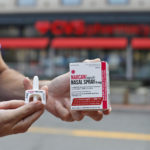
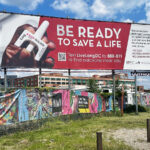
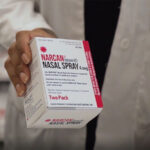
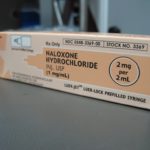
The overdose-reversing drug, Naloxone, will soon be available in all eight wards of D.C. for free. It’s part of the initiative, LIVE.LONG.DC., that Mayor Muriel Bowser introduced last year to address the opioid epidemic in the District.
According to a press release from DC Health, NARCAN (also known as naloxone HCI, an FDA-approved nasal form of the drug), will be available in several D.C. pharmacies starting August 31. It “works within minutes, requires no assembly, contains pre-measured dose, and is easy to use,” per the release. And although overdoses have been most prevalent in Wards 7 and 8, the participating pharmacies are located across the city:
- Morgan Pharmacy (3001 P Street NW)
- Grubbs Care Pharmacy NE (326 East Capitol Street NE)
- Grubbs Care Pharmacy NW (1517 17th Street NW)
- Grubbs Care Pharmacy SE (1800 Martin Luther King Jr. Avenue SE)
- Kalorama Pharmacy (1631 Kalorama Road NW)
- Good Care Pharmacy (2910 Martin Luther King Jr. Avenue SE)
- Excel Pharmacy (3923 S. Capitol Street SW)
- CVS #22 (320 40TH Street NE)
- CVS #1340 (845 Bladensburg Road NE)
- CVS #1354 (2601 Connecticut Avenue NW)
- CVS #1360 (2834 Alabama Avenue SE)
- CVS #1364 (6514 Georgia Avenue NW)
- CVS #2834 (3031 14TH Street NW)
- Safeway #1445 (2845 Alabama Avenue SE)
- Walgreens #15360 (801 7TH Street NW)
- Walgreens #16049 – Howard University Hospital (2041 Georgia Avenue NW)
- Giant #384 (1535 Alabama Avenue SE)
In addition, customers who fill an opioid prescription at one of the pharmacies will be given a NARCAN kit and will be taught how to use it. They’ll also receive information on addiction treatment and recovery from the pharmacist.
There were 279 opioid-related deaths in 2017, 213 in 2018, and 72 as of May 31 this year. And according to data from the Center for Disease Control, D.C. “had drug overdose death rates that were higher than the national rate (21.7 per 100,000)” in 2017, with an overdose rate of 44 per 100,000.
But an opioid overdose—from drugs such as heroin, fentanyl methadone, and morphine—can be treated with naloxone, and that can save someone’s life.
Bowser’s administration has faced criticism over its handling of opioid deaths in the city, which increased by 249 percent in D.C. from 2012 and 2017, per the CDC. In an about-face at the beginning of the year, the mayor said she would begin to equip police officers and community organizations with naloxone. This new pilot represents another part of a plan to combat the crisis.
“This pilot allows us to test and identify new channels of Narcan distribution as part of our commitment to combat the opioid epidemic,” said DCH director Dr. LaQuandra S. Nesbitt in a press release, calling it “a big step forward in Mayor Bowser’s plan to reduce opioid use and misuse and to reduce opioid-related deaths by 50 percent by 2020.”
Previously:
In About-Face, Bowser Announces Plan To Equip D.C. Police With Opioid Overdose Antidote
Bowser Releases Plan To Combat D.C.’s Opioid Crisis
D.C. Health Department Expands Access To Heroin Overdose Antidote Naloxone