Ally Schweitzer
The D.C. area must aggressively ramp up housing production between 2020 and 2030—and most of that housing must be affordable and located near transit.
That’s the substance of a nonbinding resolution adopted Wednesday by the board of the Metropolitan Washington Council of Governments, which represents elected officials from across the D.C. region. The board agreed during its September meeting to commit to a set of housing production targets for the District and suburban jurisdictions in Maryland and Virginia:
- Build at least 320,000 new units across the region between 2020 and 2030.
- Locate 75 percent or more of that new housing in an “activity center” or near mass transit.
- Ensure that at least 75 percent of the units are affordable to low- and middle-income households.
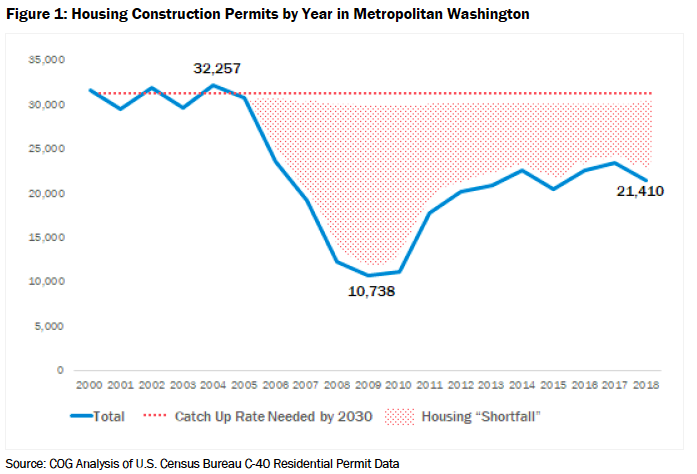
As of now, about 245,000 new housing units are forecast to be built in the region by 2030. The council proposes building 75,000 more homes on top of that to match the pace of job growth.
Economists, planners, affordable housing advocates, and some elected officials in the Washington area have said building more housing is one way among several to bring down overall housing prices, which have risen dramatically, in part due to a slowdown in new home construction following the recession.
“Housing affordability is inextricably linked to economic development opportunity, our transit system and taking care of the people that make up the workforce of tomorrow,” said Prince George’s County Council Member Derrick Davis, vice chair of the board, during a press briefing Wednesday. “We know that this is the tackle of the generation to come.”
Challenges To Building More Housing
Board members acknowledged there are significant hurdles to meeting the region’s current and projected housing needs. Much of the Washington area is zoned for single-family development, not for the multifamily buildings that are required to provide more affordable, transit-adjacent housing. The process of upzoning—or allowing for more density—routinely encounters fierce resistance from homeowners across the region.
“Us being the largest jurisdiction in Maryland, we struggle with this on a daily basis,” said Montgomery County Council President Nancy Navarro, citing the recent controversy over accessory apartments in the county.
Affordable-housing developers refer to other challenges, such as the high cost of land, bureaucratic delays, the rising price of labor and materials, a lack of public funding for subsidized housing, and intense competition from the luxury market. Meeting attendees also addressed the challenge of local governments working together, in a metropolitan area known more for intraregional competition than cooperation.
“We will be pushing each other,” said Board Chair Robert White Jr., a D.C. council member. “We’ve already started having conversations about how we pull the right groups together, how we put the right pressure and create the right tools for every part of the region.”
“It’s got to be all hands on deck,” added MWCOG Executive Director Chuck Bean.
Board members and advisors seemed to agree that not building enough housing — especially homes priced for low- to middle-income people — could worsen the economic and infrastructural toll over time.
“This is what is needed to attract and retain the future workforce that we have to have,” said Alexandria City Housing Director Helen McIlvaine, who co-chairs MWCOG’s Housing Directors Advisory Committee. “And people drive to affordability. If they can’t find it in Arlington or Alexandria, they’re going to have to go further and clog our roads further.”
This story originally appeared on WAMU.