Natalie Delgadillo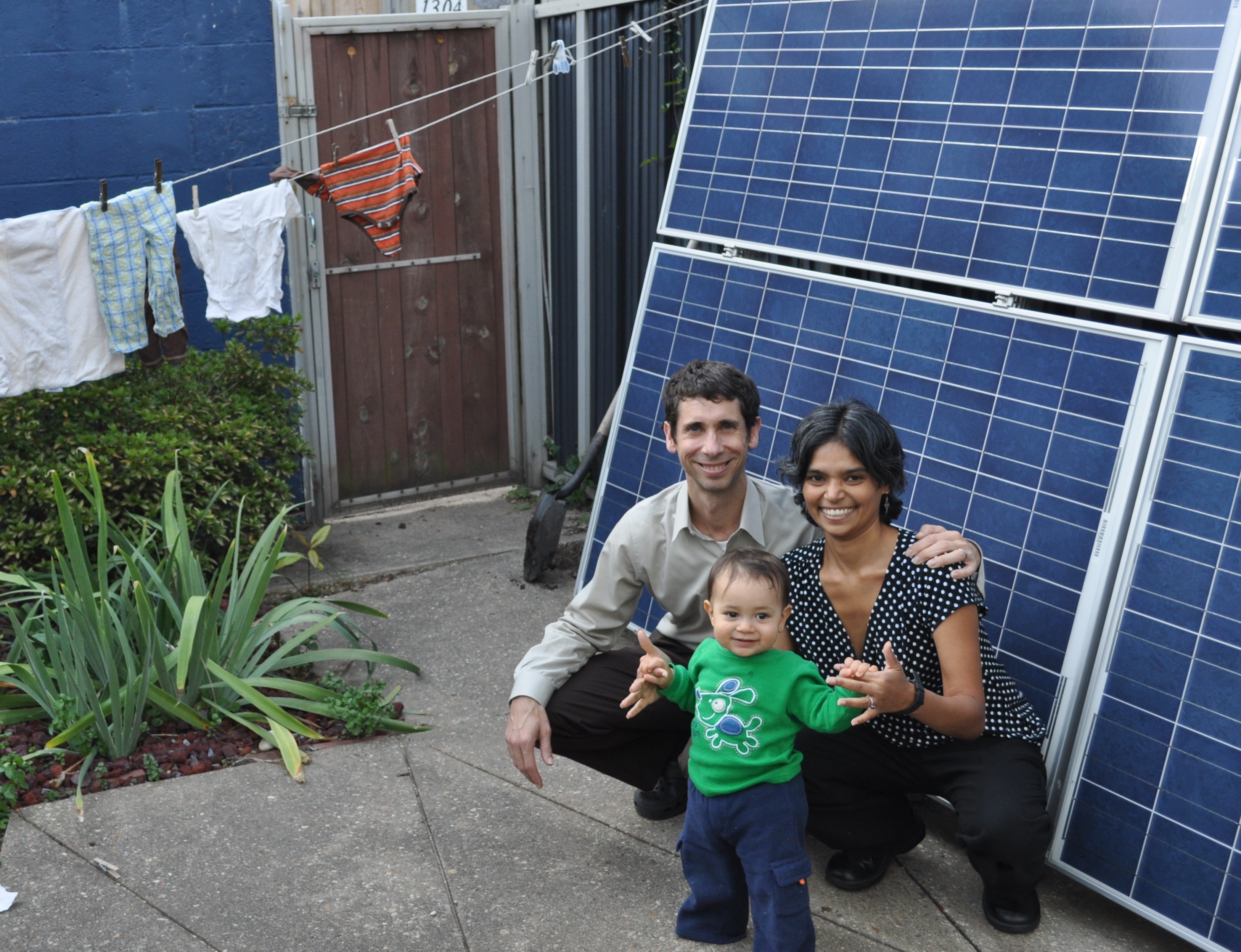
DCist is providing special coverage to climate issues this week as part of Covering Climate Now, a global collaboration of 250 news outlets designed to strengthen coverage of the climate story. Many of these stories originated as questions from our readers.
Keya Chatterjee was sick of paying $300 a month in electricity bills. After three years of arguing with Pepco, D.C.’s electric utility, about how on earth her small household could be consuming so much power (all to no avail), she made a decision.
“You can’t force me to buy your product,” Chatterjee says in a video produced by the Atlantic in 2016. “I don’t want it.”
And so she and her husband simply … stopped consuming electricity from Pepco. It was January 2009, and cold as January usually is in D.C. But the pair went through with it anyway, stuffing sleeping bags with hot water bottles at night to keep warm. Soon, they purchased four solar panels, which they propped up on the side of their home, carefully cutting down on their energy use so their panels could support their needs. And they’ve never looked back.
“[This] was sparked by a bad customer service experience with Pepco, but I was working at NASA and looking at the numbers in the climate science, so I knew we, as a society, needed to get off of dirty energy fast,” says Chatterjee, who is now the executive director at the U.S. Climate Action Network. “I wanted to be one of the first to live in the future I wanted.”
Chatterjee is trained as a scientist, and while she was working at NASA as a program officer in 2005, she became deeply concerned by climate projections on the melting of the polar ice caps. She began focusing her career on preventing and mitigating climate change.
Her concern, combined with the sky-high electricity bills, motivated her to make her home a bastion of energy efficiency and low waste. For about a decade now, she and her family have consumed little or no energy from the city’s electrical grid, and cut down on consumption and waste in a variety of other ways, composting and drastically limiting the packaging they bring into their home.
Chatterjee and her husband have lived in Ward 6 in D.C. for about 18 years, 16 of those in a co-op in Southwest. That’s where their adventure in renewable energy started, and where the Atlantic profiled Chatterjee in 2016.
But two years ago they moved with their son to their own home in Northeast, and a whole new era of energy-efficiency began. Before moving in, the family drastically re-engineered the home: They pulled all of the gas out of the house, which meant getting rid of the dryer, the stove, and the hot water heater. They took out the centralized heating and air conditioning, replacing them with mini splits (which they still only turn on when they have company). They put a five-gallon hot water heater near the shower, and another even smaller one under the sink in the kitchen (which they only ever use during the winter). They installed an induction stove, an array of 20 solar panels on the roof, and a battery for those solar panels in the backyard. They have a Lumin Smart Panel, which allows them to monitor their energy use and cut down on any areas of waste, and an ultra-efficient refrigerator common on boats.
“When we installed solar back in 2009, we were an early adopter. Now everyone is doing it,” Chatterjee says. “Now, in 2019, I wanted to be one of the first to get gas out of our house and be powered by all renewable, clean energy. I like figuring out how to make things work so that I know what I’m asking for when I’m demanding climate policy. Every time I make a change in our home, I want to make it easier for the next person by figuring out how to do it and where to go.”
It’s true that Chatterjee and her family are ahead of the curve. There aren’t a huge number of people yet who willingly do an array of things that Chatterjee and her family do with consistency, dedication, and discipline: They line dry all of their clothing, avoid taxis or ride-shares and opt to bike whenever possible, bring packaging along with them to takeout restaurants and ask staff to fill it up, unplug every appliance when it’s not in use (so even clocks aren’t using energy), buy in bulk and shop at farmer’s markets to avoid packaging, and eat a largely plant-based diet.
When her son, who’s now eight years old, was a baby, Chatterjee and her husband used cloth diapers when they were out, and a technique called elimination communication when they were home (basically, reading the baby’s cues and taking them to a toilet to use the restroom when you know they have to go). She even wrote a whole book on this subject, called The Zero Footprint Baby: How to Save the Planet While Raising a Healthy Baby.
At this point, she says, her lifestyle feels to her and her family like complete second nature. This is particularly true for her son, who has never lived in any other way. In more ways than one, Chatterjee says, his presence has actually made it easier for her and her husband to live environmentally conscious lives.
“I don’t know if this is true of all kids, but my kid is hyper-attuned to hypocrisy, and to parents violating the norms in our house,” she says. “So he very much is the person that polices all of this, and he’s far more strict than we are … even though this is something I work on for a living, I would say he really embodies it more.”
Just a few weeks ago, in fact, her son opted to bike 16 miles roundtrip to go to a LEGOLAND preview event in National Harbor rather than simply take a ride-share vehicle. “That is not something I would have done,” Chatterjee says, laughing.
Even though their lifestyle has become easy for her family over time, there have been plenty of failed experiments. Chatterjee used to have a bicycle that generated energy, and a solar oven, both of which ended up creating more work—so she simply got rid of those things. “Everything we do, we do because it fits well with our lifestyle,” Chatterjee says.
And she points out, not everything they do is all that uncommon in the District.
“In this country, it’s unusual to say ‘no I don’t have a car and I have solar panels on my house,'” Chatterjee says. “But I think it’s really amazing that in D.C., those things are not unusual.” Many people in D.C. bring their own containers to takeout restaurants, eat plant-based diets, don’t own cars, shop at farmers markets, she emphasizes. Her family is just “the first to get these latest gadgets.”
Since they moved to their new home, Chatterjee hasn’t had time to check whether they’re ever drawing any energy from the grid. Their setup allows them to draw energy from their battery first, but it’s possible they draw small amounts from the grid at night. Overall, however, their home produces far more energy for grid than it would ever draw.
“I used to keep a very close eye on this kind of thing. You know how some people count calories? I used to count kilowatts,” she says. “Now that we have all these practices in place, I just don’t look. I feel pretty confident.”
Her biggest advice for people who want to live lives a little closer to hers? “Just don’t have the thing you don’t want to use,” she says. “We don’t drive places because we don’t have a car. It creates an extra barrier and makes you aware of the cost. We don’t have a dryer, so if something is wet and it needs to be dry immediately we have to walk to the laundromat. Just don’t have the thing.”
If all this sounds hard, it’s easier than the long-run consequences of doing nothing, Chatterjee says. “For me, it’s an act of love,” she says. “Not just for my kid, but for all of our kids.”