Natalie Delgadillo
 Rachel Kurzius
 Rachel Sadon
We’ve got answers to all the questions you were afraid to ask about the District’s bid to become the 51st state.
The History
Historically speaking, why isn’t D.C. a state?
The short answer is: because the Constitution. Specifically Article 1, Section 8, Clause 17, which holds that “Congress shall have the Power To … exercise exclusive Legislation in all Cases whatsoever, over such District (not exceeding ten miles square) as may, by Cession of particular States, and the Acceptance of Congress, become the Seat of the Government of the United States.”
And so it was — after stints in New York and Philadelphia, the capital of the United States was carved out of parts of Maryland and Virginia, and D.C. was born. (The government gave Alexandria back to Virginia in 1846.)
The founding fathers’ rationale for this arrangement was to keep any state from having undue influence over the federal government
Want more? Read all about that rationale in James Madison’s Federalist 43.
How has D.C.’s self governance changed over time?
This is a doozy. Buckle up.
When the capital was moved to D.C. in 1800, the District was controlled by the federal government, and (in addition to having no voting Congressional representation) it had no votes in the Electoral College. But the people who lived there were able to vote for either Maryland or Virginia congressmen, depending which state used to own the land where they resided.
In 1801, Congress passed legislation dividing the District into two counties, Washington County on the Maryland side, where Maryland’s laws would govern residents, and Alexandria County on the other side, where Virginia’s laws would apply.
In 1802, citizens petitioned the government for a municipal charter. One was granted, along with a governing body called a council, that had the power to pass local laws and levy taxes. In this initial structure the mayor was appointed by the president, and then from 1812-1820, by executive council.
From 1820 to 1871, the mayor of the District was popularly elected. But in 1871, a new law reorganized D.C.’s political structure, putting a territorial governor at its head (appointed, of course, by the president). Governors, and then a three-person board of commissioners, governed the District until 1967, when Lyndon Johnson created a “mayor-commissioner” of the District and a nine-member council.
In 1961, the country ratified the 23rd Amendment to the Constitution, granting D.C. votes in the Electoral College. In 1968, the city elected its first Board of Education. In 1971, the District got its first-ever nonvoting delegate to Congress.
But it wasn’t until 1973 that the Home Rule Act was passed, enacting the governing structure still in place in D.C. today. The act gave D.C. the power to elect its own mayor and a 13-member council, which functions much like a legislature in any other state — with a few key exceptions.
The Home Rule Act still requires congressional sign-off on all of D.C.’s laws, and gives the federal government ultimate control of the District’s purse strings. The act also declined to give D.C. any voting representation in Congress, a fight which the mayor and D.C. Del. Eleanor Holmes Norton continue to this day.
In 1978, Congress actually passed a constitutional amendment granting D.C. voting representation in Congress (yep, you read that right). But amendments to the Constitution need 38 of the 50 states to ratify them before they’re approved. By the seven-year expiration date, only 16 states had ratified the amendment, and it failed.
Want more? Check out this history from the D.C. Council.
Didn’t the feds have to bail D.C. out at one point?
The financial control board, officially called the District of Columbia Financial Responsibility and Management Assistance Authority, was signed into law by President Bill Clinton in 1995 because D.C. was in deep financial trouble (think a $518 million deficit with its bonds at junk status). A similar route has been taken with other states and jurisdictions in the past — including, most recently, Puerto Rico. But losing its limited home rule after so recently gaining it was a harsh blow for the District government.
The five-member control board wrested control of the city’s daily operations from then-Mayor Marion Barry and the D.C. Council, making decisions about how and where to cut and spend.
The law establishing the board also established the role of a chief financial officer to help the city stay financially healthy.
The control board became dormant on Sept. 30, 2001, after the city submitted a balanced budget for four straight years, but the board could theoretically take control of matters if the city finds itself in another financial mess.
Want more? Read this Washington Post story from 10 years after the dissolution of the control board.
What part has racism played in D.C.’s disenfranchisement?
From the beginning, lawmakers opposed to statehood have implied — or directly said — that D.C. is incapable of governing itself, and they’ve couched those claims in racist ways.
After the government moved to strip D.C. of its local governance rights in the 1870s, Sen. John Tyler Morgan of Alabama, a former Confederate soldier, said that it had been done “to burn down the barn to get rid of the rats … the rats being the Negro population and the barn being the government of the District of Columbia.”
In 1972, by which point D.C. was more than 70 percent black, Rep. John Rarick of Louisiana said that D.C. was “a sinkhole, rat infested, the laughing stock of the free and Communist world.” He said that allowing the District to govern itself could result in a Black Muslim “takeover” of the capital, per news coverage at the time.
An advocacy group called Citizens United Against D.C. Statehood in the 1990s ran mailers that said D.C.’s Senator might embrace “Arab terrorists” or “Black Muslim hatemongers.”
More recently, lawmakers have “continued to assert old stereotypes about the District’s supposed inability to govern itself,” per the D.C. Attorney General’s Office.
Want more? Here’s a very informative thread and story from the New Republic’s Osita Nwanevu.
The Present

How many people are affected by D.C.’s disenfranchisement?
As of July 2018, the official population is 702,455 people. Yes, that’s bigger than two states: Wyoming and Vermont.
Want more? Here’s a report on the latest Census numbers.
What powers does D.C.’s delegate in the House of Representatives have?
D.C.’s nonvoting delegate to the House — a role created in 1971 and held by Eleanor Holmes Norton since 1991 — may serve on committees, speak on the floor, and sponsor bills, but she cannot vote on legislation’s final passage.
One of the wonkier aspects of the delegate’s power, or lack thereof, is whether she can vote in the Committee of the Whole, a body that allows for relaxed rules to expedite debate (the full House must still meet to pass final legislation). When Democrats are in the majority in the House, Norton has typically been granted the vote. The argument goes that the Committee of the Whole was created by House rules, so those same rules can also grant nonvoting delegates the right to vote. It doesn’t fly when Republicans are in power.
Aside from real political power, Norton has used her long tenure, knowledge of the inner workings of the Capitol, and public advocacy to serve as the District’s most visible advocate on the Hill.
And Norton has used her ability to sponsor bills to introduce statehood legislation, among other issues that would affect D.C.: to allow the city to purchase the RFK campus, to allow the use of marijuana in public housing, and to remove a statue of a Confederate general in Judiciary Square, to name just a few recent ones.
Want more? This Wikipedia page offers up a good overview of all nonvoting members of the House of Representatives.
What, uh, is a shadow delegation?
In answering a question about why D.C.’s nonvoting delegate has more power than shadow senators, reporter Will Sommer once wrote: “You’re confusing the District’s mostly pointless elected representative with its entirely pointless ones.”
If D.C.’s delegate to the House of Representatives is limited in playing legislative ball, D.C.’s shadow delegation isn’t even on the field.
First elected in 1990 (to two- and six-year terms that mirror their counterparts with actual power), the District’s two shadow senators and one shadow representative can’t vote in committee or for legislation. They aren’t allowed on the Senate floor. Their offices are in the Wilson Building rather than Capitol Hill. They don’t even get paid.
There are some small perks: tickets to inauguration, access to the Senate dining room. But what’s the point? More or less, it’s to advocate for statehood.
Want more? Read how the city’s shadow senators were feeling in early 2017.
Where does the American public stand on statehood?
According to a June 2019 Gallup poll, there’s a long way to go for statehood advocates: 64 percent of Americans think the District shouldn’t be a state.
The idea is more popular on the eastern side of the United States, and much more popular among Democrats than Republicans (50 percent to 15 percent, respectively).
Also, at this point, the majority of Democrats presidential candidates are in favor of statehood.
Want more? Here’s more information about the Gallup poll.
How do D.C. laws get passed?
After going through a committee process, D.C.’s elected lawmakers (eight ward-level councilmembers, four at-large members, and the chairman) vote on a bill on two separate occasions. If it passes, it goes over to the mayor. She can choose to sign it, let it go forward without her signature, or veto it. In either of the first two cases, it then has to go through a congressional review period to actually be enacted.
If there’s opposition to it, the House and Senate have 30 legislative days (60 days if the bill affects the criminal code) to pass a disapproval resolution and get it signed by the president. If not, the legislation passively becomes law.
Want more? Here’s a really clear outline of the process from the D.C. Council
What sorts of things has Congress exerted its authority over, and how?
Congress can override laws passed by the District’s elected officials (see above). But it’s a challenging process that involves getting Congress and the president to agree on something in a pretty timely fashion. In fact, it has only ever happened three times, the last of which was in 1991 with attempted changes to the Height Act (thanks to Council of D.C. and Fenit Nirappil for answering this one).
But there’s another way, and it’s a lot easier: Federal lawmakers can insert provisions, known as riders, into must-pass spending legislation that funds the federal government. These need to get passed every year, so they aren’t always exactly the same, but there have been some consistent ones in recent years: blocking spending on marijuana regulation and funding for abortions for low-income women.
Much of Eleanor Holmes Norton’s time has been spent in trying to remove riders — including attempts that would have blocked gun control legislation, a law that prohibits employers from discriminating based on reproductive health decisions, and right-to-die legislation — from federal appropriations bills.
Want more? This story from 2016 illustrates how this process usually goes.
Does D.C. control its own budget?
Historically, D.C.’s budget could only go into effect after getting explicit congressional approval—unlike other laws that are automatically passed after the required review period (see above). As D.C. Council Chairman Phil Mendelson has argued, long lags in the federal budget appropriations process resulted in “hiring delays, lost revenues, untimely procurements,” and other negative consequences that cost D.C. money.
Back in 2013, the city voted in favor of a ballot measure for budget autonomy to free the city from this dependence — at least for the vast majority of D.C.’s budget that is raised by local fees and taxes. After a lot of back-and-forth analysis of the law at the local level, a judge held up the measure in 2016.
Congressional Republicans, predictably enough, tried to repeal the law. The effort passed the House along party lines, but earned a veto threat from then-President Barack Obama.
They’ve attempted to insert riders into federal appropriations bills to block budget autonomy nearly every year since, but those amendments have not made it into the final legislation.
Want more? Read this very detailed overview of the budget process from the D.C. Fiscal Policy Institute, a left-leaning think tank.
How much of D.C.’s budget is federal tax dollars?
Two fairly common myths about D.C. are that residents don’t pay federal taxes and that the federal government is propping up the city financially.
In fact, D.C. residents pay higher federal taxes per capita than residents of any state.
As for federal funding of the budget, only about 25 percent of proposed D.C. spending in 2019 came from the federal government, which includes things like Medicaid payments. That puts D.C. towards the low end of states, in terms of the proportion of our budget that is footed by the federal government.
Want more? Check out this map with percentages of each state’s share of federal funding.
Do we get anything special for all the trouble of being the nation’s capital?
Well, we technically get reimbursed for expending city resources on events related to the federal government (think inauguration, security for protests, etc).
Want more? Here’s details on the Emergency Planning and Security Fund.
Why doesn’t D.C. have control of its own courts and jail system?
This one actually has less to do with statehood than you might think. Two years after the control board was enacted, D.C. struck a deal with the federal government, known as the Revitalization Act, in 1997. The city stopped receiving an annual payment from the federal government, which then took over the city’s debts and began managing the courts and prison system.
As DCist noted in May 2019:
“The lack of local control over criminal law enforcement can leave D.C. prisoners and their loved ones adrift between two different systems. Returning citizens caught with marijuana, for example, would not be violating D.C. law, but could still be charged with violating parole because the drug is federally illegal. And since the closure of the Lorton prison (also following the National Capital Revitalization Act), felons from D.C. are held in prisons across the country — as near as Cumberland, Maryland and as far as Victorville, California.”
Advocacy efforts are underway to gain back control of some of those functions, like getting a local parole board.
But there is one other element of the court system that does have a connection to statehood: D.C. is the only jurisdiction where a U.S. attorney appointed by the president prosecutes local, in addition to federal, crimes.
Want more? Brookings has a long and detailed history of the Revitalization Act and the D.C. Policy Center has an overview of what’s changed in the 20 years after it was enacted.
Is it just me, or does statehood have more visible support these days?
It’s not just you. Efforts for D.C. statehood have seen a noticeable boost, at least among Democrats.
Most Democratic presidential candidates, for instance, have been vocal about their support for D.C. statehood. Sen. Elizabeth Warren’s first fundraising email even mentioned it. But it’s more than just the people vying for the Oval Office.
Twenty attorneys general announced their support for statehood. For the first time in history, the House voted to endorse the idea of D.C. statehood as part of a larger bill about voting rights. There are groups like Iowans for D.C. Statehood voting with Washingtonians in mind. There’s also a new group called 51 for 51 that announced itself as a “coalition comprised of D.C.-based and national groups committed to equal representation rights for D.C.’s over 700,000 residents.” 51 for 51 has pledged to spend seven figures promoting statehood — though they but won’t say who is funding the effort.
Want more? The New Yorker looked at the growing popularity of statehood among Democrats.
The (Possible) Future
How far along are efforts to get statehood? Is it likely to happen any time soon?
Currently, D.C. officials are touting what’s called the “Tennessee Model” to become a state, rather than fight for a constitutional amendment. Announced by Mayor Bowser in April 2016, that plan requires residents to approve the notion and vote for a state constitution (which happened in 2016), followed by the passage of a statehood bill in the House and Senate and then, finally, the president’s signature. Voila, statehood!
This congressional term, the bill that would make D.C. the 51st state (aptly called H.R. 51 in the House, with an accompanying Senate version) has more support than ever before. But even with a historic number of representatives and senators on board, it has little chance of passage.
While it could conceivably be approved by the House of Representatives (House Speaker Nancy Pelosi backs the measure, and Norton is confident it will pass if it gets a floor vote), its prospects in the Senate are dim. Despite a record number of senators on board (including most of the ones running for president), Senate Majority Leader Mitch McConnell is very unlikely to put the bill to a vote. He has called D.C. statehood efforts “full-bore socialism.”
During the 2016 campaign, President Donald Trump appeared somewhat supportive of statehood, though it’s tough to imagine him signing the bill into law.
So, whether D.C. becomes a state depends a lot on who gets elected into federal office.
Want more? Here’s a more detailed overview of the plan, anyway.
Wait, but I thought D.C. being a federal district was in the Constitution? How can you make D.C. a state without a constitutional amendment?
There are certainly people who believe that HR 51 is unconstitutional. The Republican witness testifying at Thursday’s statehood hearing in the House, Roger Pilon — director of the CATO Institute for Constitutional Studies — believes that Congress doesn’t have the power to grant the District statehood. This argument is in keeping with GOP messaging about D.C. statehood.
But that legal perspective is by no means a consensus. The American Civil Liberties Union’s legal analysis found that HR 51 is “a constitutionally permissible and valid and defensible exercise of congressional authority” (the ACLU backs statehood). The reasoning is that the legislation would keep a federal district in place to serve as “the Seat of the Government of the United States,” as the Constitution demands. It’s just that the federal district would be smaller, and no longer include residential areas.
Want more? Read the Constitution of the United States for yourself.
Who gains power when D.C. has statehood? Who loses power?
Local statehood activists have long maintained that D.C.’s disenfranchisement is an issue that should horrify everyone, regardless of party. But most Republicans view statehood for the District as “more votes in the Democratic Party,” as former Ohio Gov. John Kasich plainly put it, given the overwhelming majority of people who vote blue.
Now, some national liberal activists are trying to capitalize on that idea, and use that same reasoning to galvanize Democrats to support statehood. They view Republicans as having an unfair advantage in the Senate, and think statehood for D.C. could help even it out. Imagine, for instance, the Kavanaugh hearings or the incredibly close Affordable Care Act vote if Democrats had two more senators. This GQ headline puts that idea plainly: “The Senate Is Broken. Washington, D.C., Statehood Can Save it.”
Of course, D.C. residents could ostensibly vote for a person of any party to represent them in either the House or the Senate.
Want more? This Vox story lays out the cases for and against statehood
What happens to D.C.’s courts?
Currently, the federal government pays for D.C.’s court system. But that’s not because of the Home Rule Act — that’s thanks to the much more recent National Capital Revitalization and Self-Government Improvement Act of 1997. At the time of its passage, D.C. was in the midst of a financial crisis and so the federal government took over the criminal justice system.
Now, the District is significantly wealthier than it was two decades ago. Under statehood, the courts would revert to local control. HR 51 doesn’t specifically spell out how this process would happen—there could be a period of transition between federal and local control.
The more complicated question is what happens to D.C.’s prison system. All 50 states operate their own prison systems for people who have been convicted. D.C. has a jail for people waiting for trial and for serving short sentences (city leaders have acknowledged that the jail building needs to be replaced in the coming years). Currently, however, D.C.’s convicted felons are the responsibility of the U.S. Bureau of Prisons, which ships them out to any one of its 122 facilities across the country. (Like the courts, this is because of the Revitalization Act.)
To be able to incarcerate people with long-term sentences, the District would need to either build its own prison or find a way to continue its arrangement for prisoners with the feds.
What’s retrocession, and is it an option?
The land that became D.C. once belonged to Maryland and Virginia. Until 1801, residents in the federal district voted for a congressional representative in either Maryland or Virginia, depending which part of the city they called home.
About half of that original land was retroceded back to Virginia in 1846 — it’s now Arlington County and Alexandria, both of which can vote for senators and have full representation in the House. A big reason for that retrocession was the burgeoning movement in the District to ban slavery, and Alexandria was a huge slave port.
There’s a small effort underway to secure congressional representation in D.C. by copying that move from a century and a half ago, and retroceding the city’s land back to Maryland. That plan wouldn’t change the number of senators.
Its proponents, chief among them David Krucoff, the founder of the nonprofit Douglass County, Maryland, claim that this version of enfranchisement is a more feasible way to ensure that Washingtonians have representation. (Krucoff announced this week that he’s running to challenge Norton for D.C. delegate in what will surely be an uphill battle.)
But many Washingtonians view the idea of rejoining Maryland as insulting to the homegrown, separate culture that has existed in D.C. for the two centuries it has developed as a separate entity. “It’s a preposterous insult to the people of D.C.,” says Josh Burch, the founder of Neighbors United for Statehood. “This is a jurisdiction that, for over 200 years, has been bossed around and pushed around by people we didn’t elect.”
Meanwhile, Republicans in Maryland are especially wary of introducing another large, blue-leaning city into the state, and Annapolis would have the final say on retrocession.
Want more? Here’s the story behind the Douglass County, Maryland efforts.
What would D.C. be called if it became a state?
According to the 2016 vote, it would be the state of Washington, D.C., only the initials would stand for Douglass Commonwealth.
Want more? Read more details about the proposal.
What would the American flag look like?
It would look basically the same, only it would have 51 rather than 50 stars.
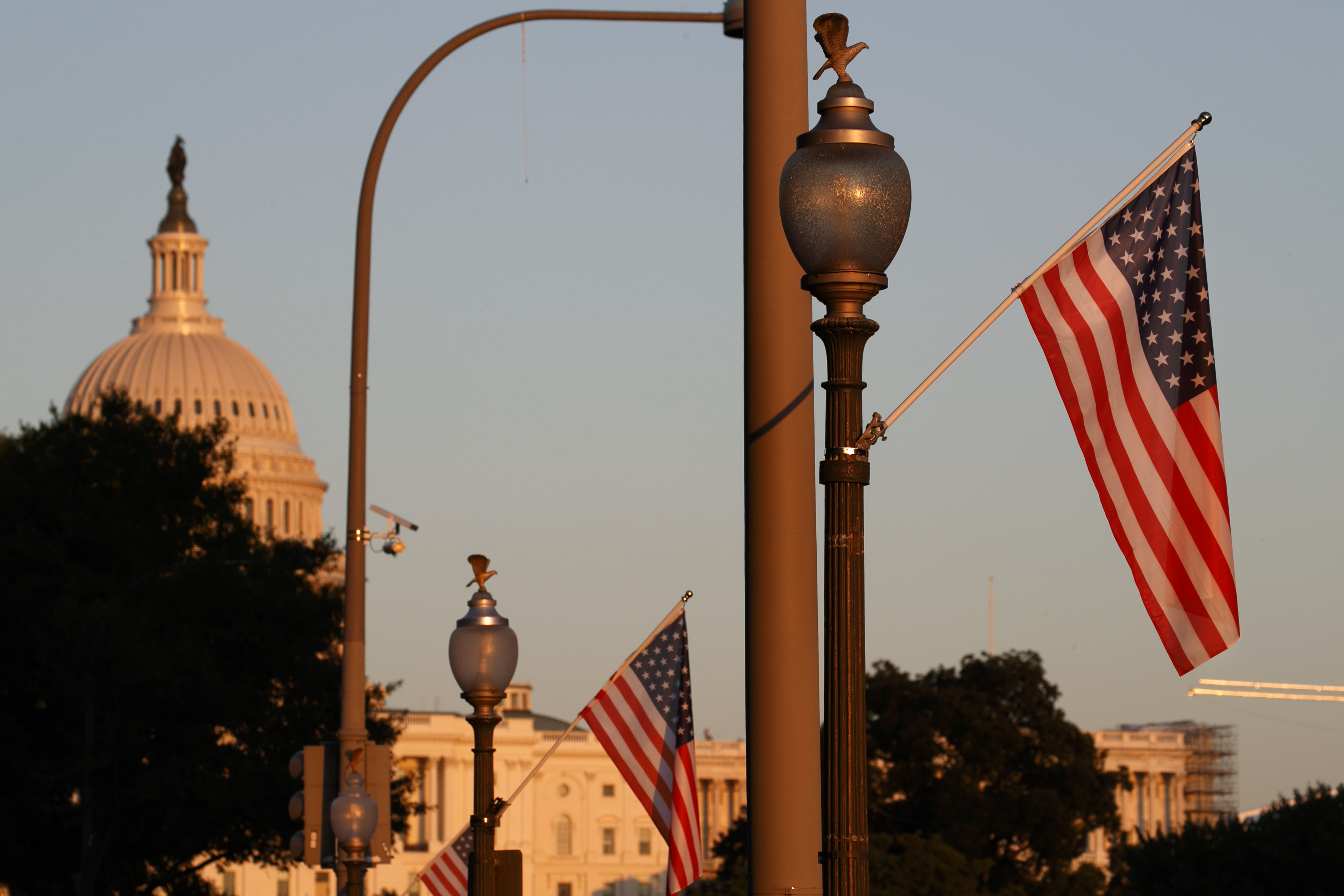
Want more? Check out the flags that Mayor Muriel Bowser has installed on Pennsylvania Avenue.
What would happen to the National Mall and the monuments?
The National Mall, monuments, the Capitol, and a number of other sites would still be federal property.
Want more? Check out this map of what that could look like.
If D.C. is a state, is Puerto Rico next?
Statehood for these two federal territories is often listed in the same sentence. Indeed, before the Puerto Rican primaries in 2016, an ad in support of D.C. statehood ran on the island’s cable news channels. “We believe that all Americans deserve equality. That’s why we support statehood for the District of Columbia and economic justice for Puerto Rico,” said actor Esai Morales in the commercial.
But that commercial didn’t advocate for Puerto Rican statehood because the issue is far more contentious there. While a 2018 poll of Puerto Ricans found that statehood was more popular than remaining a territory or gaining complete independence, pro-statehood sentiment still didn’t add up to a majority. However, multiple nonbinding referendums on the island since 2012 have supported statehood, though turnout was low and opponents organized boycotts.
Puerto Rico has more than quadruple the population of D.C., and in some polls of Americans, statehood for Puerto Rico polls higher than for the District. Indeed, the slow federal response to hurricanes like Irma and Maria has highlighted the sometimes fatal ramifications of Puerto Rico’s lack of statehood. Also, unlike D.C., it’s far less clear that Puerto Rican statehood would be an electoral boon for Democrats.
While the District’s push for statehood doesn’t explicitly include Puerto Rico, it’s possible that seeing a new star on the flag could lead to a shift in the Overton window. After all, plenty of Americans were alive the last time the U.S. added new states — both Alaska and Hawaii officially joined the union in 1959.
Want more? Washington Monthly dispatched reporters to D.C. and Puerto Rico to make the case for the 52-state strategy.