 Jenny Gathright
DCist is providing special coverage to climate issues this week as part of Covering Climate Now, a global collaboration of 250 news outlets designed to strengthen coverage of the climate story. Many of these stories originated as questions from our readers.
For the neighborhoods immediately east of the Anacostia River in Northeast, environmental challenges are hardly a new phenomenon.
“The River Terrace neighborhood, across the street from the Benning Road plant, may be the most polluted spot in the metropolitan area,” wrote attorney Kevin Chavous in a 1989 Washington Post op-ed. “The pollution comes not only from the Pepco plant but from the city’s trash incinerator, from the city’s underground sewer conductor and from major thoroughfares, including I-295, East Capitol Street, Minnesota Avenue and Benning Road. Citizens in the River Terrace area view breathing problems and watery eyes as a way of life.”
A coal-fire powered plant run by Pepco operated off Benning Road for decades, until it was decommissioned in 2012. Residents in Northeast—not just River Terrace, but also neighborhoods like Mayfair, Eastland Gardens and Kenilworth-Parkside—say the pollution caused by the plant had lasting effects.
Now, as the investigation and cleanup of the Benning Pepco site continues, the surrounding neighborhoods are preparing for the next round of environmental challenges: the worsening effects of climate change.The areas in far northeast around Watts Branch, the Anacostia River’s largest tributary, also face some of the highest flood risks in the city.
This part of Ward 7—which is overwhelmingly black and disproportionately low-income—is one particularly poignant example of the city’s past, present, and future environmental challenges. But advocates say this is the lens we should take everywhere; that it is impossible to climate-proof a city without a thorough look at historical and ongoing inequality.
“Climate does not work in a vacuum,” says researcher Malini Ranganathan, an assistant professor at American University who co-authored a recent paper arguing for “abolitionist climate justice” in D.C. “It works in unpredictable ways as a catalyst for already existing challenges.”
Climate change is expected to make D.C.’s weather conditions warmer, wetter, and wilder, as the District Department of Energy and Environment’s climate chief recently put it. The District’s poorest residents are already facing enormous challenges around housing and health. And without significant intervention, advocates say that rising temperatures, increased rain, and more intense flooding will almost certainly exacerbate these interrelated problems.
Housing
Beth Harrison, a housing attorney with Legal Aid, predicts that extreme weather events will disproportionately affect her clients, some of D.C.’s poorest and most housing-insecure residents.
Low-income people in D.C., Harrison says, “tend to be in properties that are not in as good condition to start with.” And while D.C.’s tenant protections against mold are among some of the toughest in the country, the city’s Department of Consumer and Regulatory Affairs is “not particularly good at helping [tenants] enforce their rights,” Harrison says.
DCRA has long been criticized by housing advocates, residents, and public officials for being overly bureaucratic and failing to respond to housing code violations (most recently, two people were killed in a fire in an unlicensed rental that had been reported to authorities).
When DCist reached Harrison for this story, she said the timing of the inquiry was fitting. At the moment, she has a client with the common D.C. problem of water intrusion in their home: When it rains outside, it rains inside.
Harrison says the client’s landlord is arguing that the building is simply not made to withstand the amount of rainfall it was asked to handle this summer (On a Monday in July, for example, D.C. received a month’s worth of rain in just an hour).
It may be true, Harrison says, that the building was given more than it could bear. But, she added, “if we see more and more periods of time when we have these rains, owners are going to have to do more.”
Harrison says it’s difficult for low-income families to move in response to poor living conditions, in part because it is so hard to find housing to begin with.
D.C.’s public housing stock is in such a state of disrepair—with problems including lead contamination, mold exposure, plumbing problems, and vermin infestations—that the city considers them unsalvageable and is proposing to demolish or gut 10 buildings (in the process removing them from D.C.’s federal public housing stock). Hundreds of other units are in need of serious rehabilitation work to make them safe.
The District’s Resilient D.C. Plan, a 160-page document that sets goals around climate change preparation, identifies that the region will face a shortfall of 690,000 housing units by 2035—which increases the current housing gap of 575,000 units by 20 percent. It also notes that between 2002 and 2013, the bottom 20 percent of incomes in the city stayed completely stagnant, while rents for the poorest fifth of the city increased by 14 percent.
The document sets out ambitious goals for expanding the city’s stock of affordable housing and offering more pathways to homeownership.
“Part of what we’re trying to do in the district is recognize those disproportionate harms that are caused by climate change and address them,” said Kevin Bush, the city’s chief resilience officer, on the Kojo Nnamdi Show recently.
Resilient D.C. also explicitly voices a commitment to minimize displacement of longtime city residents, but activists are already sounding alarms about the environmental harm that rapid development is inflicting on D.C.’s black neighborhoods.
Buzzard Point, which is home to the Syphax Gardens public housing complex, is adjacent to some of the city’s most ambitious construction projects, Nationals Park and Audi Field among them. According to a report from the Georgetown Law Center’s Institute for Public Representation, pollution in the neighborhood had also “exacerbated respiratory health problems in the community” and led some companies to face fines for violating air-quality regulations.
Kari Fulton, who has done organizing work in Ward 6’s Buzzard Point neighborhood for years, worries about whether the city has adequately accounted for this harm. And according to Fulton, residents who have suffered the environmental brunt of development should not then be displaced by it.
“If we have to live through … the environmental degradation and the pollution from the construction, and then … you’re displacing people, you’re not even really taking the time to see what is causing health disparities in our community,” Fulton told DCist.
Heat
Current projections have the number of “heat emergency” days (when it feels like at least 95 degrees out) doubling or tripling by 2080. Because heat exacerbates certain illnesses, like diabetes and heart disease, it is no surprise that climate change has the potential to magnify the city’s already significant health disparities.
And while the air quality in D.C. has dramatically improved over the past 20 years, the National Climate Assessment says climate change stands to worsen air pollution levels and increase the risk of ozone-related health issues.
Children living in Ward 8 are hospitalized for asthma at a rate 10 times higher than kids in wealthier, whiter parts of the city, according to the Washington City Paper. A 2018 report from D.C.’s Department of Health found of the four D.C. zip codes which sent the most children to the emergency room for asthma, three were east of the Anacostia River.
“Asthma is not the same for every income level,” says pulmonologist Elgloria Harrison, a professor at UDC who is working on a study about public health and climate change in D.C.. Harrison says asthma is a chronic condition that can be managed—but asthma management is easier if you have access to proper medical care and a home without environmental stressors.
Harrison says rising temperatures and longer allergy seasons can trigger asthma symptoms. Another asthma trigger, black mold, pervades a significant portion of the city’s public housing stock and remains a problem in other market-rate and subsidized apartments where many of the city’s low-income families live.
“Asthma is a condition that actually could be treated,” Harrison said. “But indeed, if those that have been identified with these kinds of chronic conditions continue to live in housing that is substandard and don’t have the proper medicine that they need … these are things that need to be considered.”
For people experiencing homelessness and other vulnerable populations, the amount of time spent in dangerous heat is only likely to get worse, and hyperthermia can be just as deadly as hypothermia.
“People are acutely aware that a person can die if left overnight in very cold weather, but they are less aware of the dangers of heat,” Ger Skerrett, an outreach and engagement specialist at Miriam’s Kitchen, told DCist last year. “A person can become very confused. They can be sweating profusely. Their skin can go pale. In the later stage, when it becomes very dangerous, the sweating stops all together.”
Landlords in D.C., housing attorney Beth Harrison pointed out, are also not currently required to provide tenants with air conditioning (Montgomery County is currently weighing a law mandating that rentals come with cooling units) .
How do we talk about climate change when it’s really about everything?
The Resilient D.C. plan has a huge scope. It mentions topics as wide-ranging as policing, cybersecurity, and construction of a hospital east of the river.
This article touched on a few of the city’s existing inequities—but did not, for example, mention disparities in employment, education, or public transportation access. Climate change might just be a multiplier for nearly every existing social problem, and that can make the policy discussion around it inescapably broad.
There is a risk, Ranganathan acknowledged, of including too much in the conversation about climate change, “because then it becomes everything and nothing at once.”
She argues that the solution lies in gathering stories. Hearing from communities about their intersecting concerns, she says, allows policy makers to “find levers of intervention that are specific.”
Dennis Chestnut sits on the Far Northeast Ward 7 Equity Advisory Council, a group of residents and community leaders brought together to advise the District Department of Energy and Environment on its climate resilience strategy.
That group of residents developed a concept of community resilience hubs. He defined the hubs as centralized, community-managed spaces where neighbors can convene during emergencies to stay in touch and get access to power and other necessities. The idea has since gotten pilot funding.
Chestnut says it’s a climate-related initiative, but the need for a resilience hub “could develop out of any kind of situation,” a testament to his community’s varied concerns and the need for more community resources in general.
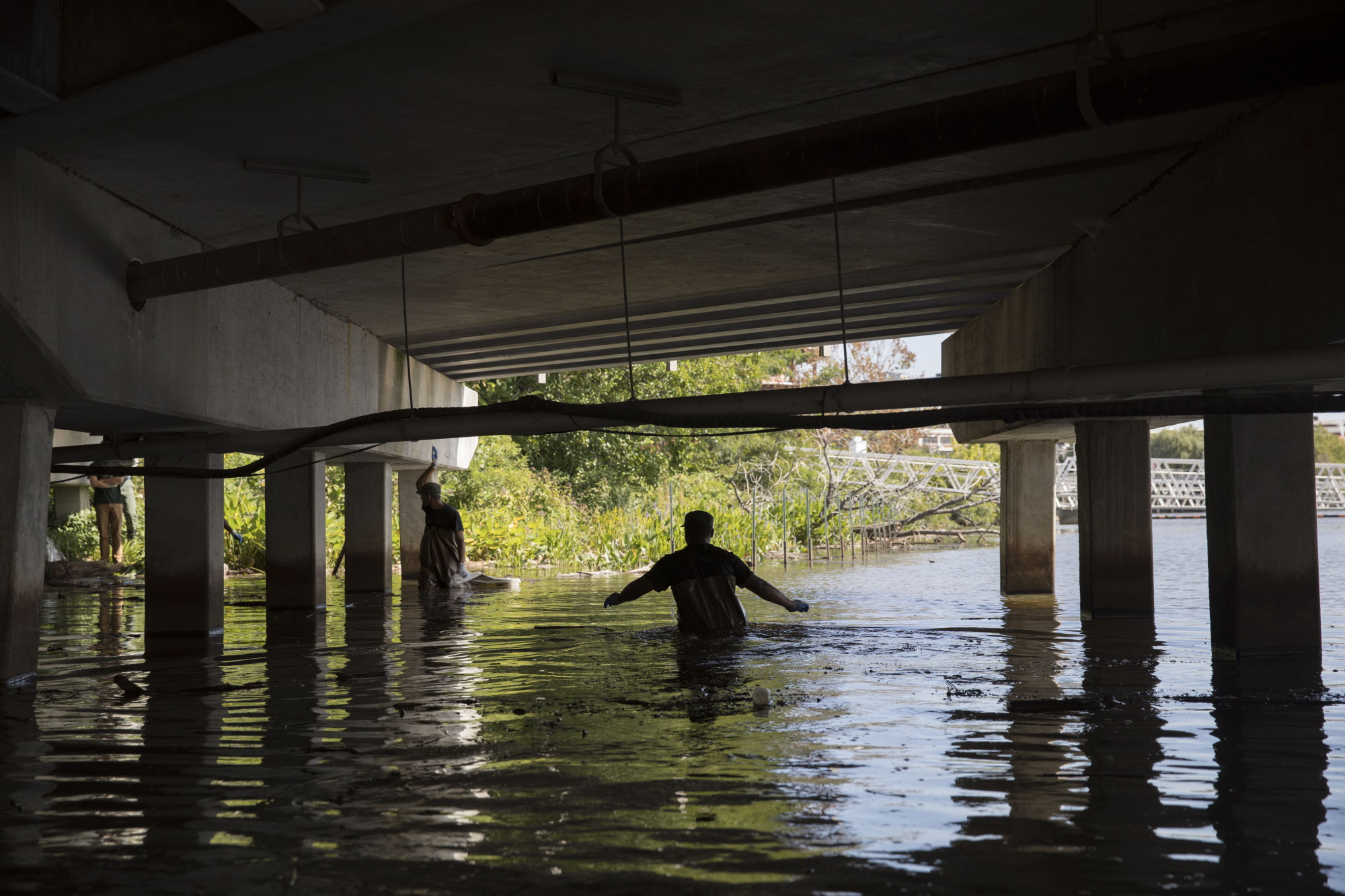
Chestnut, a longtime local environmental advocate, has worked for years on initiatives related to cleaning up the Anacostia River and improving the city’s green spaces. A lifelong resident of Ward 7, he says his neighborhood has been resilient for a long time.
“When we didn’t have recreation centers, we had what we called ‘the woods,’” Chestnut says. “We also had the Anacostia River. And when the swimming pools were segregated in the city, the river was available.” Efforts are underway to make the city’s rivers swimmable again.
“It gave me an ownership of the natural resources that I grew up enjoying and gaining an appreciation for,” Chestnut said. “It opened my eyes to how important it is to make sure that what we leave for the next generation is not some devastated and denigrated community.”
At this point, nearly all scientists agree that climate change will leave the next generation a more challenging and less predictable environment. Chestnut says the only thing left to do in the face of that massive challenge is to keep going.
“I have a philosophy that our work is never done,” he says. “We just have to be constant in our work.”