Rachel Kurzius
While Democrats at the D.C. statehood hearing sought to make the proceedings about the more than 700,000 District residents without full voting rights, Republicans on the Oversight Committee were interested in focusing it on a handful of people: namely, scandal-plagued D.C. Councilmember Jack Evans and the Founding Fathers.
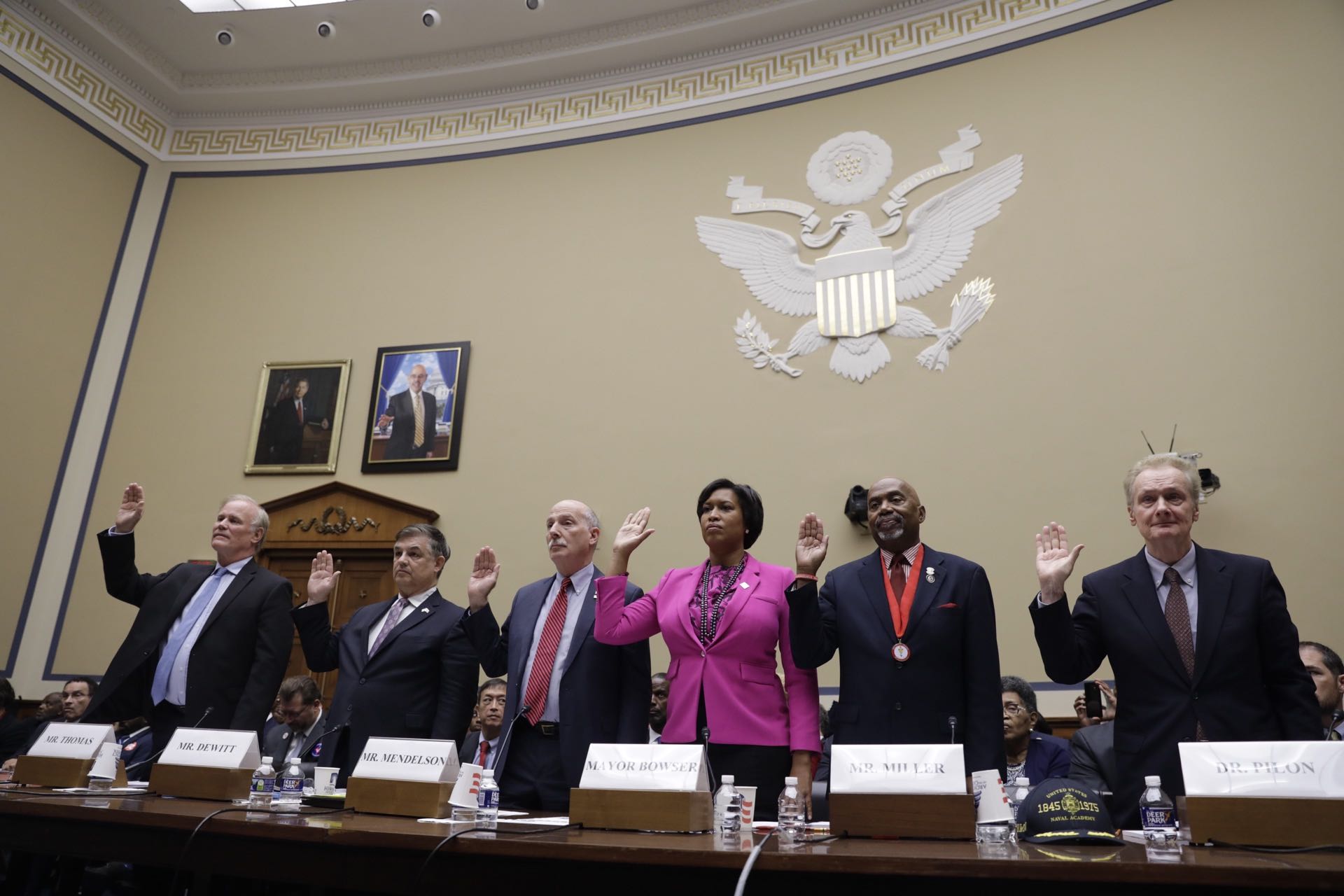
It was the first House of Representatives hearing on the subject of D.C. statehood for more than 25 years, and advocates wearing red lined the hallways in the hopes of making it into the hearing room in the Rayburn Building. (There were two overflow rooms and a screening in nearby Spirit of Justice Park, as well.) With Oversight Committee Chair Elijah Cummings away, D.C. Delegate Eleanor Holmes Norton was in charge, and the Democratic witnesses were largely District officials and residents.
“It is true that we are more brown and more liberal than some of you, but denying statehood would be unfair no matter who was affected,” D.C. Mayor Muriel Bowser said during her testimony. “It should not matter what our politics are or what yours are.”
But to Jim Jordan—the Congressional Republican from Ohio who serves as the minority ranking member on the committee—the politics, or at least the politicians, of D.C. mattered very much. After a failed bid to have Evans, the Ward 2 councilmember currently facing a series of ethical scandals, serve as a Republican witness, Jordan hammered home the idea that the “serious allegations of misconduct” against Evans illustrated that D.C. wasn’t ready for statehood.
In a moment of political theater at the start of the hearing, Jordan announced he was moving to subpoena Evans. Norton maintained that any questions about Evans and his time at the Metro board were better suited for another hearing, and that Evans’ issues had “nothing to do with the suffrage of 700,000 Americans,” adding that, while Jordan’s home state had seen its share of scandals, “no one has seriously questioned Ohio’s fitness to be a state.”
For the most part, the Democrats on the Oversight Committee (and House Majority Leader Steny Hoyer, a new convert to the statehood cause who made an early cameo) heralded the hearing as “historic,” and issued their support for HR 51, the House legislation that would make D.C. the 51st state. The legislation has 220 co-sponsors, per Norton, two more than necessary to pass in the House.
Their arguments are familiar to anyone who has followed the statehood movement: D.C. pays more per capita in taxes than any state, has a bigger population than two states, and has residents who serve in the military, yet has limited representation in the House and no one in the Senate. Congress often meddles in the District’s local business, and prevents the D.C. government from enacting the will of Washingtonians. Statehood, they say, would fix that.
But, aside from concerns about Evans, Republicans argued against the idea of statehood by saying it is unconstitutional. Their witness, Roger Pilon of the Cato Institute, maintained that D.C. statehood didn’t square away with the Founding Father’s intentions, and “is exactly what James Madison feared.” Democrats had their own witness to counter the claims that Bowser characterized as “bad faith”—Kenneth R. Thomas, a legislative attorney at the Congressional Research Service who finds HR 51 constitutional.
And the Democrats also had Jamie Raskin, the representative from Takoma Park who has taught constitutional law and was in attendance for the full hearing. Raskin listed the objections levied against other territories before they became states—Alaska and Hawaii for not being part of the contiguous United States, Utah for concerns about polygamy, Texas for having a foreign government. He also dismissed the idea that D.C. would have “undue influence” over the federal government. “D.C. isn’t trying to turn the seat of the federal government into a state,” Raskin said, noting that statehood would instead redraw the map so residents wouldn’t live in the seat of power. (Under HR 51, the Capitol, the National Mall, and other sites would remain in the federal enclave.)
Republicans like Jordan and Kentucky Representative Thomas Massie had questions about the boundaries that D.C. residents voted on in 2016, which include the Trump International Hotel, a federally owned property leased to the company founded by President Donald Trump. Bowser and D.C. Council Chairman Phil Mendelson said that the property had a commercial use, so it didn’t make sense to keep it in the federal enclave.
Massie had another worry about the boundaries of the 51st state: some of his staffers parked in an area that would become a state.
Bowser scoffed at that answer. “I wish I could say that I was surprised that it was suggested that the parking rights of staffers should supersede the rights of 702,000 people to be represented in this Congress,” she said after the hearing ended.
Mendelson, Norton, and Bowser all characterized their perspective after the hearing as “optimistic.” Norton pledged that HR 51 would pass the House by the end of the Congressional term.
As the hearing went on, multiple Democratic presidential candidates issued their support for the hearing, and for D.C. statehood. That underlined how bleak the political realities are for D.C.’s statehood bill in the current Senate.
So if Trump is voted out of office in 2020, alongside Democrats holding the House and taking the Senate, could the District really could notch that 51st star on the flag?
“We can’t tell you how Democrats who haven’t been elected yet will vote,” Norton said after the hearing. Acknowledging that the Upper Chamber can be more difficult, because legislators represent more people, “but we think this is a good time for this bill to have come forward for both the House and the Senate.” Senate Minority Leader Chuck Schumer tweeted in support of statehood after the hearing ended.
One of the most fiery moments of the hearing came courtesy of Gerry Connolly, a Northern Virginia Democrat. When Republicans “say it is not about race and partisanship,” Connolly said. “You can be sure it’s about race and partisanship.”
Pilon, the Republican witness, acknowledged that the arguments against statehood had a little to do with partisanship, but said they had nothing to do with racism. He demanded that Connolly rescind his statement. Connolly leaned into the microphone and said definitively, “Never.” The crowd in the hearing room applauded and cheered.
More:
The Past, Present, And (Potential) Future Of D.C. Statehood, Explained