Jacob Fenston
 Jordan Pascale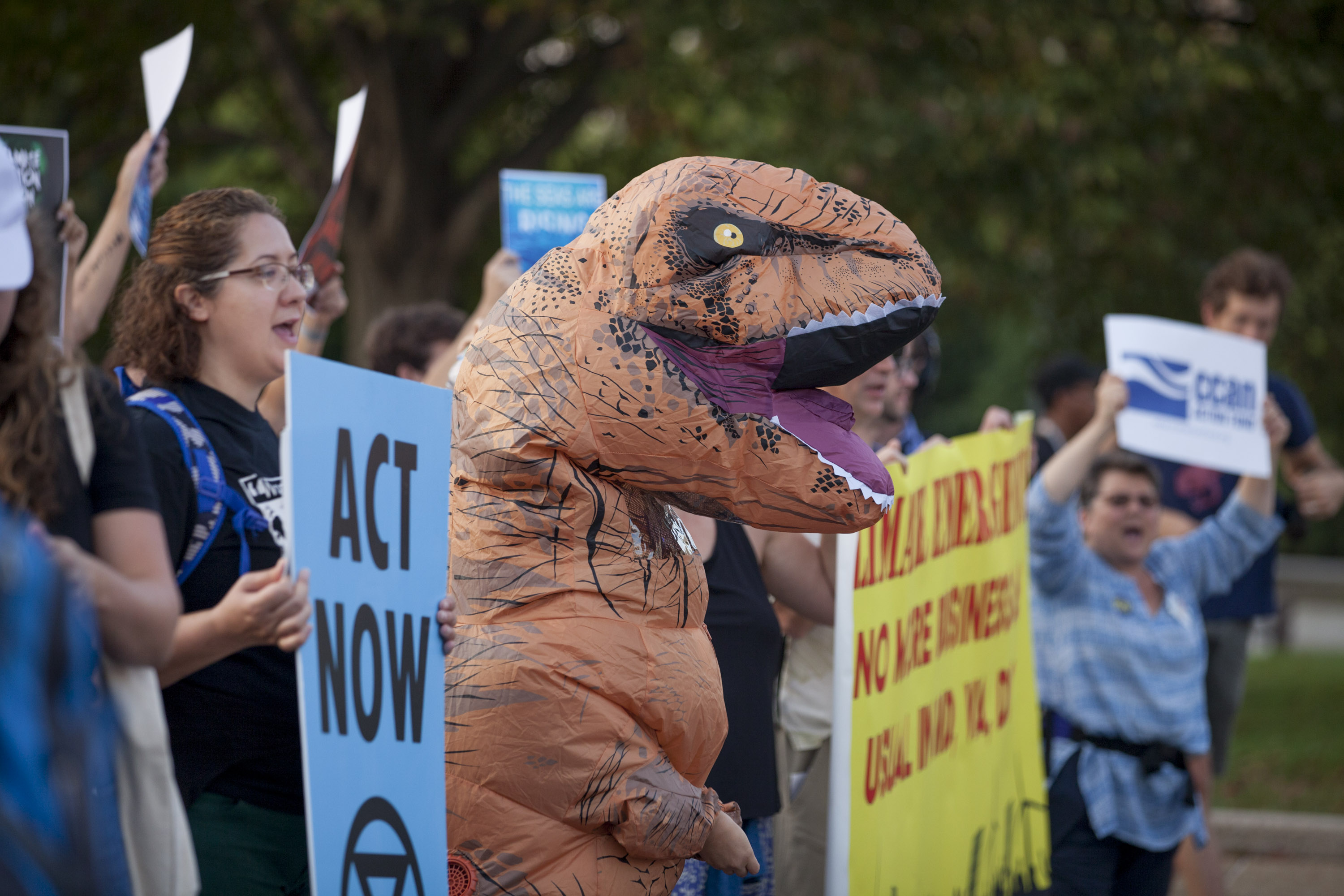
Update, 9/27/19:
About 250 protesters marched in D.C. Friday during a second day of climate action, timed for the morning commute hours. Demonstrators didn’t disrupt traffic as much as Monday’s protests, which shut down key intersections for up to three hours.
The march moved quickly through downtown D.C. Demonstrators stopped at four strategic locations: the Trump Hotel, Wells Fargo, BlackRock (an investment management company), and the EPA. Organizers say those locations emphasize “the corrupting influence of the fossil fuel industry in U.S. politics, but also fossil fuel finance.”
Police redirected traffic, so disruptions on the roads were minimal. Protesters offered
Now at 14th and New York Ave where investment banker BlackRock is located. Appears protesters will stop here for a while for speeches.
Some traffic blocked momentarily but police redirecting well so minimal impact. Protesters giving drivers bagels and bananas pic.twitter.com/UIVlamZ7ah— Jordan Pascale (@JWPascale) September 27, 2019
Original: Climate activists want to capitalize on their success shutting down D.C. streets earlier in the week with a repeat performance Friday.
On Monday, some 2,000 protestors blocked 22 key intersections, according to organizers, snarling the morning commute. They are planning a smaller operation targeting four downtown locations while continuing their demands for quick action on climate change.
“This isn’t a one-off event,” says Kaela Bamberger, an organizer with the group Extinction Rebellion, and one of the planners of the street blockades. “This is an ongoing mobilization around the climate emergency.”
Bamberger says this time activists are focusing on four strategic locations to emphasize “the corrupting influence of the fossil fuel industry in U.S. politics, but also fossil fuel finance.”
Here are the locations:
- The U.S. Environmental Protection Agency Headquarters (12th St. and Pennsylvania Ave. NW.): The agency, Bamberger says, “has stopped at nothing to destroy existing climate protections.”
- The Trump International Hotel (directly across from the EPA): “A symbol of corporate influence in U.S. politics,” Bamberger says.
- The D.C. office of BlackRock (14th St. and New York Ave. NW): An investment management company, and “the world’s largest investor in fossil fuels and deforestation,” according to Bamberger.
- Wells Fargo (13th St. and I St. NW, on Franklin Square): According to a recent report, the bank has put $151 billion into fossil fuel industries in the past three years, ” at a time when really we should be thinking about the managed decline of the fossil fuel industry,” Bamberger says.
Protestors will meet at 7 a.m. at McPherson Square before moving to the four locations.
Bamberger would not say whether similar protests will become a feature of life in D.C. But she says Monday’s blockades were a “huge success,” allowing relatively few protestors to garner national attention.
As for annoying commuters: “Honestly, it’s not about being polite at this point,” she said. “We’ve had literal decades of asking politely and proposals for small changes. This is about the climate emergency.”
Friday is the last day of a worldwide week of climate protest, the Global Climate Strike, organized to coincide with the U.N. Climate Action Summit.
This story was originally published on WAMU.