Natalie Delgadillo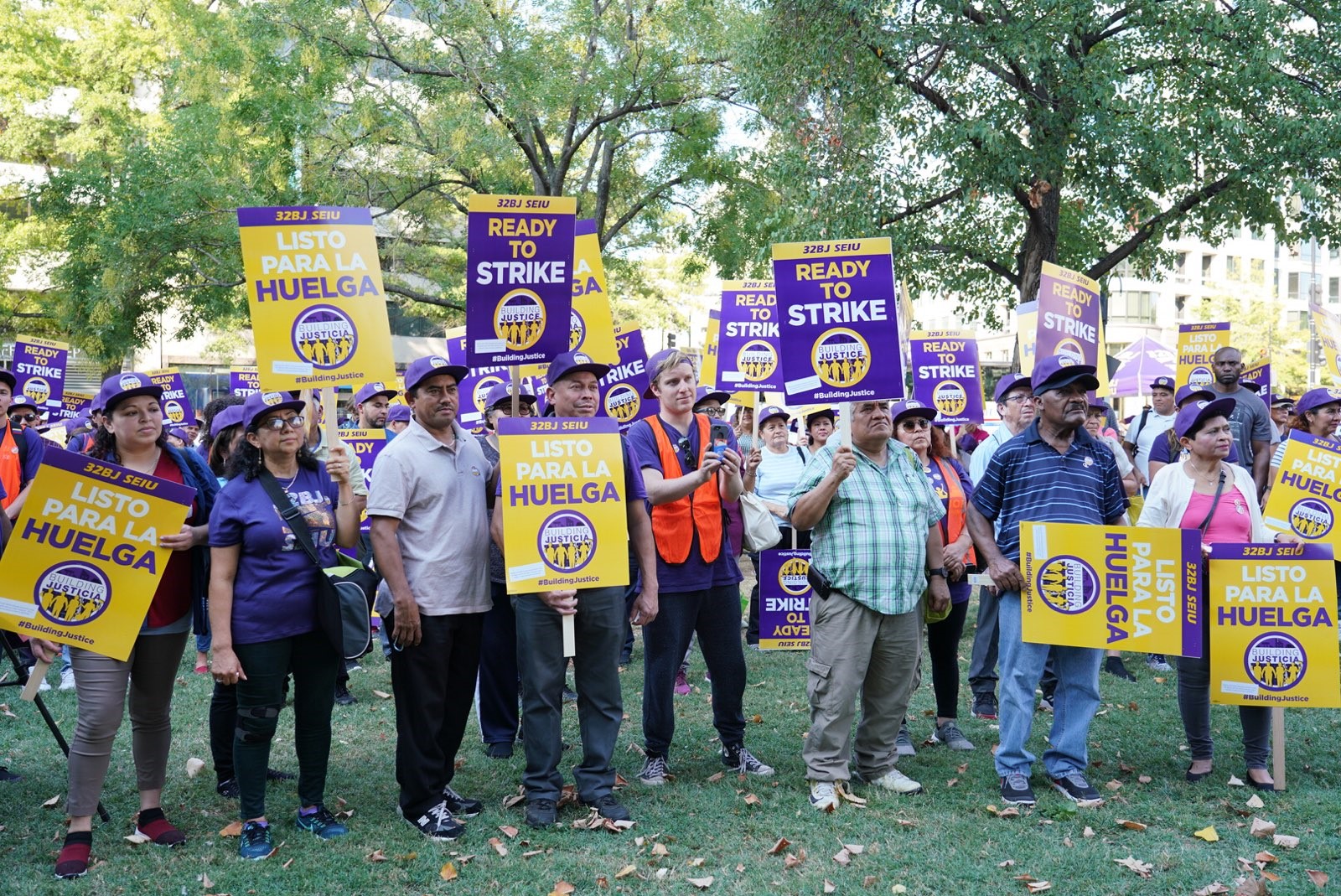
Hundreds of D.C.-area janitors are expected to gather downtown during rush hour on Tuesday to rally and march in favor of better working conditions, including higher wages and more full-time positions.
About 10,000 janitors across the D.C. area and Baltimore—the vast majority of those employed to clean the region’s office buildings—may go so far as to call a strike if their union cannot reach an agreement with employers, according to a press release from 32BJ SEIU, a national union that represents 173,000 members across 11 states.
The march comes ahead of the union’s contract expiration on October 15, and it will include some prominent local guests: Mayor Muriel Bowser, D.C. Council Chairman Phil Mendelson, and At-large Councilmember Elissa Silverman.
“I have always been a supporter of unions and workers’ rights,” said Mendelson in a statement to DCist. “Without SEIU, it’s likely that janitorial workers would remain at the bottom of the working class. This is about decent wages for hard work.”
Bowser, who has in the past expressed support for 32BJ, told DCist in a statement she is concerned with making sure that D.C.’s janitors “share in [the city’s] prosperity.” She also tied the rally to her continuing struggle to bring late-night service back to Metro: “We’re going to continue fighting to keep Metro open late so that our late-night workers have viable options to get back home to their families,” she said in the statement. Janitors in the city often work night shifts after normal working hours, and are part of the class of nighttime workers that Bowser has repeatedly said need late train service.
Silverman, who has a reputation on the D.C. Council for being pro-labor, says that she “hopes this rally will prompt good faith negotiations that ensure [janitors] earn a living wage.”
The union says that it’s fighting to help janitors, a largely immigrant workforce in the District, keep up with the astronomical cost of living in the city and its surrounding suburbs.
“32BJ janitors often must work more than one job to keep up with the rising cost of living in D.C., which now ranks as the seventh most expensive city among the nation’s top 75 cities,” the release from the union reads. Full time janitors in the area currently make about $16.10 per hour, while part-timers make $12.10 per hour. Part-time workers do not currently have access to health insurance, per the release.
32BJ started negotiations with the Washington Service Contractors Association, which represents about 70 percent of the cleaning companies in the area, on September 12. The deadline to reach a deal is October 15, and according to 32BJ vice president Jaime Contreras, the two sides are still far from an agreement.
“The actions that are happening this week are workers coming together to send a strong message to employers that they’re willing to do what it takes, including a strike, if we don’t see big movement across the table,” Contreras tells DCist.
According to Peter Chatolivicz, the lead negotiator for employers WSCA, the two sides have been working together for about 12 years, and have managed to avoid a strike for all of that time. “It’s been a very healthy and even relationship between the parties,” he says. “Union workers’ wages have gone up substantially over the last ten years, everybody has some benefits now.”
The union is seeking a significant pay raise for its members, far outstripping the 50 cent per hour raise they agreed upon during the last negotiation period in 2015, Contreras says. In addition, the union is looking to increase the number of full-time positions available in Arlington, where most janitors “have no choice but to accept part-time hours, forcing them to take multiple part-time jobs and still often not getting employer-paid healthcare,” per the press release. 32BJ is also trying to significantly increase the number of full-time positions available in Montgomery County. According to Contreras, janitors in D.C. already have access to many full-time jobs, after concessions won in the last round of contract negotiations.
Contreras says that negotiators will also attempt to win some protections for immigrant janitors, which he says make up the vast majority of the workforce. Many of them are Salvadorans present in the U.S. under Temporary Protected Status, which Trump has been trying to renege (a judge has ordered the federal government to extend TPS programs to Salvadorans until January 2020, and the future of the program is up in the air). The union is looking to increase the probation period that allows employees to miss extended periods of work without losing their jobs, which protects employees that may be caught up in immigration proceedings, Contreras says.
Chatolivicz says that the employers he represents don’t plan to fight with the union over health insurance benefits, despite projected increased costs for plans. But he says there will likely be three points of contention in negotiations: wages, the desire for more full-time positions, and the union’s ask for more holidays (which would equalize all the jurisdictions with D.C., the jurisdiction with the best holiday schedule in the region).
“We hope that this [negotiation] is going to focus on economics,” meaning wages, Chatolivicz says. “We are not coming in looking to cut things, and we are going to offer what we think is a reasonable proposal.”
The union represents 4,000 workers in D.C., 4,000 in Northern Virginia, more than 1,500 in Montgomery County, more than 600 in Baltimore, and hundreds of newly-organized employees in Loudoun County, Virginia and Prince George’s County, Maryland.
All throughout last week and this week, the union has been holding strike votes at several locations in the region—so far, all the clusters of members have approved a strike if an agreement isn’t reached. On October 3, a strike vote is taking place in D.C. at Union Station.
The action on Tuesday started with a rally at 4:15 at McPherson square, per the press release. Just before 5 p.m., the demonstrators will begin their march down K Street NW to Connecticut Avenue and then loop back around again to end at McPherson Square.
The march is taking place during rush hour because it’s right after day shift workers get off, and right before the night shift begins, according to 32BJ. The union says it has received 600 RSPVs for the event.