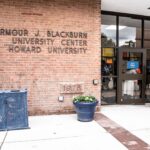
Trinity Pisarsky, a freshman student at Howard University, says she chose to live in the Harriet Tubman Quadrangle (aka “The Quad”), which comprises five dormitory halls, because she’d heard it was the best place to build a sisterhood.
It’s been seven weeks since the beginning of the semester and Pisarsky says although she’s gotten the sisterhood, she’s also had to deal with things she “never would have expected”: rats, leaking pipes, water-shutoffs, and what she alleges is unsafe water.
She’s one of a group of 16 students that met with student affairs on Tuesday to address their housing concerns.
This liquid has been dripping from the ceiling in our hallway for over 3 days. We were told a pipe is leaking but it has not been fixed yet. This is a health hazard for all the girls on my floor. Pls explain how this is okay? #HuCantFixIt #HUFailedQuad pic.twitter.com/sX4hoVkbyy
— Leah?? (@Leah_janelle24) October 1, 2019
Pisarsky anticipated some level of residual construction would be ongoing when she arrived in August. She had been told by campus administrators that The Quad was undergoing renovation, and the university had been in communication with incoming students over the summer to update them on the construction.
But she says the emails she received made it seem like the construction was nearly done. “They were sending us pictures of what the dorm is going to look like,” she explains. “But they were computer-generated pictures, not actual pictures of the building.”
The day before she moved in, Pisarsky says she got an email from the school saying construction would continue until December.
Pisarsky says Quad residents were promised there would be a hair salon on-site, along with a state-of-the-art fitness center. But she says at this point, it’s not the lack of amenities she’s upset about.
“It’s literally uninhabitable,” she sighs. “We’re living in a construction zone.”
Serene Thomas, a freshman from Michigan, agrees. When she first moved in, her room wasn’t completed. “I didn’t have any paint and my flooring was not done,” she says.
Thomas says the conditions have only gotten worse and calls construction on her room a “rushed job.”
this is @jasmineadetunji and I’s room. Construction came to fix a leak last wednesday and this is how they left the wall. They have not been back since last wednesday. #HUFailedQuad #HuCantFixIt pic.twitter.com/ry12CS89Kw
— Vannah✨ (@SavannahLarrier) October 1, 2019
“My room had a giant hole in the wall leftover from construction that a rat —not a mouse—a rat crawled through,” she says. “It ate through all my food. It cost me over one hundred dollars in food costs.”
She’s not the only student who’s had to deal with rodents.
Khrissy Bernard, a psychology major, says from day one, she’s had rats in her building and claims it took three weeks for someone to come and help her, after sending a request through an online “fix-it” portal.
“We had to go out and buy our own rat traps out of our own pockets,” she says, exasperated. “And then once we finally did, they took so long to actually come pick up the traps.”
Y’all…we killed the mouse ourselves ? #HuCantFixIt #HUFailedQuad pic.twitter.com/n7ySVvWlHg
— enya ✨ (@enyajolie) October 1, 2019
Bernard says even though her air conditioning doesn’t work and she’s had five rats in her room at one time, that’s not the biggest issue. She, along with Pisarsky and Thomas, are worried about the quality of their tap and shower water.
“I know girls who take a shower, and they get out, and their skin is on fire, like fire ants,” Pisarsky says. She says the health concerns of her group were brought up with housing administrators and they’re waiting on a resolution.
Another student, who wished to remain anonymous, says she’s so concerned about the rashes and respiratory issues she’s been having since the start of the semester she started seeing a doctor and may test the water herself.
Howard University did not have any comment at this time about testing the water or water quality and did not allow WAMU staff to enter the residence halls.
After #HUCantFixit and #HUFailedQuad started gaining attention on Twitter earlier this week, 16 residents of The Quad met with Kenneth Holmes, the Vice President for Student Affairs, and his colleagues. Pisarsky says the meeting was a start but wasn’t sure what progress would actually be made.
On Thursday morning, Holmes sent an email to “Quad students and families” acknowledging the concerns of students. The email says in part, “We sincerely apologize for the stress that these [construction] issues may have caused your student and your family.” The email goes on to say, “Unfortunately, Washington, D.C. has a rodent problem — mice even make appearances in the White House Press Briefing Room. Howard partners with Orkin for pest control, which we will continue in addition to implementing more tactics to address the problem.”
The email cautions that some of the issues circulating on social media are “inaccurate,” including a video of liquid dripping from the ceiling. Students believed that liquid to be urine; Holmes writes it is actually the result of debris in pipes.
Holmes’ email promises weekly open meetings with the students, the building manager and construction.
In a statement issued to WAMU, Holmes adds, “We ask our students to pardon our growing pains during this process. We are actively working with the residents to address each issue they have raised. We are addressing these housing issues daily, making weekly inspections and meeting with our student residents to hear their concerns in order to continuously improve their on-campus living experience. All students are encouraged to report any housing concerns to their Resident Assistants for a timely response.”
One of Pisarsky’s frustrations is how much it’s costing her to live in The Quad. On average, it costs $3,983 to live in one of its resident halls for the semester—nearly $8,000 for the academic year.
Pisarsky explains she’s at Howard on an academic scholarship and her biggest expense is housing. Her mother, a nurse in Oregon and California, had to take a second job in order to pay for her housing.
“I try really hard not to tell her absolutely everything I’m going through because I don’t want to seem ungrateful and stress her out even more because as it is, she’s working six days a week,” Pisarsky says. “On the other hand, I want her to know what’s going on because she’s paying far more than she should be for what I’m living in.”
Pisarsky, Thomas and, Bernard are all seeking refunded housing costs for the semester. The university didn’t comment on any housing refunds but says it is in constant communication with the students and discussions are ongoing.
Bernard says there’s been support from campus alumna but less so from upperclassmen.
“We’ve been called a lot of names—idiots, crybabies,” Pisarsky says.
Bernard admits it’s been difficult. “The upperclassmen think everything should stay in house,” she explains. “They have a view that just because we went through it, you have to go through it, too. It’s frustrating because we’re here to make everything better, not just pass on struggles.”
Thomas says no matter what happens, she’s planning to advocate for what she thinks is right. She says her role model is Dr. Mona Hanna-Attisha, whose research showed children were exposed to dangerous levels of lead in Flint, Michigan. Thomas met her while living in Michigan.
“She was the one who taught me to advocate for myself — no one else is going to do it for you.”
This story originally appeared on WAMU.