Ally Schweitzer
D.C. Mayor Muriel Bowser set a goal this year to add 12,000 new affordable homes to the city over the next six years. Tuesday, she unveiled her administration’s plan for where those homes will go.
Bowser wants to significantly increase dedicated affordable housing options in Rock Creek West, which encompasses some of the city’s highest-income neighborhoods. Her administration has set a goal to bring 1,990 affordable housing units to that part of the District by 2025—more than four times its current amount of 470 affordable homes.
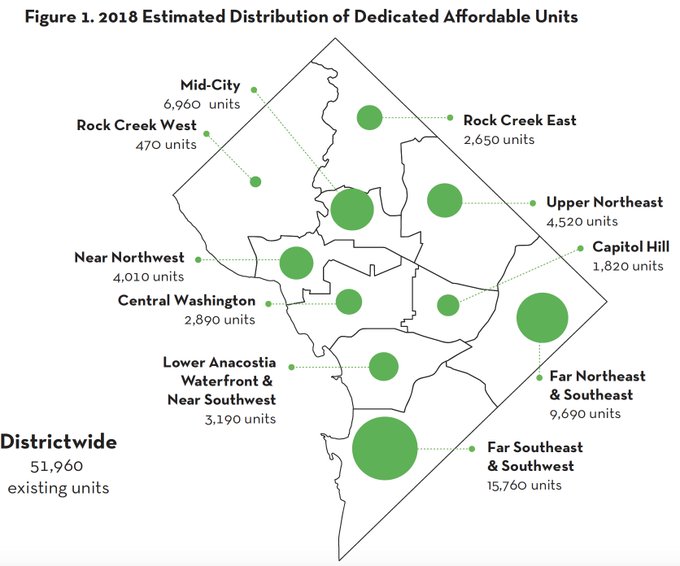
Where D.C.’s existing dedicated affordable housing is located, by planning area.Provided by D.C. Office Of Planning
Capitol Hill and Near Northwest are also targeted for big increases because they have the second and third largest shortages of affordable units, according to city data. Meanwhile, large swaths of Northeast, Southeast, and Southwest D.C. are considered “on track” to meeting their affordable housing production goals.
According to a report released Tuesday by the Office of Planning, D.C. has a larger goal to make sure at least 15 percent of all housing in each planning area is affordable. Rock Creek West, Rock Creek East, and Capitol Hill have the most catching up to do to reach those goals, the report says.

Areas with the biggest shortages of affordable housing are targeted for the biggest increases by 2025.Provided by D.C. Office Of Planning
Adding 12,000 dedicated affordable units is part of Bowser’s larger goal to produce an additional 36,000 homes in the city—including market-rate units—by 2025.
How Is “Affordable” Defined?
In this context, the mayor defines “affordable” in a very particular way: The term refers to homes where rents are subsidized so they don’t exceed 30 percent of household income. Generally, federal and city affordable housing funds target households earning up to 80 percent of Median Family Income, which is defined by the U.S. Department of Housing and Urban Development. The D.C. region’s Median Family Income for a family of four is currently $121,300.

The federal government defines the D.C. region’s Median Family Income. Generally, federal and local affordable housing funds target households earning between 0 and 80 percent of MFI.D.C. Office of Planning
How Will The City Pay For All That Housing?
The mayor hasn’t released a specific plan for how to fund thousands of new affordable units, but the housing report released Tuesday by the Office of Planning says the money will have to come the same way it already does: from a combination of public and private resources.
The report identifies city subsidies, such as the Housing Production Trust Fund, as a primary means of constructing new affordable homes and preserving what “naturally occurring” (read: non-subsidized) affordable housing remains in D.C. It also mentions “expanded land use incentives and requirements,” like the Inclusionary Zoning program and Planned Unit Developments, which allow developers more density in exchange for community benefits, including affordable units.
Public land partnerships and “expanded and enhanced voucher programs” are other options, according to the report.
But without a substantial increase in public funds, the cost of adding or preserving 12,000 affordable units is likely to exceed budget allotments. Buying and preserving a 20-unit apartment building as subsidized affordable housing can run between $8 and $10 million, according to a nonprofit developer WAMU interviewed in 2018. Meanwhile, the Housing Production Trust Fund has a $116 million budget for the 2020 fiscal year.
What About Neighbors Who Fight Affordable Housing?
Figuring out the finances is just one of the enormous hurdles standing in the way of solving D.C.’s affordable housing crisis. Another obstacle comes in the form of residents who fight development—aka NIMBYs.
At a press conference Tuesday, multiple reporters asked Bowser administration officials how they plan to approach the NIMBY (Not in My Backyard) problem. To date, officials have mostly given vague answers to this question (except for that one time the mayor suggested using shame), and they didn’t stray far from that on Tuesday.
But officials have been taking steps to reduce litigation that jams up housing construction. The biggest step so far was the recently approved amendments to the city’s Comprehensive Plan, which, the administration hopes, will reduce ambiguity in the planning document that allowed activists and residents to file successful appeals of zoning decisions.
With that achievement under her belt, the mayor urged developers Tuesday to not let angry neighbors scare them away from building housing.
“I’m discouraging any developer that has the opportunity to build more units so that we can have more affordable housing, to be scared away from the process,” Bowser said. “These units have been held up for too long, and we can’t continue to hear residents across our entire city be concerned about affordability without doing everything that we can to get more units.”
This story originally appeared on WAMU.