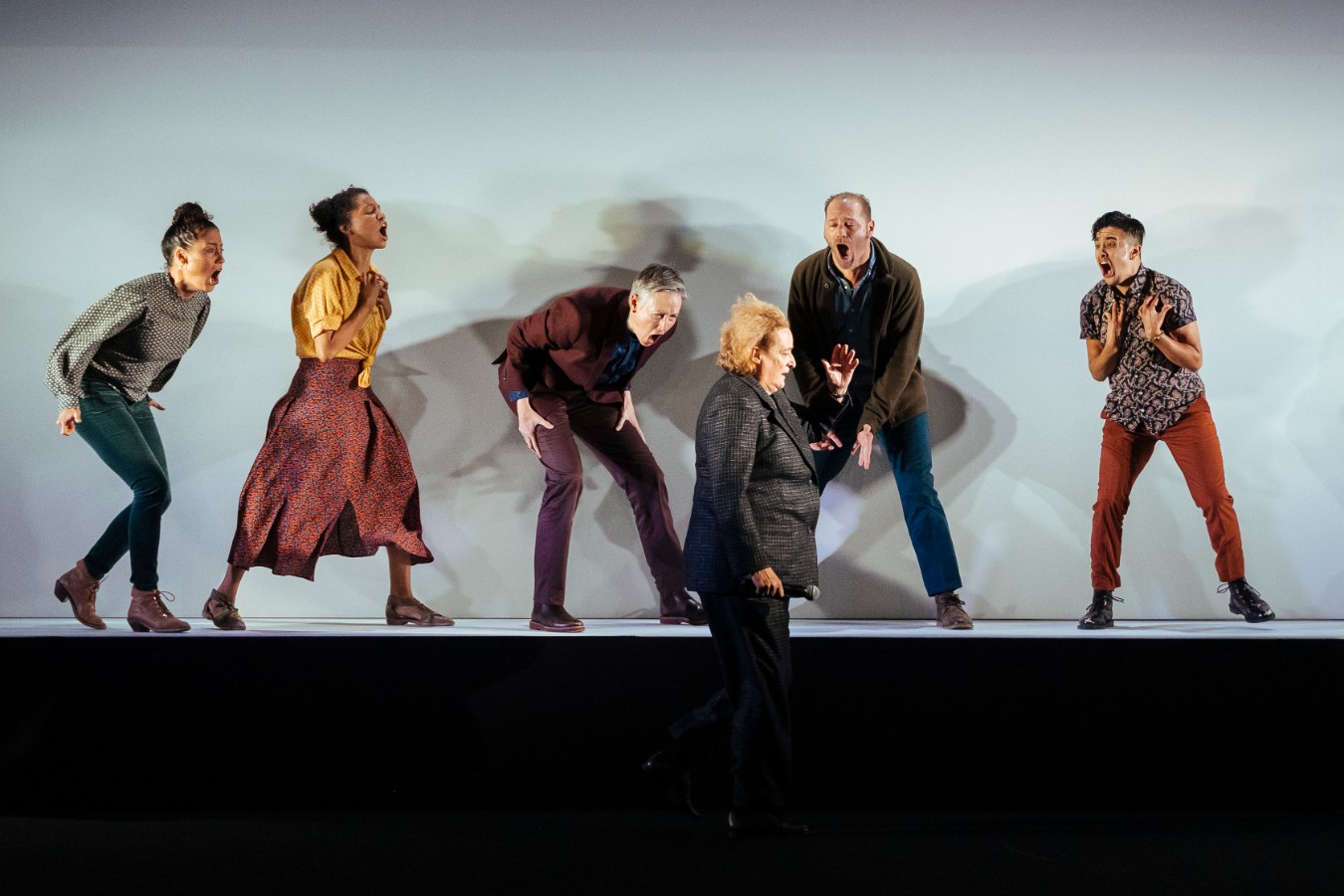
In Shakespeare Theatre Company’s Everybody, five characters face death as well as the only thing many people fear even more than that: performing a play in front of hundreds of people in which your role is assigned during the performance.
Miraculously, Avi Roque, Elan Zafir, Alina Collins Maldonado, Ayana Workman, and Kelli Simpkins pull it off, playing five ‘Somebodies’ that rotate roles night by night, their fate decided by choosing a ball from a golden lottery machine on stage. For those that need to brush up on their factorials, five actors in five possible roles equals 120 possible iterations, so it is unlikely that any two audiences will see the exact same show.
To prepare for such an ordeal, the Somebodies used the lottery to choose among the roles of Everybody, Friendship, Cousin, Kinship, and Stuff before each rehearsal. The actors would practice a scene and then switch places, meaning they might inhabit several different characters’ bodies over the course of an afternoon.
It must have been a disorienting and exhausting experience, but the result is a play that combines the freshness of improv with the crispness of a precise script. Written by Branden Jacobs-Jenkins (also behind Gloria and An Octoroon, both at Woolly Mammoth around the corner), Everybody was a finalist for the 2018 Pulitzer Prize for drama. Part of the play’s brilliance is that the actors bring their own visible and invisible identities to the stage, so the same line of monologue may take on different meaning depending on who draws the role, and scenes may be performed in dozens of different relational combinations.
Beyond the novelty factor, Everybody explores some thoughtworthy themes—death, mainly—while still managing to be extremely funny. The question posed at the beginning of the play—“Can I bring someone with me?” (into death, that is)—drives much of the narrative arc. An update of the 15th-century morality play Everyman, Jacobs-Jenkins’s modern version maintains the allegorical lesson-teaching of medieval theater, but is more sarcastic than didactic. Biblical references are replaced by an Usher/God character (played each night by Yonatan Gebeyehu) who is as concerned with getting people to turn off their cell phones as he is with shepherding Everybody into the afterlife. His assistant Death (Nancy Robinette) seems new to the job, explaining to her victims “Once you’re there, you can never come back—I think.” Under Will Davis’s direction, Everybody adds on arresting production elements: electric lighting, latex balloons that seem pregnant with meaning, and a Día de los Muertos-esque skeleton dance.
The ‘lessons’ of the play, as they were, are no less poignant just because they’re obvious. We all know that the items in our storage units won’t serve us after death, and yet that reality becomes glaring when a personified Stuff is there to tell Everybody that their curated collections cannot come with them to the afterlife. Similarly, we all have a nagging inkling that our friendships might not be Abby-and-Ilana iconic, but it’s still hilariously familiar to watch Everybody’s ride-or-die ‘Friendship’ cower towards a side door when asked to accompany their dying ‘BFF.’
While a few of the play’s gimmicks, such as the dream-within-a-dream frame with its odd voiceovers, don’t work, for the most part, Everybody will keep you along for the journey, wherever that may lead. Though the cast’s surprises for the evening end when the lottery is drawn, the audience is kept guessing nearly until the final curtain. And when that moment inevitably arrives, at least you know you can come back for a reincarnated version of the play another night.
Everybody is playing at Shakespeare Theatre Company’s Lansburgh Theatre through Nov. 17. Tickets: $49-$112. Runtime 90 minutes with no intermission.