Gillian Stewart had just finished describing her beloved pastime, rapper dancing—a fast-paced type of traditional English folk dancing that involves making intricate patterns with a “super bendy” sword. All was going well. But then, the ultimate faux pas: an inquiry about whether said sword ever lands on the ground.
“Uh, I’m sorry. Did you just ask if people are jumping around, getting super sweaty and moving really fast, and sometimes things slip out of their hands?” Stewart asked, palpably alarmed. “Absolutely, people drop swords.”
Stewart, who lives in Cambridge, Mass., will be in D.C. this weekend to compete in the 10th annual Dancing America Rapper Tournament, or DART, with her team, Justice League. She grew up folk dancing and listening to folk music—it’s basically in her DNA, given that her parents met at a folk dance. Today, she’s part of a tight-knit American rapper dancing scene that enjoys year-round performances and one big annual competition.
This year’s DART, which will be held at a few Old Town Alexandria pubs on Saturday, is hosted by D.C.-based Sligo Creek Sword, which won last year’s national championship. The team, one of two in the District, was created in 2017 and has performed up and down the Eastern Seaboard.
“It’s an activity that’s both deeply rooted in tradition and has a really rich history and culture, and also completely offers itself to inventiveness and creation and creativity,” says founding member Leah Sakala, who started rapper dancing as a teenager. “There’s a lot of room for trying new things and experimentation, and it’s just really high-energy and fun.”
Rapper dancing traces its origins back to the coal-mining villages of northern England in the 19th century. The prevailing understanding of the time period is that while hitting the pub after work, miners would perform a folk dance with the implements they used to scrape dust and sweat off their ponies’ backs. Eventually, those tools morphed into what’s now known as a “rapper”—a flexible sword with a handle at each end that’s typically 18 to 28 inches long. English rapper dancers continue to compete annually at the Dancing England Rapper Tournament, or DERT, which inspired the American spin-off, DART.
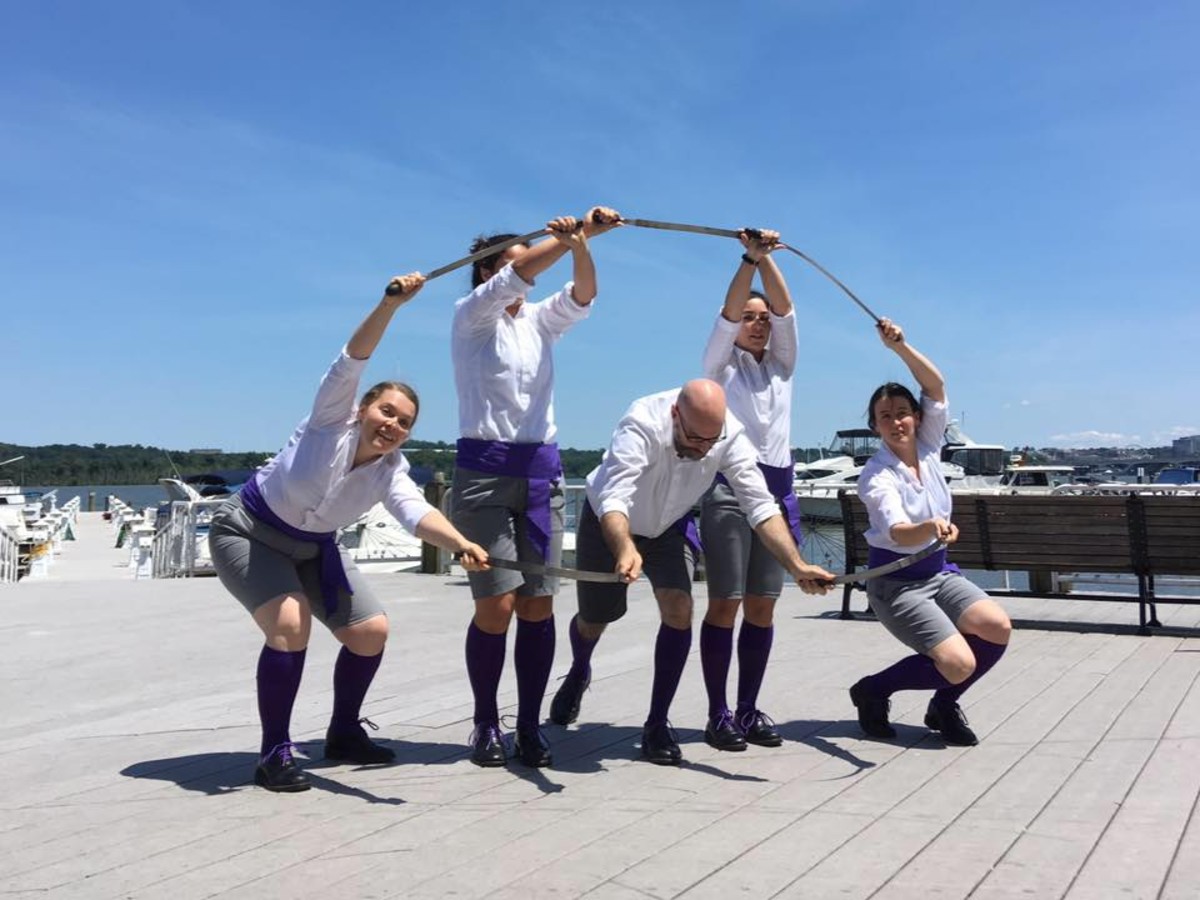
In the U.S., most rapper teams consist of five or six dancers who huddle closely together, holding one end of their own sword and the free end of a teammate’s sword. They clash their swords together, weaving in and out of each other and under and above the swords, forming complex figures. In addition to the sword work, dancers show off their “stepping,” or fancy footwork set to traditional English jigs that are generally 160 beats per minute.
“It’s a very acrobatic, quick style of dance,” says Dave Casserly, who belongs to both of the District’s rapper dance teams, Sligo Creek Sword and Cutting Edge Sword. While DERT in the U.K. can be intensely competitive, DART is usually more fun—since the American scene is smaller, most dancers know each other, and many teach the teenage teams that also compete. Though there’s only one tournament in the U.S. per year, the teams often perform together at non-competitive gatherings, known as “ales.”
Rapper dance teams are frequently social, similar to intramural kickball teams that get together to practice and then head to dinner or to hang out elsewhere. In D.C., Sligo Creek and Cutting Edge regularly perform at the same events, but each team has unique traits. The “Sligo Creek style,” as Casserly calls it, incudes “a little more space to our sets. We do a lot of traditional figures that are common for American rapper dancers, and we have some twists with how we flash our swords.” Cutting Edge, meanwhile, is known for its “very, very tight sets.” “The idea is fast, tight and power, so there’s a lot less of the fancy flourishes with the swords,” Casserly continues. “It’s more about getting there in a strong way, and quickly.”
Both Sligo Creek Sword and Cutting Edge perform with the local morris teams, Foggy Bottom Boys and Rock Creek Morris Women. Morris is one of the most common types of English display dance—think a bunch of people with bells around their ankles, jumping up and down to the tune of a fiddler or accordionist.
There’s a “solid folk nucleus” in the D.C. region, Sakala says, aided by a core group who hold the scene together. She points to a number of local folk festivals each year, such as the Folklore Society of Greater Washington’s annual events. Most feature traditional folk dancing, including rapper dancing. “That infrastructure and network make it particularly easy for people to tap in,” Sakala says.
Casserly has been rapper dancing for nearly 15 years. When he was a junior in college, friends convinced him to join a team. He had no performance dancing experience at that point, though he’d done some social dancing on campus, like tango lessons. Most anyone can become a rapper dancer, he says, provided they’re in reasonable shape and “know how to step on a beat.”
Stewart takes a slightly more specific approach when considering who might enjoy rapper dancing. You have to be willing to stand super close to four other people, she says—and inevitably get soaked in their sweat. Practicing the same thing repeatedly can feel redundant. “And you have to be excited about looking kind of funny in public, and willing to get your knuckles scraped up,” she says. (Dancers occasionally sweep their swords along the floor so their teammates can jump over them, and it’s not unusual for those who are particularly zealous to scrape their knuckles in the process.) Minor injuries aside, she emphasizes that rapper dancing is fun, and gatherings are similar to, say, Comic-Con: a chance to get together and show off your skills, while hanging out with friends and scoping out what other teams are doing.
During Saturday’s DART, dancers will appear at several pubs, with a new performance every 15 to 30 minutes. Dances are capped at 5 minutes and judged on factors like precision, coordination, musicality and the inventiveness of their choreography. Judges also critique stepping and sword-handling skills— the swords all need to be up when they’re supposed to be up, for example, and down when they’re supposed to be down.
On Saturday evening, post-competition, Sligo Creek will host a ceilidh dance—a traditional song-and-dance celebration reminiscent of a Scottish wedding, as Casserly puts it. In addition to the public dance, each participating team will perform, and dancers often take creative liberties or try out new moves.
The experience is an opportunity to “watch some people do mildly death-defying stuff,” Stewart notes—and during the tournament, quiet observation is discouraged. “It’s good form to heckle people,” she says. “You’re there to be like, ‘Oh dang, that was super cool,’ or ‘Oh, I bet you can jump higher than that.’”
Which means, at least in this context, a quick taunt—“you’re so going to drop that sword”—might not be such a gaffe, after all. It’s all in the delivery.
DART starts Saturday at 1 p.m. Competitions take place at Light Horse, Columbia Firehouse, and Bilbo Baggins Restaurant and Green Dragon Pub, all in Alexandria. Free entry.