 Jordan Pascale
Pedestrians, cyclists, and the families of people killed in traffic gave moving testimony in front of the Transportation Committee of the D.C. Council on Thursday, urging support for several roadway safety bills in the District.
The hearing was underscored by the death of a 15-year-old girl, who was killed by a hit-and-run driver on East Capitol Street just two hours before the hearing began. Another pedestrian was hit earlier in the day, too.
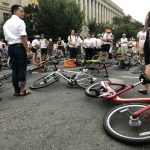
More than 60 people shared how traffic violence has affected their lives.
A driver hit and killed a mother and a grandmother who was on her way to pick up a hairbrush at CVS.
A bus that sucked a cyclist underneath.
A tour bus driver that hit tourists walking across Pennsylvania Ave.
Aggressive truck drivers berating and intimidating cyclists.
A father scared to cross the street with his less than 1-year-old daughter.
Children afraid to ride their bikes.
Many wore black stickers with “3,004” labeled on them, the number of people seriously injured or killed on District roads since 2016.
Tears flowed often as the stories went on for nearly eight hours. So many say they have been affected by traffic violence that the families of victims have created an advocacy group, D.C. Families for Safe Streets, to cope with their losses.
Twenty-one people have been killed in traffic in D.C. so far this year. The city adopted a Vision Zero approach to traffic safety in 2015, but traffic violence has increased every year since then. This year it’s down about 30 percent so far.
The testimony boiled down to “D.C. streets aren’t safe, do something about it.”
“This makes it real for people who may react to these [bill] proposals,” said committee chair and Ward 3 Councilmember Mary Cheh. “These are not statistics, they are people’s lives.”
Seven Bills Aim To Address Issues
The seven bills aim to reduce speed limits, ban right turns on red, mandate more protected bike lanes and have stricter drunken driving laws.
- The Bicycle Advisory Council Expansion Amendment Act seeks to get the Department of Public Works on the city’s bike council. Public Works is in charge of ticketing for obstructing bike lanes.
- The Mandatory Protected Cycling Lane Amendment Act aims to install protected bike lanes immediately anytime a street that is scheduled to have a bike lane in the future is torn up or reconstructed.
- The Curb Extensions Act requires DDOT to install curb extensions anytime an area is reconstructed or repaved. Curb extensions help reduce pedestrian crossing distances.
- The Cyclist Safety Campaign Amendment Act seeks to add questions to the DMV drivers license test about cycling laws and how to drive around cyclists. It also establishes a public outreach campaign.
- The Ignition Interlock Program Amendment Act says that if a driver convicted of drunken driving doesn’t enroll in the ignition interlock program within 30 days, their license and vehicle registration will be suspended.
- The Vision Zero Distracted Driving Amendment Act would make it so that points can be assessed to a license for a distracted driving offense.
And last the largest bill, the Vision Zero Enhancement Omnibus Amendment Act, comes with a number of provisions.
The omnibus wants to reduce speed limits to 25 mph on most minor arterial roads and 20 mph on local and residential roads, in addition to banning right on red turns.
It also calls for pedestrian improvements like connecting sidewalks and having sidewalks on both sides of the street. The bill would allow $10,000 a day fines for contractors who do not restore crosswalks and bicycle lanes within 24 hours of completing work.
Cars parked illegally in crosswalks and bicycle lanes can be impounded. It also allows parking enforcement staff to mail tickets when a driver leaves before receiving the ticket
It also addresses the rise of ride-hailing, and food and package deliveries’ impact on roads. The omnibus requires that new developments with 10 or more units create a space for pick-ups and drop-offs that don’t block right-of-way of sidewalks or bicycle lanes.
Drivers also would be required to take a written exam to renew their licenses.
Parking enforcement would be able to target repeat reckless drivers by impounding parked cars with five speeding violations at 31+ mph over the speed limit or violations for passing a stopped car yielding to pedestrians in a crosswalk.
In between emotional testimonies, the hearing also saw pushback typical of such meetings.
People equated cyclists not following the rules of the road with drivers who did the same behind two-ton vehicles. AAA argued that slowing cars down and banning right on red turns would just make drivers more frustrated and would do nothing to increase safety.
At the end of the night, directors of the District Departments of Transportation, Public Works and Motor Vehicles testified on everything from replacing crosswalk striping to retesting drivers.
DDOT Director Jeff Marootian said the department is against the idea of blanket rules of right on red for the whole city, saying each intersection and road should be looked at individually.
He also says reengineered roads are more important than speed limit reduction: Instead of just changing the rules, which drivers will still break, make it physically harder to speed.
DMV Director Gabriel Robinson said he’s for additional testing, but hasn’t seen studies on if it works to improve driver behavior.
All seven bills, which were introduced earlier this year, will now go to the full council, which will review them later this fall.
Ward 6 Councilmember Charles Allen said the testimony was important to hear, but what mattered is what they do after the hearing. Later, he said he believed the directors and the council share the same values but is frustrated by the path they are going on.
“It feels like working in fits and starts,” Allen said.
This story originally appeared at WAMU.