It was far from ideal conditions in Washington on Sunday morning for the 44th Marine Corps Marathon. Sheets of rain came down in slants, and the course at times turned gusty, testing runners’ endurance in an already challenging race.
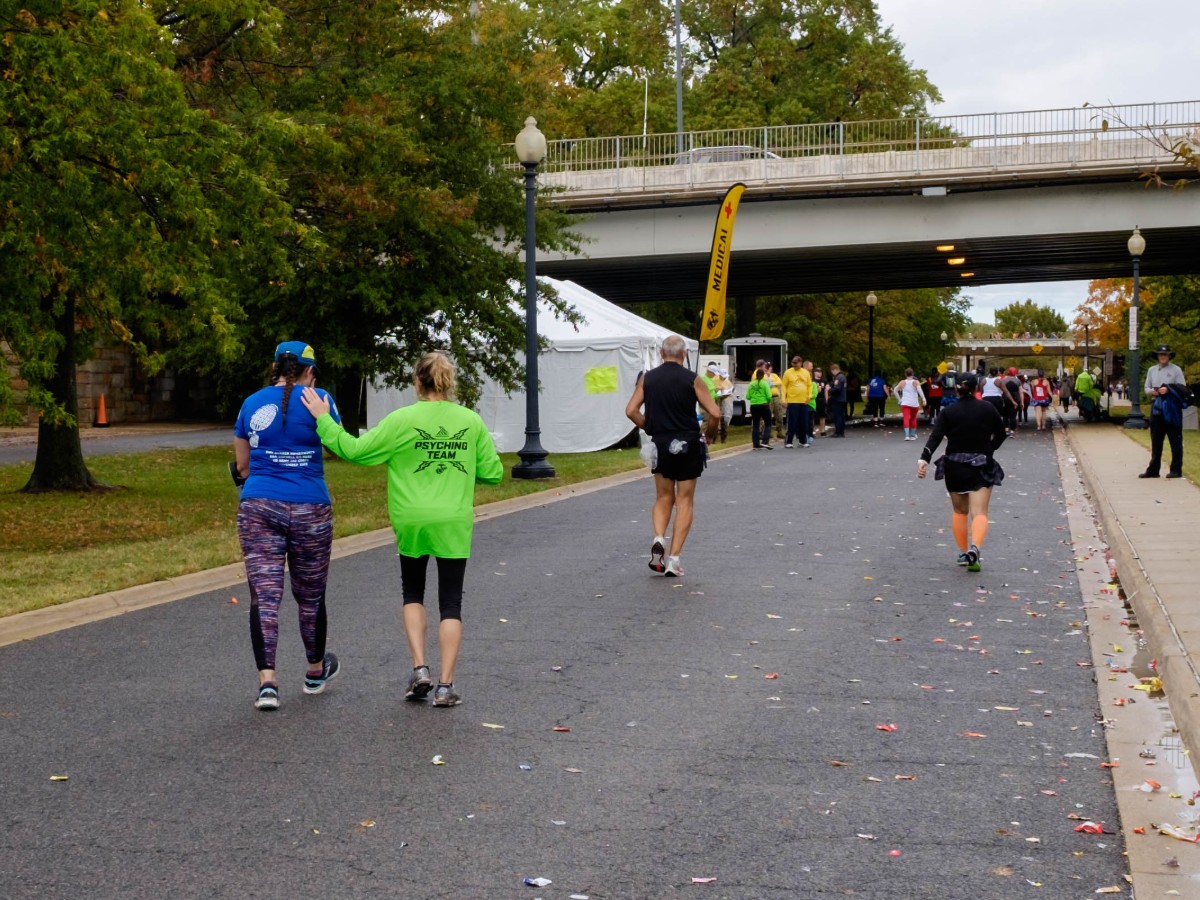
It was dreary and chilly as participants slogged toward the halfway mark on tree-lined Hains Point, where volunteers who wore lime green shirts kept a watchful eye on the course.
“Hey, how are you doing?” VJ Iannone, one of the volunteers, asked a runner walking by, lightly touching her shoulder.
The soaked runner, rain dripping off her glasses, shrugged miserably.
“Can I walk with you for a bit?” Iannone continued. And, after a nod, the woman matched the runner’s stride and they were off, talking along the way.
She was one of the members of the marathon’s new psyching team, a group of six psychologists—not all of them runners—who volunteered their time to assist runners on the course.
“I’m part cheerleader out here,” said Jennifer Lager, a clinical psychologist in Tysons Corner who developed the team for the marathon, as she walked along the course. She’d been jogging with runners braving the roughly 26.2-mile feat, escorting them to a nearby aid station offering them encouragement—and even let a runner whose phone died use hers. “Whatever we can do to help.”
This year marked the marathon’s first use of a psyching team, but the concept isn’t new: The Toronto Marathon has built on its psyching team program since 1999, and the Boston Marathon added one after the deadly bombings in 2013.
“Marathons are just as much psychological as they are physical,” Lager said. “There are lots of challenges that need to be overcome.”
Lager, the driving force behind the psyching team here, said she’s been trying for years to bring one to the Marine Corps Marathon. She finally found an opportunity at Hains Point. That’s where organizers have noticed a significant increase of runners stopping at aid station No. 5, at the very bottom of East Potomac Park, over the past three years, said Shelly Weinstein, the marathon’s medical operations coordinator.
Aid station No. 5 reported 60 users in 2016, 89 in 2017, and then last year, 125—despite the weather being cooler than the previous two years. Runners at the aid station primarily received doses of medicine like Tylenol and ice packs.
Organizers went looking for answers. “It was strongly suggested that we give [a psyching team] a try,” Weinstein said.
Musculoskeletal problems are always the No. 1 complaint in the race, she said, but only the Hains Point aid station saw such a big jump in use, making it “statistically significant.”
“Most of our aid stations see the same number of runners, even with shifts in weather,” Weinstein said. “Something is going on.”
Organizers have a few suspicions: Because of its location, Hains Point doesn’t have many spectators, so isolation might be a factor, Lager said. That was especially true on Sunday morning, which cycled through periods of heavy downpours that only the most determined spectators were willing to brave.
Temperature might come into play, too. “It’s the coldest location on the course, no matter the weather, because there is water on both sides,” Weinstein said. (The marathon collects temperature data at four points along the course.)
Weinstein and Lager both suggested that there might also be a psychological element involved, too. Hains Point is home to the Wear Blue Mile, which falls around Mile 12 and is lined with American flags and placards featuring the names and faces of fallen servicemembers. It’s a somber memorial organized by the nonprofit Wear Blue: Run to Remember. “Runners might be slowing down as they pass through it,” Weinstein said. “Maybe there’s an emotional piece.”
Placing the psyching team around the halfway point was also a natural fit. “At the halfway point, runners are assessing themselves,” Lager said. “They might be thinking: ‘I’m really tired, I’m not hitting my times, it’s time to move to Plan B and adjust goals.’”
That’s where the psyching team comes in. The volunteers worked the sidelines between miles 11.5 and 15, checking in with runners passing by and looking for anyone struggling. “You can’t just sit back and wait for runners to seek you out,” Lager said. “You really have to work to introduce yourself.”
Some runners had stopped to stretch out cramps, and still others were limping along. If a runner was willing to chat, the psychologists would try to help them take stock of their situation and help develop a strategy to finish strong.
Some of that strategizing is as simple as helping runners chunk up their race by shifting their focus every mile, instead of on how much farther they have to go to the finish line. It also might entail discussing runners’ motivation for taking on the marathon, as a refresher. Or it could be helping a runner move from what psychologists call an “outcome goal,” such as finishing time—to a “process goal,” like finishing with a positive mindset.
Psyching team members also helped coach people through the disappointment that comes with needing to drop out of the race, or discovering they wouldn’t make the dreaded time cutoffs. Runners must make it through three gauntlets—one at Independence Ave. and 15th St., another in Crystal City, and a third across the 14th Street Bridge—by specific times, or they won’t be recognized as official finishers. That means they must maintain a pace of 14 minutes per mile.
On Monday morning, Weinstein said the psyching team’s efforts were well received. “[Organizers] loved the concept and what was done,” she said, adding that the team had a “very positive impact” —especially as the rains halted around 11:30 a.m., and the sun came out, increasing the heat.
This year, aid station No. 5 saw 101 people during the race, she said, and heard from her staff that they believed the psyching team contributed to that reduction in numbers. She also increased the aid station’s size by 100 square feet and added 25 personnel, bringing the staff up to 68 medical volunteers.
For Lager’s part, she said she hopes the marathon will extend an invitation for the team to return—and that she’ll be able to recruit more psychologists. An industry conference meant many local psychologists weren’t able to volunteer their time this year. “We could have benefited from having more [psychologists] out there,” Lager said. “The weather made it a tough race for a lot of people.”
Marathon organizers are likely to invite the team back next year and expand their role, as well as train more of its medical staff in how to assist runners from a mental health perspective, Weinstein said.
“It was a good pilot,” Weinstein said, adding that the feedback she received was they could have used more psychologists on hand. “On a day like yesterday, it was definitely needed.”
And many runners seemed glad for the check-ins. Even just asking someone walking by how they were doing was at times was all that they needed.
“How’s your race going?” Lager asked one runner, dressed in a Wonder Woman shirt.
“Awful,” she answered grimly.
“Would you like some company?” Lager asked, turning to walk with her.
“No,” she said. “I’ll be good.” She picked up her pace again, and she continued on her way.