Natalie Delgadillo
Salvadorans are the largest immigrant group in D.C., according to Census and American Community Survey data culled by the Urban Institute. The community is so hugely influential among the Salvadoran diaspora that the owner of Lauriol Plaza, who was born in El Salvador, was recently asked to join a presidential ticket in his home country.
But many of them have been living with profound uncertainty for nearly the past two years.
About 32,000 Salvadorans in the D.C. area—and 200,000 around the country—are beneficiaries of Temporary Protected Status, which gives people provisional permission to reside in the United States due to natural disaster or dangerous levels of conflict in their home countries (nine other countries are also currently designated for TPS: Haiti, Honduras, Nepal, Nicaragua, Somalia, Sudan, South Sudan, Syria, and Yemen.)
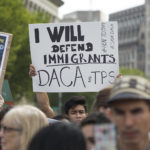
The Trump administration has been trying to end TPS for Salvadorans since January of 2018 (several other countries also face possible TPS termination, including Haiti and Honduras), resulting in a series of legal challenges, protests, and a climate of fear ahead of a looming January 2020 expiration date.
On Monday, though, the community got some measure of peace: the governments of the United States and El Salvador announced that they have reached an agreement to extend protections for Salvadoran TPS recipients for another year.
In an announcement on Twitter Monday morning, Salvadoran President Nayib Bukele and U.S. Ambassador Ronald Douglas Johnson said that they had successfully signed an agreement to extend TPS. “With this, various decision makers will have additional time to search for a permanent solution,” Salvadoran President Nayib Bukele said in Spanish in a video announcing the agreement on Twitter. “We will keep working side by side to construct a better and more prosperous El Salvador for everyone.”
Later, though, the Department of Homeland Security painted a more complicated picture, announcing that it would only be extending work permits for Salvadoran TPS recipients until January 4, 2021. The agreement also states that Salvadorans with TPS will have 365 days from the conclusion of TPS-related lawsuits to go back to El Salvador.
“A clarification: some reporting has spoken of ‘extending TPS,'” wrote acting director of U.S. Citizenship and Immigration Services Ken Cuccinelli on Twitter. “That has important legal meaning, and that’s not what happened w/ the agreements. Rather, work permits for Salvadorans will be extended for 1 year past resolution of litigation for an orderly wind down period.”
Salvadoran Foreign Affairs Minister Alexandra Hill called that distinction a “technicality” to press. The back-and-forth about the announcement has left uncertainty about how the agreement will practically play out.
“The devil is in the details. We want to see what are the provisions of this permit, because from Cuccinelli’s tweet we can only guess,” says Abel Nuñez, executive director of local advocacy organization CARECEN. “What is clear is that January 2 is not the end of TPS … this allows people to go get a legal consultation and hopefully expand their protections and look at their options.”
Meanwhile, the extension of TPS protections wasn’t the only thing El Salvador agreed to on Monday. The country has assented to ramping up collaboration between Salvadoran national police and U.S. federal immigration officials, including sharing biometric data. Officers from U.S. Customs and Border Protection, as well as Immigration and Customs Enforcement, will also travel to El Salvador to “advise and mentor” the national police, per DHS.
The announcement carries particular weight in D.C. Immigrants from the country—particularly from Intipucá, a town on the Pacific coast—have been settling in D.C. and its surrounding suburbs for decades.
“I’ve been afraid, because it makes me think about all that I’ve accomplished up to now, and I’m going to have to lose it all and start a new life,” says Erickson Ramirez, a Salvadoran TPS recipient living in College Park, in Spanish. Ramirez has been in the U.S. since 1999, and he received TPS in 2001. He has two children in the U.S. with him, one of whom is 18 months old and a U.S. citizen.
“The truth is I’m very happy today, not just for me but for the rest of the Salvadorans who depend on TPS,” he says. “Many of them are in my situation, or maybe they’re in a different situation but just like me, they’ve made a life in this country and they feel like they belong here.”
Salvadorans, who are the largest beneficiaries of TPS in the country, were granted the status after two disastrous earthquakes in the country in 2001, and it has been extended by various administrations since then.
“We cannot afford further temporary fixes to TPS; it is time for full citizenship for our Salvadoran neighbors, who are part of the fabric of our community and have called DC home for decades,” Mayor Muriel Bowser said in a statement later on Monday. “I urge the Senate to take up House-passed legislation to permanently protect Salvadoran TPS holders and provide these aspiring Americans with a pathway to citizenship.”
This story has been updated with additional comments and clarification from the Department of Homeland Security, USCIS, advocates, the mayor, and a current TPS recipient.