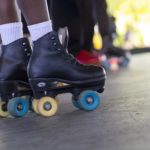
Lace up your skates and get ready to roll: D.C. is bringing back skating culture at with the first-ever Capital Skate Festival at the DC Armory on Saturday.
The event, which is hosted by the DC Office of Cable Television, Film, Music, and Entertainment and Mayor Muriel Bowser’s Office, hopes to celebrate D.C.’s roller skating culture.
“People need to see that roller skating is still alive and well in the country and thriving right here in our region,” says Saletta Coleman, Capital Skate Festival co-producer.
The event officially begins at 3:30 p.m. with a welcome kick-off where skaters can get fitted for roller skates and purchase them from skate artisans (free rentals are also available). There will also be skate performances from local troupes and concessions available for purchase. DJs including DJ Soulnificent, DJ Joe Bowen, and DJ Freestyle will perform throughout the day.
The event took 17 months of planning, drawing more than 300 everyday skaters from far-flung places including New York, California, and England. Even though the event is drawing many visitors from out of town, Coleman says that the group wants D.C. residents to experience what the skating culture was like here for decades.
It all started when OCTFME director Angie Gates saw United Skates, a documentary about the history of skating in urban communities, at the 2018 Tribeca Film Festival. Coleman was an associate producer on the film. Gates wondered what the current skating presence was like in D.C., Coleman says, and was surprised to learn from Coleman that it wasn’t like it used to be.
Looking back at D.C.’s history, the roller skating scene thrived, Coleman says.
“[Skating] is attached to the music and how the city moves,” Coleman says. “It’s very much connected to your city’s music culture. What’s done in Atlanta doesn’t look the same here.”
There was a time when D.C. had as many as five skating rinks at one time, including Riverside Stadium, which was near the Kennedy Center. It was a multi-purpose space where roller skating took place regularly, Coleman says.
“Skating was so popular in D.C.,” Coleman says. “To know it had five rinks at one point, is astonishing. That’s a lot of rinks.”
But keeping the rinks open was an issue; as land values went up, more places closed down. Even though indoor spaces closed down, people still wanted to skate and outdoor options became available. Roller blades rose in popularity in the late 1980s, Coleman says, because it was easier to ride outdoors on rough, uneven pavements.
The National Roller Skating Rink (also known as the Kalorama Road Rink), the last indoor rink in the city, closed in 1992. Based on her experience skating along the East Coast, Coleman says she noticed that the District seems to be the only major city from Atlanta to New York that doesn’t have an indoor roller skating rink. D.C. still has the outdoor Anacostia Park Roller Skating Pavilion, but it closes during colder times of the year and people can’t go out to skate as regularly as before. A thriving skating community still flocks to rinks in Maryland and Virginia.
Gates wanted to find a way to reintroduce skating in the District, and after discussing the plan with her colleagues, the Capital Skate Festival was born.
For Coleman, being involved in the rebirth of the skating community means a lot to her. She’s a hardcore skater herself, ever since a friend introduced her to the sport in 2001 to cope with the events of 9/11. She needed something to let her hair down, but night clubs weren’t her thing. Skating gave her everything she needed.
“I had music, peer groups, cardio; I had never felt more free,” Coleman says. “It became my thing. When I’m stressed and I hit the wood, nothing else exists.”
Capital Skate Fest takes place at the DC Armory on Saturday. Skating open 4:30 p.m.-7:30 p.m. and 7 p.m.-12 a.m. Admission $9.40 for adults, free for kids 12 and under. Registration required.