Rachel Kurzius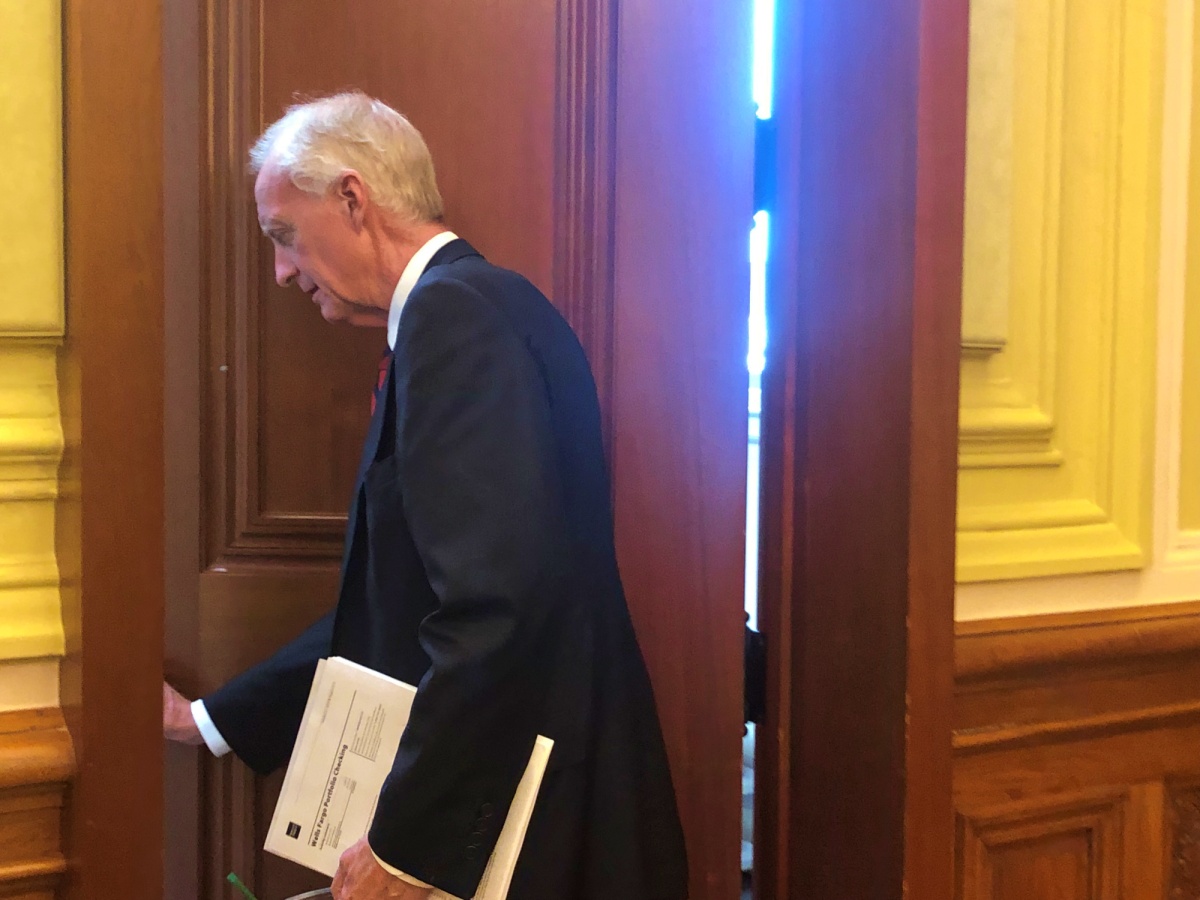
Over the summer, Ward 2 Councilmember Jack Evans cast a decisive vote about … well, Jack Evans. His vote ensured that he would remain on committees, even as he was removed as the chair of the Finance Committee amid a D.C. Council investigation into his potential conflicts of interest.
In light of allegations that he used his public role for private gain, it was one of a bevy of votes that Evans cast about his own future on the council (he denies those allegations). And he is sure to vote on more, too: Ward 3 Councilmember Mary Cheh, who is chairing the committee that will decide on Evans’ discipline, confirmed at a press conference last week that the Ward 2 councilmember will be able to vote on his own punishment once it’s taken to the full council.
But now, the question of whether Evans is permitted to vote on his own discipline is itself a matter of investigation by the Board of Ethics and Government Accountability, as first reported by The DC Line.
The investigation was prompted by a complaint from Alan Roth, a former Ward 1 Advisory Neighborhood Commissioner, who outlined all of the times Evans voted on amendments that impacted him on a personal or professional level.
Roth alleges that Evans’ votes are a violation of D.C. law related to standards of conduct for city government employees, adding that “the stench rising around his votes … surely undermines the public’s confidence in the integrity of their District government.”
At its November meeting, BEGA director Brent Wolfingbarger confirmed that the board opened a formal investigation into Roth’s complaint about Evans. This summer, BEGA fined Evans $20,000 over emails sent from his D.C. Council office, in which he sought job opportunities with law firms and hawked his connections in D.C. government. For the BEGA settlement, Evans did not admit to wrongdoing.
Those emails also prompted a D.C. Council reprimand, and a probe from the Metro board’s ethics committee. Metro’s investigation uncovered “a pattern of conduct in which Evans attempted to and did help his friends and clients and served their interests, rather than the interests of WMATA,” according to a memo from the law firm. Evans stepped down from the Metro Board of Directors following the release of that memo, after initially contending that the ethics committee had cleared him of all wrongdoing. Evans is also facing a federal probe.
Evans’ office is not releasing any statements about the most recent BEGA investigation.
Since the council’s report was released last Tuesday, the majority of the D.C. Council is now calling on Evans to step down.
D.C. Council Chairman Phil Mendelson, among the few lawmakers who haven’t publicly called for Evans’ resignation, has contended that it is not a violation of D.C. Council’s ethics code for Evans to vote on his own discipline. “It has always been the practice of the council, modeled after Congress,” Mendelson said in an emailed statement. “If the council is going to discipline a member it should be such a clear majority that the member’s vote does not affect the outcome. Also, the assumption behind the question is that the member is guilty of the alleged violation, but it is conceivable that it may not always be the case, and the member should be able to defend him/herself by voting against the discipline.”
Evans’ lack of recusals is not just a question for BEGA. The issue came up repeatedly in law firm O’Melveny & Myers’ investigation into the Ward 2 councilmember, which found that he violated the D.C. Council code of ethics 11 times in five years. The report states that Evans “failed on several occasions to recuse himself from matters involving financial interests of a prospective employer.”
Martin Austermuhle contributed reporting to this story, which has been updated to reflect Roth’s accurate ANC ward.