Martin Austermuhle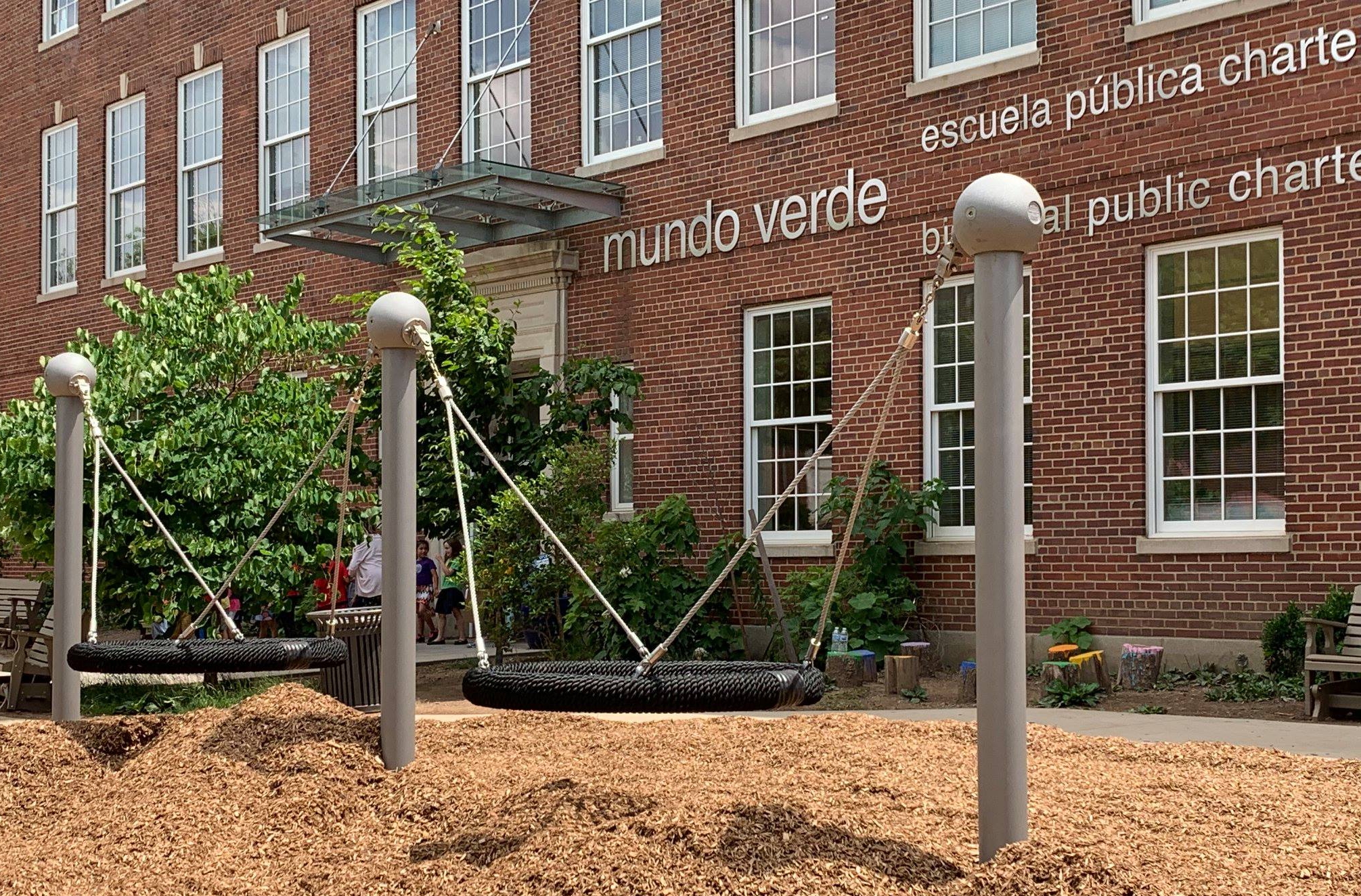
Teachers, staff, and management at one campus of the Mundo Verde Bilingual Public Charter School in D.C. have agreed on a tentative union contract, putting the popular school a vote away from becoming the first charter school in the city’s history to unionize.
The move to form a union—which now only needs final approval from teachers and staff at the campus on P Street NW—is significant because it departs from one of founding principles of the charter movement, which was to break free from the traditional constraints faced by public schools and their unionized workforce.
But as charter schools have expanded nationwide, there have been parallel pushes to unionize the teachers and staff who work there. There have been successful union drives in Chicago, New Orleans, and California, while states like Maryland require any charter operator to allow collective bargaining.
In D.C., an effort to unionize teachers at Paul Public Charter School fizzled in 2017, while another at a campus of the César Chávez Public Charter School resulted in teachers voting to form a union—but the campus then closed due to declining enrollment. (Teachers say the closure was an act of retaliation.)
For teachers at Mundo Verde, which has 600 students in PK3 to 5th grade at its P Street campus, the move to unionize flowed naturally from the bilingual school’s mission.
“Mundo Verde has a really big commitment to social justice and equity, and we teach that to our students. The conversation about how do we provide teachers with more resources, and how do we give teachers and educators a voice is not a new one. There were a lot of spaces for us to share these feelings with leadership of the school, but it felt like it was time to do something more formal,” said Andrea Molina, a kindergarten teacher and member of the bargaining unit.
The effort began late last year, Molina says, after school administrators surprised staff by announcing they would have to share in more of the costs of their healthcare. Staff responded with a letter asking for more input in how decisions are made, and soon thereafter started organizing a union under the auspices of the American Federation of Teachers.
By April of this year, a petition signed by more than 80 percent of teachers and staff at the campus was submitted to administrators, but the school’s leadership refused to voluntarily recognize the union. A month later, a majority of the 115 teachers and staff voted to form a union, kicking off contract negotiations that ran through the summer months. (Staff at a new campus in Northeast are not covered by the agreement.)
The tentative agreement—which is expected to be ratified by teachers and staff in the coming weeks—includes benefits like job security that are rare in charter schools.
“Every single teacher that works at a charter school in D.C. works at will, and that means they can be terminated whenever,” said Molina. “But that’s not the case with us anymore. We’re no longer at-will employees, and that’s amazing.”
Molina says teachers also have guaranteed raises every year for the next three years because of the collective bargaining; and just cause, which is a grievance procedure for any disputes. “That just gives us a lot of security in the job,” Molina said.
School officials say the contract negotiations involved give-and-take and resulted in compromises on both sides.
“Our leadership team and bargaining team members demonstrated the true spirit of negotiation, engaging respectfully, openly and directly. Both sides made appropriate concessions to address what matters deeply to our staff, while also ensuring the long-term financial sustainability of our school and, most importantly, the success of our students,” said Kristin Scotchmer, Mundo Verde’s founding executive director.
In an email sent to parents, Scotchmer said the school’s leadership remained committed “to continue to work in good faith to ensure the tentative agreement is ratified as a contract.”
Randi Weingarten, president of the AFT, calls the negotiations and tentative agreement a “win-win … we rarely see in the charter school sector.”
But some fervent advocates of charter schools see the development at Mundo Verde in much starker terms.
“I think it’s a terrible development, and overall it will hurt our charter school movement,” said Mark Lerner, an education writer who also served in leadership positions of various charter schools. Charter schools “need to be able to react quickly, and if you have to work through a collective bargaining agreement, you can’t make changes quickly. If unions were widespread throughout the charter movement, they would look more and more like DCPS schools where it’s difficult to fire teachers, change curriculum, or change times.”
The teachers’ union contract was of particular interest to former D.C. schools chancellor Michelle Rhee, who re-negotiated its terms to allow highly rated teachers access to specific pay bonuses—in exchange for some of the usual job protections built into many contracts.
But the challenge of unionizing D.C. charter schools—which educate almost half of all students in the city—remain significant, largely because there are so many independently operated schools, and, as in Mundo Verde’s case, teachers and staff at one campus could unionize while those at another don’t.
Molina says there are lessons to be learned from what she and her colleagues went through at Mundo Verde, and she hopes it sparks a trend.
“We hope that this is inspiration for other charter school teachers in the District,” she said. “Teachers are workers too, and they deserve to be protected under the law and they deserve rights.”