Martin Austermuhle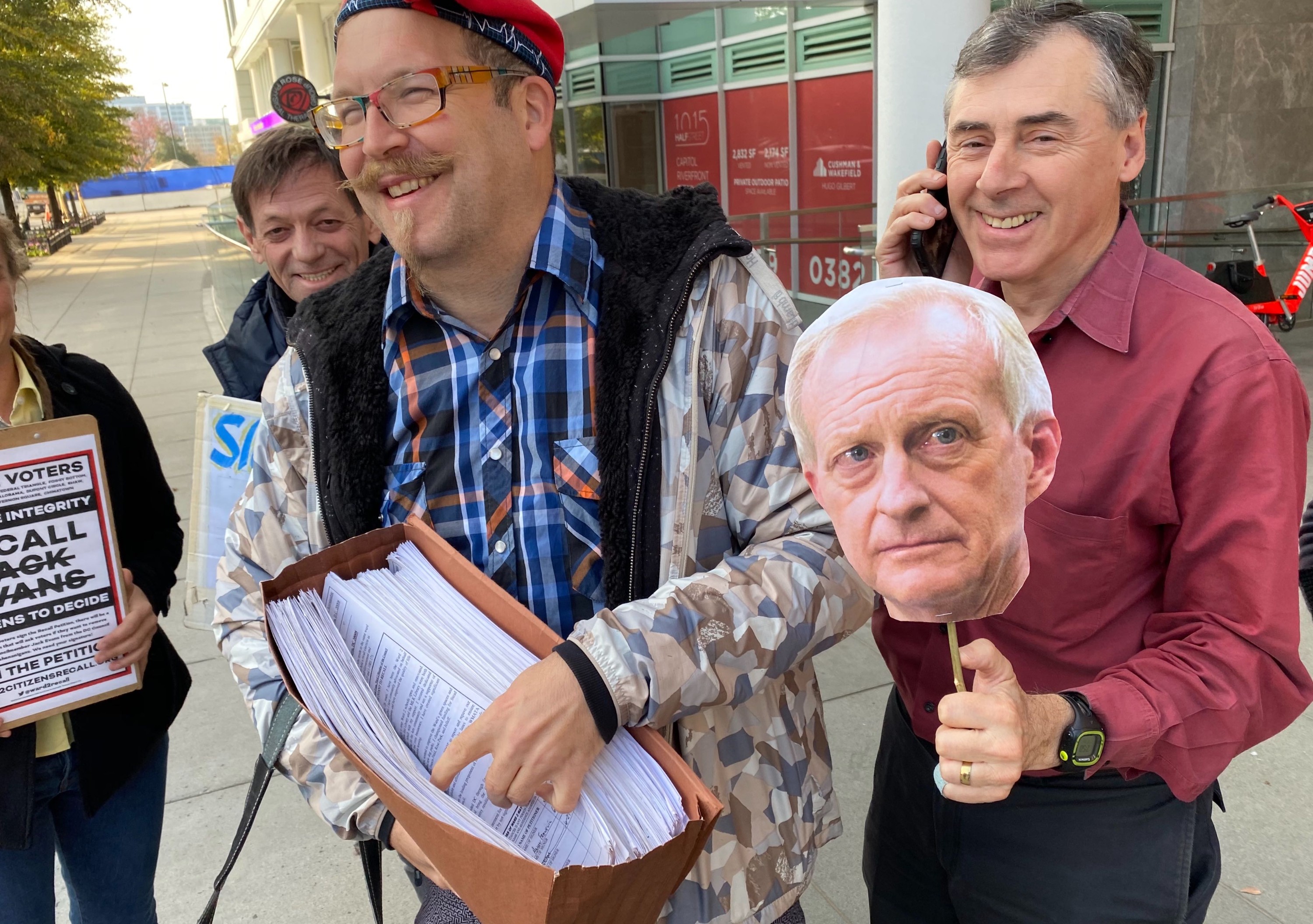
A group of activists looking to recall embattled Ward 2 D.C. Councilmember Jack Evans from office submitted what they said are enough signatures from his constituents to force an election in the coming months.
The Committee to Hold Jack Evans Accountable submitted more than 5,588 signatures from registered Ward 2 voters to the D.C. Board of Elections on Monday as part of an effort to force a recall vote — essentially, a chance for voters to un-elect him from the seat he has held for 28 years. If the Board determines the committee gathered 4,949 valid signatures — that’s 10 percent of the number of registered voters in Ward 2 — it will trigger the city’s first-ever recall vote for a member of the Council.
“While Councilmember Jack Evans has been asked to resign by most of his colleagues on the D.C. Council, it will be his constituents who have the final say,” said Adam Eidinger, who is leading the recall effort. “I offered to suspend this campaign on multiple occasions, but Mr. Evans has refused to either resign or indicate that he would not seek re-election, so for the last six months we have spoken to thousands of voters who overwhelmingly support restoring integrity, and these signatures are proof.”
The possibility of a potential recall only ramps up the pressure on Evans, who is facing accusations that he used his public office for private gain. A recent investigation commissioned by the Council determined that on at least 11 occasions over the last five years Evans violated the city’s code of ethics by taking public action to benefit private clients — and not disclosing those clients publicly.
An ad hoc committee of his colleagues will gather tomorrow to hear from the law firm that led the investigation, and Evans has been invited to speak to the committee on Dec. 3. In a 40-page document he submitted to the Council, Evans said he never intended to break any rules, that existing ethics guidance is difficult to understand and that none of the votes on legislation he cast changed because of clients of his consulting firm.
The Council will consider a range of punishments, including potentially expelling him. A majority of his colleagues have already called on him to resign from office. On top of that, Evans — who was first elected to the Council in 1991 — faces at least six challengers in next June’s Democratic primary.
A recall vote, should it happen, could toss another variable into an already fluid situation in Ward 2. The Board of Elections has 30 days to decide whether enough valid signatures were submitted to force an election. During that time, Evans or his allies will be allowed to review and challenge signatures. In many cases, campaigns collect twice the number of signatures needed to ensure the board’s review and challenges from opponents.
If the Board confirms the petitions are valid, it must call an election within 114 days, which would cost an estimated $250,000. And if Evans is recalled, another election would have to happen, with 114 days to elect someone to finish out his term (which is up in January 2021). That could coincide with the June 2, 2020 Democratic primary, meaning the voters in Ward 2 would both be choosing someone to fill Evans’ seat on a temporary basis and someone to stand as the Democratic contender for that seat in November’s general election; it could be the same person.
Evans has not yet said if he would run for another term, but he could do so even if he’s recalled from office. He said he has no comment on the current recall effort.
Eidinger, who in 2014 organized a successful ballot initiative to legalize marijuana, said he feels confident with the signatures he and other volunteers collected. But he believes the board has not done a good job managing the voter rolls in Ward 2 and said it meant they had to collect a higher number of signatures to hit the 10 percent threshold.
“If the board says we don’t have [the signatures], we’re going to challenge. And it’s going to be based on the fact that we canvassed the whole ward and we know who’s here and who’s not. We need a judge or the board to revise the [number of voters] down. It’s not going to be a clean victory,” he said.
Eidinger said the six-month-long signature-gathering raised roughly $7,000 and was done largely independently of the candidates seeking to replace Evans.
“There hasn’t been any support from the campaign,” he said. “They kinda treated me like a pariah over the last six months. I think it’s remarkable that we got this far.”
This story first appeared on WAMU.