Martin Austermuhle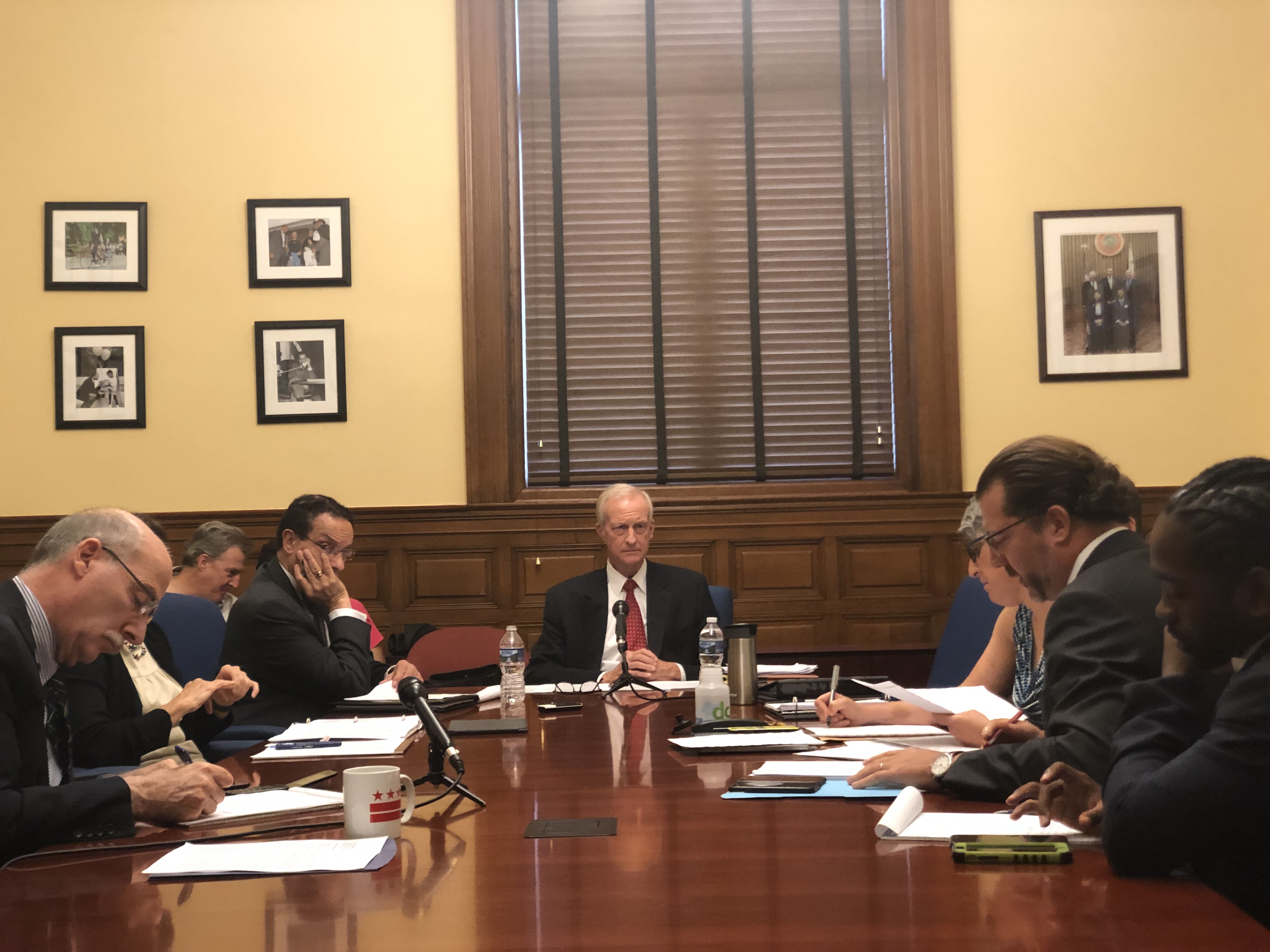
The attorneys who completed an investigation into alleged ethics violations by D.C. Councilmember Jack Evans (D-Ward 2) told a council committee on Tuesday that there was little question that he broke the rules—but they refused to conclusively weigh in on whether he intended to do so.
And that critical question—did the council’s longest-serving member purposely violate ethics rules, or merely do so without realizing it?—could ultimately be the deciding factor as his colleagues weigh whether to expel him or impose a lesser punishment.
The testimony and questions revolved around a 100-page investigation conducted by law firm O’Melveny & Myers over the summer and made public earlier this month that found 11 instances over the last five years where Evans had used his public office for private gain. During that period, Evans worked for a law firm with clients that had interests in the city and then started his own private consulting firm whose paying clients included developers, an operator of D.C. multiple parking lots and a new digital advertising sign company.
Evans “repeatedly participated in his official capacity in ‘particular matters’ in which his outside employers or his personal clients had direct financial interests, failing to recognize the inherent conflict that should have been disclosed and addressed,” concluded the report, which was based on interviews with 16 people, including four separate sessions with Evans, and a review of 240,000 pages of documents.
In a 42-page response, Evans said he didn’t mean to break any ethics rules, contended that the rules he may have broken were vague and difficult to follow and asserted that his votes on legislation and other official actions he took were consistent with his decades in public office and were not swayed by what his paying clients wanted.
But that defense didn’t sway Steve Bunnell, a former federal prosecutor and current attorney at O’Melveny who led the investigation into Evans and fielded questions from Council members for more than four hours on Tuesday afternoon.
“I don’t think it really matters if you are willfully violating a conflict of interest provision or aren’t paying attention, it’s a violation either way,” he told the Council’s ad hoc committee, which was created to weigh possible punishments for Evans.
But Bunnell avoided going further than that, even when some Council members pushed him on the issue of whether Evans intended to break ethics rules that bind all lawmakers.
“We don’t look at whether Mr. Evans knew at the time this was a violation and said, ‘I’m going to do it anyway’ or he was confused about it. Because of the nature of the ethics rules, I don’t think it matters because of how the community is going to perceive the actions. We did not try to get into Mr. Evans’ head,” Bunnell said.
Council rules allow for members to expel one of their own, though it takes 11 votes to do so. And the guidance for doing so is vague, saying that expulsion is reserved for “egregious wrongdoing” and “should be used in cases in which the Council determines that the violation of law committed by a member is of the most serious nature, including those violations that substantially threaten the public trust.”
While a majority of Evans’ colleagues have already called on him to resign, only a handful have said they would currently vote to expel him. And without a clear sense that Evans flouted the rules, he may be spared the most significant punishment the Council can dole out.
Bunnell said that in the investigation of Evans, attorneys did find cases where he was sensitive to the possible conflicts that holding outside employment—which Council rules allow—could produce. His contracts with his clients included a conflict-of-interest provision that prohibited Evans from voting on matters that directly related to those clients, but those provisions also did not stop him from taking other actions to assist them.
“There were instances where he was sensitive to possible conflicts. We’re not here to suggest he never took steps to mitigate conflicts; he did on some occasions. There were also occasions he didn’t,” he said.
And Bunnell said that it didn’t seem that Evans was prepared to handle all the possible conflicts that could have emerged from representing private clients with business before the city.
“When you structure the kind of outside employment Mr. Evans had … you put yourself in a position where it’s really hard to avoid conflicts unless you’re on top of everything. We did not see an indication there was a system in place to manage those conflicts. It was not isolated … it was a function of how things were set up,” he said.
But some lawmakers hinted that regardless of intent, the investigation clearly found that Evans had violated the Council’s code of conduct—and that’s what ultimately matters.
“A lot of time you might say, ‘I did not intend to violate ethics code X,’ ” said Councilmember Mary Cheh (D-Ward 3), herself a constitutional law professor and chair of the committee. “But did you intend to do what you did? In terms of intent like that, he wasn’t acting like someone who was sleepwalking. He intended not to disclose. He intended to take on these clients. He intended not to specify who they were. He intended to do all of those things.”
Councilmember Charles Allen (D-Ward 6) appeared to agree with Cheh’s sentiment.
“It’s pretty clear as you read through the report there’s a pretty intentional effort of portraying himself as this bungling, care-free, doddering person who just didn’t know the rules. But then the body of evidence just tears that apart. It looks like it’s a part of a legal strategy,” Allen said. “It’s very clear that when we violate ethics law over and over and over again, it’s a pretty thin argument that you kinda fell into it.”
Still, the road forward in terms of possible punishments remains unclear. Anita Bonds (D-At Large) asked whether expulsion can only come if a law was violated — and if breaking ethics rules would count. Vincent Gray (D-Ward 7) said he is looking to understand what the Council rules say about violations of policies as opposed to laws.
Evans has been invited to speak to the committee and take questions on Dec. 3. After that, the committee will determine if Evans will face any punishment.
“We will look at, cumulatively, what this means and whether there’s a pattern and practice,” Cheh said. “It’s important to put it in that context. I think you have to look at the entire picture.”
Evans also faces a number of other investigations and a questionable political future. A Washington Post poll found that a majority of D.C. residents say he should resign, and he already has drawn six challengers for the Democratic primary in June 2020. On top of that, a group of activists has taken the first step to force a public vote to recall him from office.
This story originally appeared on WAMU.