It’s been weeks since a D.C. sports team won a championship, which may lead residents newly accustomed to success to hunger for more trophies. And what if, rather than watching the action, you’re right there in the middle of it, hoisting the hardware you’ve won above your very own head?
So what league should you compete in? Sure, you’ve probably already seen flag football, soccer and volleyball teams de-stressing after work. Head to bars across the city on weeknights and you’ll find trivia teams battling it out. And who hasn’t been in an establishment entirely overrun by a kickball league after a game? But if those aren’t your speed, there are other, perhaps more surprising leagues in the District.
BOCCE
Origin: Sarah DeLucas and a group of her friends on Capitol Hill founded The DC Bocce League in 2004. They enjoyed playing in kickball and softball leagues and wanted to start their own league—but needed a sport.
DeLucas says bocce came to mind for a few reasons. First, not a lot of people had heard of it. “We wanted to make a big impression and bring something new to the market,” she says.
Second, DeLucas says she wanted a sport where anybody can play.
“When I played in the softball league, every time a girl came up to bat, you’d see all the infielders and outfielders creep up because they don’t think she’ll hit the ball. It’s very dispiriting,” she says. “Those gender dynamics are not at play here. Anybody can play bocce. It doesn’t matter if you’ve played sports before or you’ve never picked up a piece of athletic equipment in your life. You can play bocce if you’re an able-bodied person or a disabled person.”
She also wanted a league where players can relax and have a drink. “A lot of other sports, you can’t really play with a beer in your hand,” she says. “Bocce you can definitely play with a beer in your hand.”
The league quickly gained popularity and grew from 50 players its first season to the approximately 4,000 players in D.C. It has expanded outside of D.C. as well under the brand “Major League Bocce” to 11 cities across the country.
What you can expect: Not quite sure what bocce is? “It’s basically Italian lawn bowling,” DeLucas says with a laugh. “The object of the game is to get your ball as close to the target ball as possible.”
The league hosts four seasons a year. Players get an 8-week bocce season and can register for multiple seasons. Games last between 45 minutes to an hour. At the end of the season, the league seeds teams based on their win/loss record. The league makes a playoff bracket and hosts a citywide tournament where the winners of each division face off for an ultimate championship.
How to sign up: Winter registration opened up in November. Cost varies depending on location and season. Registration runs $45 a person.
KARAOKE
Origin: District Karaoke was founded in 2012 by Jesse B. Rauch. Rauch says the idea came to him after an evening of singing songs with his friends at Banana Cafe (rest in peace). “Add in a little vodka,” he says, “and I came up with the idea of having a social team-based karaoke league.”
Rauch hadn’t heard of anything like that before but felt there was a magic formula. “I knew I liked singing with my friends and I knew that in D.C., we like doing team sports,” he explains.
What you can expect: The league runs three seasons a year in venues across the District.
Each venue hosts six teams with eight people on each team. Teams compete in three rounds, with the first two rounds designated for solo performances and the third round for group performances. The season lasts for ten weeks—eight weeks of regular competition and two weeks of playoffs.
Rauch calls the judging of karaoke a “very democratic process.” The judge pool is made up of audience members at the bars during the regular season, using their smartphones to cast their votes. During the playoffs, the public judges alongside guest judges.
Worried about perfect pitch? Rauch believes karaoke has actually very little to do with singing. “I think it all has to do with having a fun time, enjoying yourself, enjoying music, and being part of a supportive and inclusive community,” he says.
How to sign up: There’s a registration page that allows you to form a team if you have a group or join an existing team by registering as a free agent. It’s $65 for the whole season.
SKEE-BALL
Origin: Robert Kinsler founded the social sports league DC Fray (originally called United Social Sports) in 2009. He chose to start with a skee-ball league after reading about the game online and working with local bars who already had skee-ball installed. The company grew from one man in his apartment to a sports and lifestyle company with 31 full-time employees.
Brittany Rheault, the company’s director of sports operations, says if you can’t quite put your finger on what skee-ball is, harken back to your younger years. “Everybody probably played as a kid in a Chuck E. Cheese or something,” she says. It’s a game where you roll the soft-ball sized wooden balls up an inclined lane and try to get the ball in various holes associated with different point values.
What you can expect: The skee-ball league runs year-round minus the summer months, when Rheault says most people prefer to get outside. You can sign up as a free agent, with a small group or as a full team of six to eight people. Teams play two games a night, with nine rounds in each game. To win, a team has to win five out of nine games.
“The main reason people love skee-ball is it’s not something that you had to learn when you were two years old,” Rheault says. “You didn’t have to play tee ball, you didn’t have to play pee-wee soccer, or know all the rules of different sports,” she says. “It’s an equal playing field.”
How to sign up: Skee-ball registration costs range from $39-$45 with early bird and regular season pricing.
DODGEBALL
Origin: Depending on whether you grew up with this playground staple, you may feel some kind of way about dodgeball. But chief director of sports club Volo City D.C. Todd Nagel is here to reassure you—this isn’t your middle schooler’s gym class. Nagel says the idea for a social dodgeball league came from wanting to shift the stereotype of the game. “We saw dodgeball as a really fun sport, but too competitive,” he says, “We wanted to create something with a competitive nature where there are still winners, but where, by the end of the game, everyone is friends.”
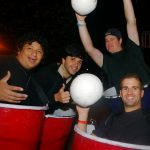
What you can expect: Never fear—these balls don’t bruise. The league uses foam balls instead of the traditional rubber balls. “If you get hit, it’s no big deal,” Nagel says. Teams are generally comprised of six players and there are 11-12 rounds in one evening, each round lasting around three minutes and ending once a team has all its players eliminated. Afterwards, teams head to the bar to continue the competition with some flip-cup. And yes, the flip-cup matches count in the overall standings.
How to sign up: You can register as a team or free agent. Fees range from $45-69, depending on the season and when you sign up.
CHESS
Origin: The D.C. Chess League is one of the city’s long standing social leagues, getting its start in the 1970s. The league has a summer and winter season, with matches once or twice a month on Fridays. There are three sections players can fall into depending on their expertise: reserve (the lowest level), amateur (mid-range skill) and open (the hardest of the levels).
The league matches up various teams in D.C. and Arlington for six matches before a semi-playoff commences to determine the league champion.
What you can expect: Teams are typically 12 players per team. Players can join at any time during the season. Andrew Rea, the executive director, says it’s fun to watch chess players’ styles evolve. “Just like tennis players and golfers have certain styles and tendencies, we have those in chess as well,” he says.
How to sign up: Email Andrew Rea at andrerea2@yahoo.com to sign up. Players have to be members of the United States Chess Federation to join the D.C. League, which costs $40 per player. The team entry fee is $75 for the open level and $50 for the reserve and amateur sections per team, split among teammates.
There’s No Paywall Here
DCist is supported by a community of members … readers just like you. So if you love the local news and stories you find here, don’t let it disappear!