Rachel Kurzius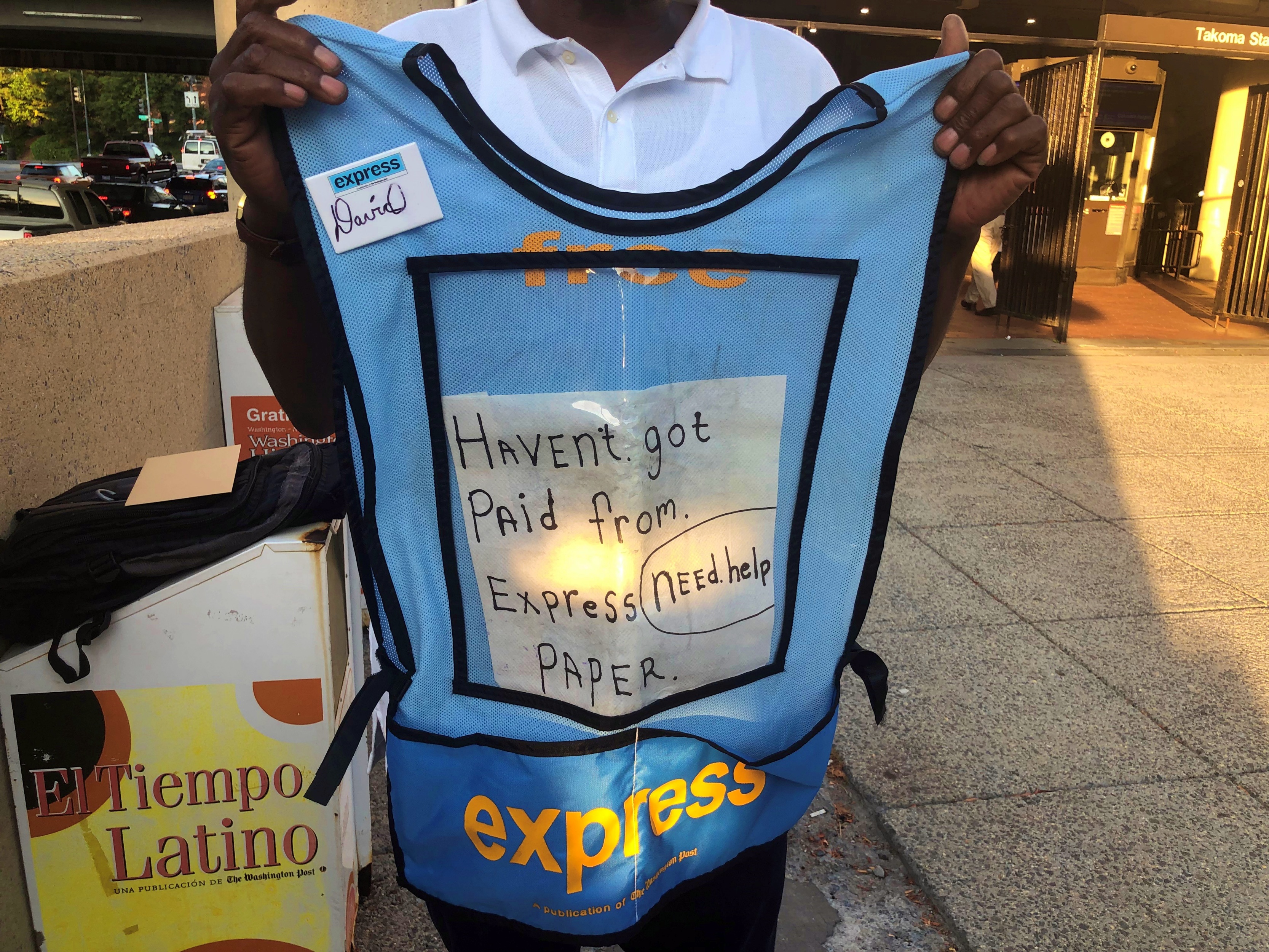
The Washington Post announced it was shutting down its free daily paper, Express, less than 24 hours before the final edition came out on September 12. More than two months later, the contract workers who distributed the newspaper each day are still waiting to receive money raised on their behalf.
The 75 contractors who greeted commuters at Metro stations were the de-facto faces of Express during its 16 years of publication, and some of them traveled long distances before the sun rose to do the job. While it wasn’t the only job for many of the hawkers, it provided a stable daily contracting gig. (The Post hired third-party companies to handle distribution.) They received no advanced notice and no severance when the paper stopped publishing.
The closure of Express also meant that 20 journalists lost their jobs. But unlike the hawkers, the journalists were direct employees of the Post, and they received severance (though they were not members of the Post’s union).
Residents accustomed to seeing the distributors each day expressed their concern, and wondered if there was any way they could help. Erin D’Amato and her sister quickly launched a crowdfunding campaign for their local hawker, Hassan Nezhadessivandi, who distributed the paper outside of the Dupont Metro station.
Nezhadessivandi didn’t learn that the paper was closing down until he was beginning to distribute its final edition that Thursday morning and a bus driver prompted him to look at the cover. “Hope you enjoy your stinkin’ phones,” it read. (In a public relations post, WaPo had explained its decision to close the paper by noting that “more and more readers are consuming The Post’s content digitally.”)
The GoFundMe page for Nezhadessivandi initially had a goal of $1,000. “His dedication to his role, no matter what the weather, is a testament to his work ethic and spirit, and I know he brightened my day more times than I can count,” it reads. Ultimately, 475 donors raised $15,775.
“I don’t have any words to express how grateful I am to them,” Nezhadessivandi says. “God bless every one of them.” He says that he has been looking for other employment but it’s been difficult: “I’m 65 and it’s hard to get a job. Once your age is older, people discriminate about giving people jobs.”
Getting the funds to Nezhadessivandi was not without pitfalls. He receives monthly supplemental security income through Social Security, money that would have been cut if his account balance rose above $2,000. So instead of giving him one big check, the funds instead have been put in a trust, with Nezhadessivandi getting money each month to pay his rent. “It would have been a really big problem, because if I had taken the check, then I would have had a really rough time collecting my SSI,” he says.
But other hawkers have been unable to access the funds raised online on their behalf.
After launching Nezhadessivandi’s fundraising page, D’Amato says she started hearing from other residents who wanted to help the hawkers in their neighborhoods, and from distributors who wanted the opportunity to receive crowdfunded money. The GoFundMe page for all the distributors called for $75,000, which would amount to $1,000 per impacted worker. It has raised $20,478, or about $275 for each hawker, thus far.
D’Amato quickly learned that the task of dispersing the money was not as simple as she initially thought. “Every step of the way has been more complicated than we anticipated,” she says.
The first hurdle was getting the contact information for all the distributors. Hawkers were employed by five individual contracting companies, she discovered. “We had to individually reach out to each manager to get the names and mailing address,” she says. “Not all of them were very responsive or very helpful.”
Then, they had to reach out to the individual distributors to make contact and confirm the information.
“They asked me for my address, and I gave it to them,” says James Freeman, who distributed Express for 14 years, including seven at the Silver Spring station. “I’ve just been keeping my head up. I’ve gotta pay my bills. I’m getting married. It’s a good thing I’ve got my fiancé here to help me out. I’ve just been going to church and something will come through,” he says. Freeman says he postponed the wedding after Express shut down.
The most significant hold-up for the GoFundMe has been the question of how to actually distribute the funds to the hawkers, many of whom have been asking about when it will come through. “They’re texting me about their energy bills and their expenses,” D’Amato says.
As it turns out, GoFundMe will not cut checks or distribute funds to more than one bank account. “Even if we had [the] 75 bank accounts, GoFundMe wouldn’t distribute those funds,” says D’Amato. And they don’t have 75 bank accounts. She says GoFundMe doesn’t “have a lot of structure in place for low-income folks. We were trying to explain that we can’t guarantee that everyone on this list has a bank account. One of the hawkers couldn’t even give me a mailing address because he’s now homeless, so that’s very complex.”
GoFundMe says that it one has one beneficiary on its platform “simply because that’s the only function our payment processors currently have,” spokesperson Melanie Yost tells DCist over email. “If the beneficiary does not have a bank account, we ask that an immediate family member or friend withdraw the funds, only after we have received permission from the beneficiary … What’s most important to us is that donors are protected and that funds reach those who need them most.”
D’Amato has been trying to find a nonprofit that is willing to receive and distribute the funds, but that has proven difficult. “Unfortunately, that is not a transaction that a lot of nonprofits do,” she says.
Now, At-large Councilmember Robert White and his office have gotten involved in trying to locate a nonprofit to help. White drafted a ceremonial resolution to honor the distributors and journalists of Express, and he held a small reception for them in early November.
“As we started reaching out to some to the former distributors to invite them to the Wilson Building, some of them made us aware of the GoFundMe account and let us know they haven’t gotten the money they, frankly, desperately need,” White says. “We have been working diligently for the past week to identify a nonprofit. I’m confident we will find one. I just wish the process was going more quickly, because I recognize the need for these folks to have some financial assistance around the holidays.”
If no nonprofit steps up, D’Amato is also considering opening a bank account to cut checks to the hawkers herself. But to do that, she needs GoFundMe to approve of her as a beneficiary, which will require additional forms and steps. “I just don’t think GoFundMe was the right means to do this,” she says. “I’m glad that my sister and I were willing to take the time to do this, but sometimes I’m at my wits end.”
White says that his office is also working with the Department of Employment Services and talking to business owners in D.C. about the distributors. “My immediate concern is employment for these folks,” he says. “These folks that residents have relied on for so many years are, many of them, without income and their resumes don’t necessarily reflect the difficulty of the work they did. They would stand on their feet, greet people, be friendly every single morning, and build relationships with folks.”
Some of the Express distributors have returned to the Metro stops where they once handed out papers. Weeks after Express shut down, David Lindsey stood outside of the Takoma Park Metro. He wore his blue Express vest, but instead of a newspaper in the front display, there was a sheet of paper that read: “Haven’t gotten paid from Express paper. Need help.”
Lindsey says he’s been distributing Express on-and-off in various locations for about a decade, and he has worked for different contractors during the course of that time. When we spoke outside of the station in September, he would greet commuters in between sharing his story with me. Many of them struck up conversation, and some would pass him gift cards and cash.
These days, Lindsey says he continues to stop by the Takoma Park station two to three times each week, still wearing his blue Express vest. “I still go up there in the mornings and greet people,” he says. “What can I say? You gotta do something.”
Freeman also spends some mornings in front of the Silver Spring station to say hello to his old customers.
He thinks back to when he first learned Express was shutting down. “I said, ‘I’m not worried about me,'” Freeman says. “I’m worried about the customers out there because they were looking forward to seeing me in the morning and I was looking forward to seeing them.”
Previously:
The 75 Distributors Of The Now-Shuttered Washington Post Express Received No Notice, No Severance
Washington Post Express Is Shutting Down
There’s No Paywall Here
DCist is supported by a community of members … readers just like you. So if you love the local news and stories you find here, don’t let it disappear!