I had known Nick less than 24 hours before I told him I loved him. As a dozen men looked on, our embrace was long, and heartfelt. When we finally broke away I was sure to add “I am not your mother,” a statement with which Nick agreed.
This was my welcome to the world of men-only support groups, a new crop of organizations aimed at getting men to be more open with their feelings and combat toxic behaviors.
When I told friends I would be attending a men’s retreat, there were three distinct reactions: most laughed, others were curious about the participants, and more than one asked a version of “Wait — is that like the thing she sneaks into in Fleabag?”
I hate to disappoint fans of the show, but at no point did we scream at an inflatable sex doll.
The growing popularity of men’s support groups coincides with a cultural moment, catalyzed by #MeToo, that seeks to reckon with what it means to be a man in the 21st century. By seeking support and embracing vulnerability, these men’s groups are attempting to shed assumptions of how men can or should act.
Solving toxic masculinity is a bit like solving climate change, in that the solution for it will involve rethinking pretty much everything we know about how society works. Men’s groups aren’t likely to do that by themselves. But by bringing men together they are at least providing an avenue to address the pressures and pain that men have been traditionally encouraged to handle with a stiff upper lip.
They also can potentially help with a much broader problem—the epidemic of loneliness. That can be acute in D.C., where about half of households are single occupancy. Social pressures too, can weigh heavy in official Washington, where one’s sense of self is often closely tied up in a profession or political affiliation.
Still, if masculinity is the problem, is a mens-only approach the solution? Who is actually going to these things? And at what cost?
To get a firsthand experience of the process, I headed to a farmhouse in Maryland this summer for a weekend retreat as a guest of Evryman, a national men’s work organization that has had a group in Capitol Hill since June 2018 and another in Bethesda since March.
Gil, a communications executive working in the District, said he gets a slew of questions when he mentions that he attends weekly meetings organized by Evryman.
“People want to know: ‘Is it religious?’ ‘Is it political?’ ‘Is it like a cult?’” he says, adding that unlike many gatherings in official Washington, it is a time when work and politics are not on the agenda. It’s a time strictly set aside for himself.
Gil admits that the group hasn’t completely changed him as a person, but he’s effusive about the support it has provided. “I think everyone in D.C. should be in one of these groups simply because the level of BS people in D.C. have to go through and the outrageous amount of pressure that people are under. It probably would benefit inside-the-Beltway folks to just have two and a half hours or three hours of completely unvarnished time in which they can be open and truthful about how they’re feeling, and just let it out.”
We are identifying Gil and others by their first names because they didn’t want their participation to be linked to their professional identities (which perhaps says something in its own right about the stigma associated with such groups).
Back in the Maryland farmhouse, my profession of maternal love came at the apex of Nick’s “healing journey,” an exercise that’s part role playing (myself taking on the role of Nick’s mom), part breathing exercise, and part light hypnotism. The “journey” borrows from somatic experiencing, a therapy designed to help those with post-traumatic stress disorder by connecting emotional pain with a physical response, and thereby releasing it. In this case, Nick had to wrestle his way through a gauntlet of the group’s outstretched arms in order to reach me.
The “journey” was conducted by Owen Marcus, one of four Evryman co-founders, who had flown in from Idaho to act as a facilitator for the weekend’s sessions—an extended version of the biweekly two-hour meetings the group’s members usually undertake. The regular meetings are free, but this longer version came with a $450 price tag, including room and board for two and a half days.
Although open to all those who identify as men, Evryman’s branding tends toward the plaid-wearing, outdoorsy lumbersexual (or those who aspire to it). The Evryman website first greets you with an image of a group of men pitching tents in the wilderness—the site’s tagline promising to “connect more deeply to your loved ones, your life’s work, and yourself.”
The men who joined for the weekend were a mix of elder millennials and middle-aged types. Almost all were white. Professionally, they were typical of official D.C.: lawyers, politicos, and non-profit workers. Members had come to Evryman from different entry points: a chance Youtube video, a New York Times article from late 2018, listening to an appearance by the group’s founder, Dan Doty, on the Joe Rogan podcast.
Over the course of the weekend, they all described their rejection and frustration with the traditional stoic, square-jawed masculinity that’s often presented as the ideal. One attendee, a man in his 50s, expressed frustration at his options before finding the group, including traditional therapy. “Everything I’ve seen up to this point has been about coping with my issues, not dealing with them,” he told the group. “Well I say: fuck coping.”
Each of the weekend’s seven sessions began with a brief meditation led by Marcus, the co-founder. Members then begin “checking in” with the group. This involves an honest description of how their body is feeling (“My neck hurts; my feet are cold”) and moves on to descriptions of their emotional state (“I feel fear; shame; joy.”) Marcus encouraged the group not to mitigate emotions with phrases like “kinda” or “a little,” as a way of becoming more in tune with—and less ashamed of—those emotions. Marcus then opened the floor for discussion, an unstructured free-for-all for men to air their feelings.
As part observer, part participant, it was difficult to sit through at times. I’m a sensitive soul—a particularly well-directed car commercial is enough to move me to tears—and so it was emotionally draining to watch and react to hours of men describing the grief, shame, and loneliness they carry with them day to day.
It was encouraging, too. Once I got over my awkwardness over so much vulnerability being shared between relative strangers, it was even liberating. Not everyone was ready to bare their soul, but the ones who did seemed to achieve a genuine release. Tears flowed (my dry eyes only survived five minutes into the first session), there was more than one group hug, and even laughter broke out occasionally.
A for-profit B corporation, Evryman is the upstart in what might be termed the mindful masculinity space. A much larger organization, the non-profit ManKind Project (MKP), rules the roost in D.C. In addition to groups across the world, MKP has four in the District and more in Arlington, Bethesda, and Silver Spring with membership in the “several hundreds,” according to Joe Bernstein, who works as a professional life coach in D.C. and volunteers with an MKP group in Tenleytown.
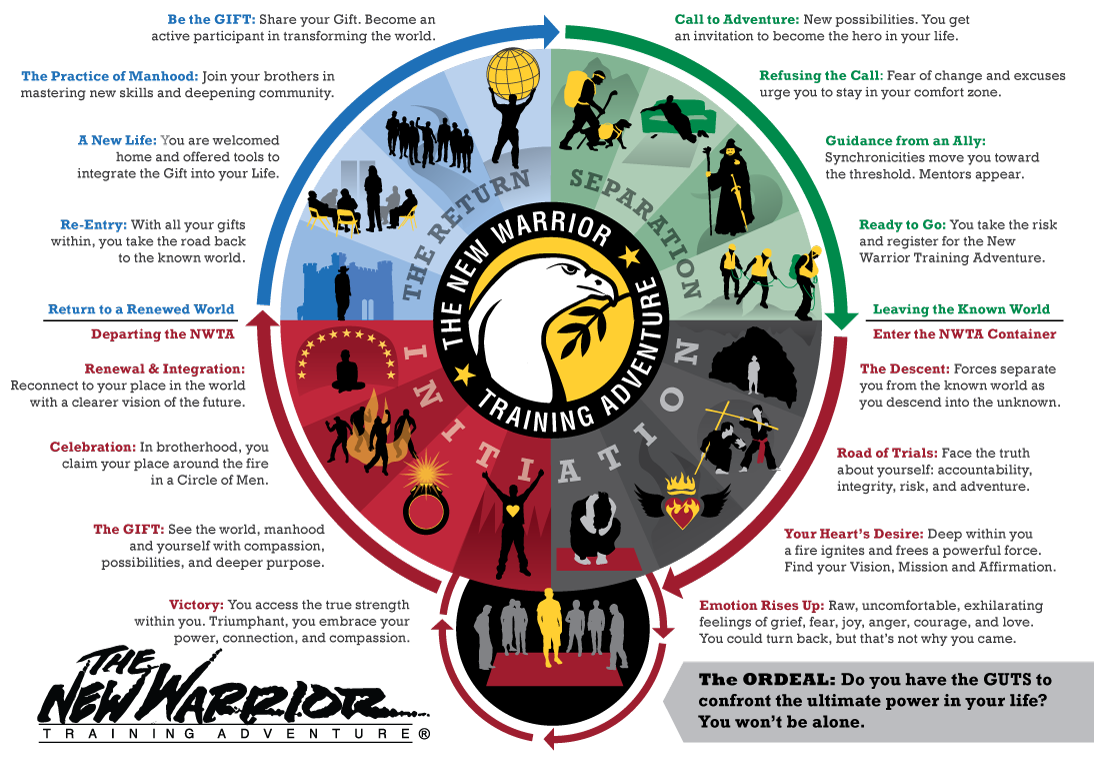
To join an MKP group, called integration groups or I-groups, men must first complete the New Warrior Training Adventure, a weekend of introspection in the wilderness modeled on an archetypal hero’s journey. MKP’s website lists the journey’s stages in epic fashion with names like “The Descent”, the “Road of Trials,” and “the GIFT.” The next such adventure on the East Coast takes place in Philadelphia at a cost of $750 per person.
MKP I-group meetings follow a similar group therapy-style outline to Evryman: men come together to share problems and attempt to connect with their emotions. Bernstein described the organization’s mission as being “about making the world a better and safer place by empowering men with more emotional intelligence and helping men select missions of service.” Those missions are determined, Bernstein says, by what world the man wants to see and what action needs to be taken. The meetings are also a way to keep members accountable.
Bernstein says the groups that meet around D.C. are mostly white, and tend to attract men in their 40s and 50s. MKP is on a mission to expand its appeal, and hosted a training in Virginia last August for men who are gay, bisexual, or trans. That weekend costs $650 (MKP says it offers assistance for those who can’t afford it.)
Not all programs reassessing masculinity come with such a steep price tag. Rethink Masculinity—a partnership between the grassroots group Collective Action for Safe Spaces, ReThink, and the DC Rape Crisis Center that began in 2017—is a fraction of such fees. Attendees are asked to contribute on a sliding scale up to $25.
Rethink Masculinity consists of an eight-week training program for those who are men or are masculine identifying to “unlearn toxic behaviors and develop new language and strategies to embody a healthier masculine identity,” according to Diego Quezada, Rethink Masculinity’s co-director.
The program has trained 57 participants and aims to serve a cross-section of D.C. “We want to make sure that it’s accessible to everyone in D.C., not just the transplants,” said Travis Brookes, the program’s other co-director. “We want to make sure that anyone is able to get into this program because it’s a need: There aren’t spaces where men are able to talk about harm they’ve experienced or harm they’ve caused and think about the ways in which they need to address it. And that’s what this eight-week program starts to do.”
Over the program’s three-hour weekly meetings, participants learn about subjects such as emotional labor, consent, and structural violence. Most of the participants thus far have come from the activist community, according to Quezada.
Each program is limited to 12-15 participants. “That’s a large enough size of people where we are bringing multiple lived experiences in the room,” Quezada says. ”But it doesn’t get so big that it seems a little bit hard to really bond.”
Ultimately Rethink Masculinity hopes to develop allies for those in D.C. that don’t experience the safety that men often take for granted. Brookes said one of their goals is to have more men show up to community actions and protests in order to help defuse the actions of agitators. The men are trained to use words, rather than physical actions, and to ponder the question “how can I leverage my level of privilege in those situations and not cause more harm as a result?” Brookes said.
The next series of classes for the program are slated to begin again in 2020, either in the spring or fall, according to the organizers.
Adam Hanson, who organized D.C.’s first Evryman group as a volunteer, is also looking ahead. Outside of his day job in nature conservation, he’s also planning the next steps for Evryman’s growth in D.C. He says a third group will begin meeting in Northern Virginia next month, and a fourth, in the Brookland neighborhood, will have its first meeting in January.
“My goal is just to make sure that men know that there’s an opportunity for them to show up and share their emotions and practice speaking from them. And that there’s other men that not only want to change the toxicity of masculinity in our culture, but also to support men that are going through tough times and feel alone,” Hanson says.
The long-term success of any of these programs will be seen through the eyes of the people these men interact with and whose lives they impact. With that in mind, I spoke to Hanson’s wife, Marie, to ask how she saw all of this. When her husband initially broached the idea of setting up a group she said she was cautious: “I was like okay…sure?”
Ultimately, Marie is supportive of the work her husband has taken on. “I think it’s definitely not something that everybody’s comfortable with—working through some of those harder, more painful things that may have underlying effects on your relationships.”
Though now that her husband is more in tune with his emotions, even banal conversations can carry weight.
“There are times where I’m like, wait, what did you say?” Marie says, laughing. “Are you adding emotion when there really isn’t anything going on here? But I’m like, oh wait, no, this is actually just Adam trying to understand and process a situation.”
There’s No Paywall Here
DCist is supported by a community of members … readers just like you. So if you love the local news and stories you find here, don’t let it disappear!