Colleen Grablick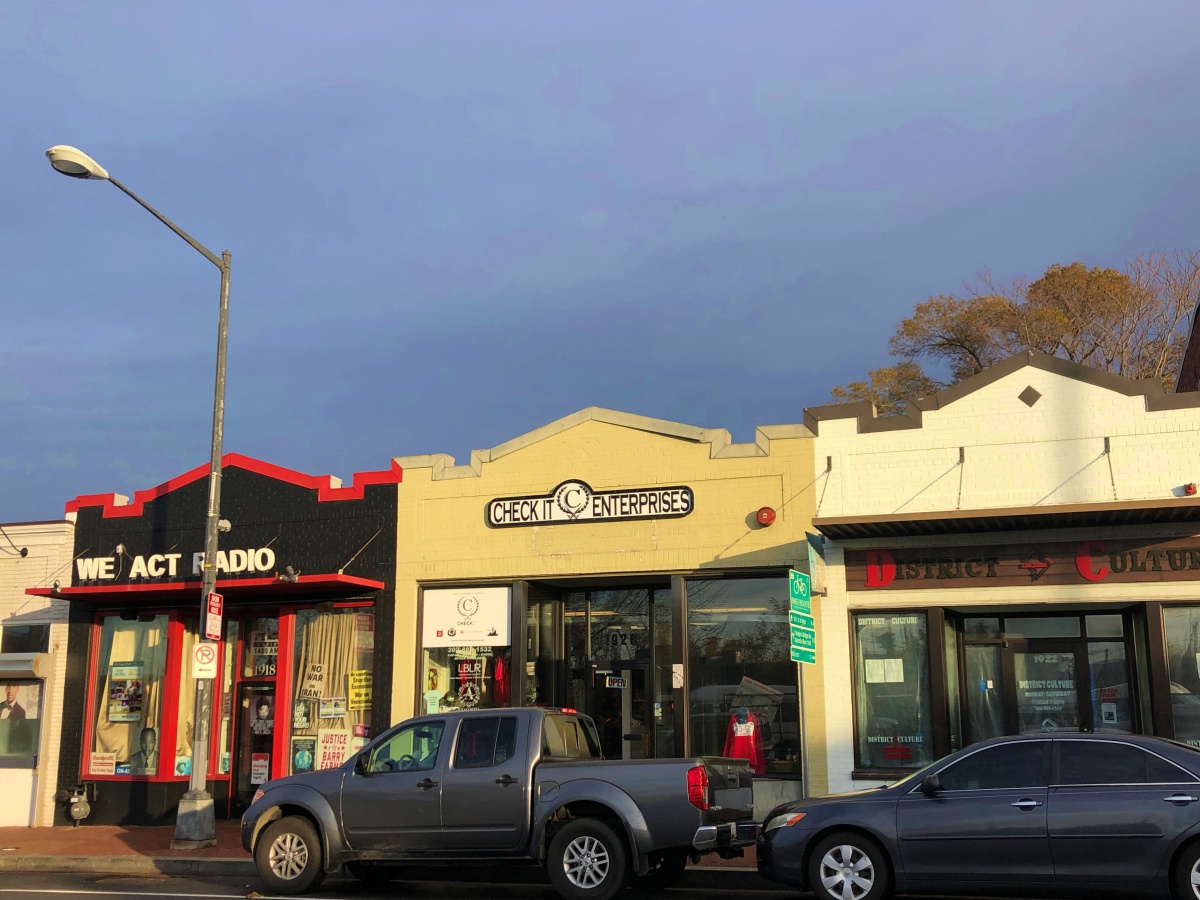
Update 2/6/2020: After months of uncertainty, Check It Enterprises secured $2 million from the city to stay in their building at 1920 Martin Luther King Jr. Avenue SE.
The D.C. Council voted unanimously Tuesday to approve Councilmember Robert White’s bill to grant city funding to buy the property that the social enterprise has been renting in Anacostia.
Meanwhile, Check It is working on plans to develop a go-go museum and cafe in the space. Museum leaders are working to raise an additional $25,000 to complete the project.
Original: Check It Enterprises might be easy to miss from the outside: a small building on Martin Luther King Jr. Ave in Anacostia, wedged between a historic radio station and a clothing store. Behind the glass window facade, mannequins don sweatshirts that read “Don’t Mute D.C,” and a small wooden desk sits to the side with papers strewn about.
But it’s what this building represents that lawmakers are seeking to protect. Check It, which originally began as a small store, has become a community resource for LGBTQ residents, returning citizens, and young entrepreneurs in D.C.
With the building up for sale, it is the latest small business threatened by gentrification to turn to city leaders for help. At-large D.C. Councilmember Robert White introduced a bill earlier this summer that would grant Check It Enterprises $2 million to acquire the building it currently rents at 1920 Martin Luther King Jr. Avenue SE. It would also enable two other fixtures of the Anacostia community, We Act Radio and District Culture, to remain.
After a hearing in front of the D.C. Council Committee on Business and Economic Development earlier this month, White tells DCist he hopes to have a vote on the bill by the end of the year.
“This bill creates a pilot to see if there’s a model we can use to help our small businesses,” White says. “Undoubtedly, there will be some lessons learned, but we have to start somewhere.”
The D.C. Council has long used incentives and tax breaks to lure companies, encourage development, or stimulate the construction of affordable housing. But as rising rents threaten longtime or small businesses, lawmakers are increasingly turning to one-off bills to help.
The D.C. Council approved a 10-year tax break for Sankofa Video Books & Cafe, a decades-old black-owned bookstore in Shaw, this summer. Similar legislation that has not yet passed would relieve Player’s Lounge, a bar and restaurant in Congress Heights.
“I hope that the Sankofa example is a spark for protections to be put in place for small black businesses,” Sankofa co-owner Shirikiana Gerima told DCist. “Legacy businesses who’ve been here through crack, through, in some cases, the riots, through gentrification—the latest devastation, they need to be supported in really, really concrete ways.”
Indeed, lawmakers have introduced a slew of bills this fall to establish comprehensive grant, tax break, and loan programs with the aim of preserving local businesses.
But in the meantime, it appears likely that the city will act to support the purchase of the Anacostia building that houses Check It.
Ron Moten—an outspoken anti-violence activist and a leader of the #DontMuteDC movement who has a fraught past with the D.C. government—and a group of former LGBTQ gang members co-founded the organization in 2011.
Star Bennett, CEO and founder of Check It Enterprises, was serving a prison sentence when her sister was shot and wounded. Bennett reached out to Moten, who was involved with anti-violence efforts, and said she needed to act both for herself and to change the lives of the city’s LGBTQ residents.
“I said why aren’t we helping the LGBT community?” Bennett says. “So from there, I knew I wanted to change my life around.”
Moten says the idea for creating a clothing brand came to the Check It members while sitting in a booth at the Denny’s in Trinidad. Over syrup-sticky tables and diner coffee, the group decided that they were going to use their interest in fashion to enter the world of entrepreneurship.
With the help of small grants, Check It Enterprises launched its business in a small room in the Martin Luther King Jr. Ave. building. The members began sewing and designing clothing, using their profits to pay the $500 monthly rent.
In 2017, Check It expanded into the rest of the building, using the basement for community meetings. The backyard, with a patio and stage, became a hub for local musicians. The renovated conference room in the building now displays Check It’s clothing: sweatshirts, hoodies, and hats, many of which read “Don’t Mute DC.”
The group’s successes were profiled in a 2016 documentary.
Check It also has plans to use the building’s kitchen space to open a cafe in January that will function as both a place for restaurant and food service training, as well as an homage to go-go. Moten says the cafe plans to serve homemade ice cream with flavors named after influential musicians, and the walls of the seating area will display artwork and posters celebrating go-go’s history in D.C.
But that vision was thrown into jeopardy when the property owner, Duane Gautier, CEO of ARCH Development Corporation, informed Moten in February that he was planning on selling the property.
He told Moten that Check It would have first priority in buying the building, hoping to close on a sale by September. The building is listed for $2.4 million, but Gautier said he settled on a price of $2 million through private negotiations with Moten. Gautier says that if Check It cannot find the funding, he plans to look for another Anacostia business or sell it on the open market.
Over the summer, Moten decided to act, calling on his connections with D.C. politicians.
“We didn’t have time to wait for some type of policy change. We were about to get pushed out,” Moten says. “We were like, if you really believe in what you’re saying about keeping residents here, then we actually need to do something. If you talk about changing gentrification, this is what needs to be done.”
By Moten’s count, only two of the 100-odd black businesses in Anacostia actually own the properties their business operate within. He says that the spectre of rising rents could push many of those businesses out, and it would hurt young people who may hope to become entrepreneurs themselves.
“A lot of the things you see you with young people’s violence is that they’re giving up, they don’t have any hope,” Moten says. “It’s stuff like this gives people hope. So we have to be intentional. This is a model where people who were once part of the problem are now a part of the solution.”
Since its beginnings in 2011, Check It has helped fund other entrepreneurial projects, an aspect of the business that would be sorely missed by the community if Check It has to leave its Anacostia location, Bennett says. Check It also hosts work-force development programs and skills trainings for young LGBT or returning citizens.
“It’s very important for the young people because a lot of these young LGBT people don’t have any help,” Bennett says. “We can help those people today, with Check It.”
That the D.C. Council is considering funneling such a sum is a testament to the role of the organization in the community.
“If we’re serious about providing economic opportunity to people who help to build the District to what it is today, we have to take these steps to help prevent important businesses and institutions from being forced out of the city,” says Ward 5 Councilmember Kenyan McDuffie, chair of the Business and Economic Development Committee.
But it’s also part of a new chapter in Moten’s remarkable, up-and-down relationship with city leaders.
Moten, a Petworth native, threw himself into community-building and anti-violence efforts after serving a four-year jail sentence for selling crack cocaine in the early 1990s. In 2004, Moten founded the non-profit Peaceaholics, which promoted conflict resolution within gangs and neighborhoods, but fell from his public perch in 2013 when the D.C. government sued the organization for misspent public dollars. Without agreeing to wrongdoing, Moten settled the suit with the attorney general’s office for $10,000 in 2016, and as a part of the settlement, Moten was barred from managing D.C. nonprofit funds in the future.
But earlier this year, as the District faces rising crime and murder rates, Attorney General Karl Racine absolved Moten from the remainder of his settlement payments, and allowed him to return to managing nonprofit funds. “We need all hands on deck. And I don’t want his hands limited in any way,” Racine told the Washington Post in May.
McDuffie says the bill has impacts for the community that will extend beyond just one local business.
“This bill isn’t about a single business or individual,” says McDuffie. “Other businesses along historic Anacostia corridor all collectively play a role in preserving the district culture, important aspects of D.C. culture. I don’t think about Check It individually when I think about this measure. I think about the concerns I’ve raised when I think about retail displacement, and what it means to residents in this community.”
White says individuals across every ward in D.C. came out in support of the bill at a hearing earlier this month. He says the vote should happen by the end of the year, but the committee has not set a date.
But Moten and Bennett say the time is ticking. Moten says Gautier has expressed a dedication to keeping Check It in the space, but with the original closing date long passed, anxieties are mounting around Check It’s future.
“We don’t know what will happen,” Moten says. “We could be asked to leave tomorrow really.”
There’s No Paywall Here
DCist is supported by a community of members … readers just like you. So if you love the local news and stories you find here, don’t let it disappear!